
A fearsome reptile

Gliding silently through the dark waters, the armoured predator stalks its unsuspecting prey. Only its nostrils and eyes protrude above the surface and the effect makes this reptile almost invisible during its deadly approach. Suddenly, in an explosive array of water, jaws and legs, a struggle disrupts the quiet of the swamp and the crocodile’s appetite is satisfied.
Meet the crocodiles
Members of the crocodile tribe have instilled fear, awe and even pagan worship for thousands of years. But, what do we really know about them? Depending on the source, there are about 23 species classified in the group called Crocodylia. All authorities recognize at least three groups; the Alligatoridae (alligators and caimans), Crocodylidae (crocodiles) and the Gavialidae (gharials).1
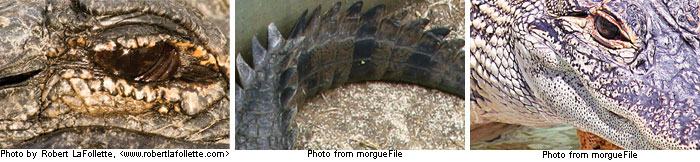
The word ‘alligator’ is a corruption of the Spanish phrase ‘el lagarto’ meaning ‘the lizard’. They mostly live in fresh-water swamps, lakes and rivers. In North America, the best-known member is the American alligator (Alligator mississippiensis). Its front feet are not webbed and it is the only member that lives in habitats where the water may freeze. Because they cannot survive under ice-covered water bodies, tracking studies have confirmed that alligators move to shallow waters in cold weather and some have even been found in frozen water with nostrils protruding above the icy surface.2
The largest of the clan is the Australian salt-water crocodile (Crocodylus porosus) weighing in at a tonne (2,200pounds) and reaching 7 m (23 ft). In fact, it is considered the largest of all living reptile species, by overall weight.
The world record captive croc is thought to be Yai, a 6 m (20 ft) 1.2 tonnes (2,600 pounds) resident of a zoo near Bangkok, Thailand. Interestingly, he is a hybrid between a salt water and Siamese crocodile (C. siamensis).3 Creationary biologists would classify these two species as part of the same monobaramin, or group of organisms that share significant similarity with each other, having descended from the original crocodilian kind, created by God.4
Not all members of the crocodile group are huge. Some are rather small like the Cuvier’s dwarf caiman (Paleosuchus palpebrosus), that may reach only 1.2 m (4 ft) long.
Differences between crocodiles and alligators
Crocodiles can be distinguished from alligators in a couple of ways. Generally, the alligators and caimans have ‘U’ shaped jaws while the crocodiles tend toward ‘V’ shaped ones. Also, in the crocodiles, more teeth are seen, giving them a ‘toothy’ look.
Jaws
Crocodiles have little strength when opening their mouth, so it is possible to hold the jaw closed by grasping the snout. Crocs with narrow jaws can close their mouths with both speed and great force. Wide-mouthed members, like the American alligator, are not as swift when shutting the jaw, but they make up for it with power. The extreme force they can bring to bear is demonstrated by their ability to crush the shells of large turtles before eating them.5
Some may ask, how can a loving Creator make such a fearsome reptile? In the book of Genesis, God created and called His masterpiece ‘very good’. He provided plants as the food source for all, including the original members of the crocodile kind. How carnivory became part of this world is a subject of speculation,6 but interestingly a fossil that has been interpreted as of a vegetarian croc has been discovered in Madagascar.7
Fossils
While the crocodiles have a rich fossil heritage, there is some conjecture and disagreement regarding how the three current groups diversified. Fossil ancestry information continues to be on shifting sand and depends on the source you use. Various creatures grouped as fossil ancestors include Spenosuchians, Eusuchians and Protosuchians. Upon further investigation, one learns how remarkably similar they are to present-day crocodile forms, even though they are evolutionarily dated in the millions of years. There is also some surprise that these ‘ancestors’ seem to come from nowhere, with no transitional forms.8–10 Their basic body plan is relatively unchanged, with minor exceptions, and nothing is said about how complex genetic changes, which are needed for their complex design features, could have arisen by chance random processes. This amazing lack of change in the crocodile body plan is a real problem for evolution.
One fossil of great interest is the ‘super croc’, Sarcosuchus imperator, recently highlighted in National Geographic as ‘one of the largest crocodilians to ever walk the Earth’. This monster, with its 1.8 m (6 ft) skull has been estimated to weigh 10 tonnes and measure over 12 m (40 ft) long. It had armour plating and bony scales that looked like roofing tiles. Some have considered this a possible candidate for the Leviathan mentioned in Job 41.11
Growth rates
There has been controversy and misunderstanding about their size as it relates to age. Biologists used to think that, because crocs grow all of their lives, the largest animals were the oldest. Current research suggests that this thinking may be too simplistic. Recent growth rates measured for salt-water crocodiles show rapid growth in the first 10 years of their life—depending on factors such as genetics, food availability, incubation temperature and social interactions. When they hatch from the egg they average 25–30 cm (1 ft) long. After reaching sexual maturity (10–15 years) their growth slows until they die at about 60–70 years.12 Therefore, the biggest crocs may not be the oldest animals but the ones that started life under the most optimum conditions.
Parental care and communication
Parental care is probably universal in the crocodile tribe and most often done by mothers.13 Once the eggs are laid, the guardian parent will protect them against all predators. Eggs are deposited in one of two types of nests.14
While in the egg, a baby croc develops an egg tooth, made of hardened and pointed skin, which grows on its snout. It is used to punch through the egg shell.15 Once the tiny hole is formed, the baby makes ‘pipping’ sounds. Other siblings join the chorus, suggesting a means by which all of the eggs hatch about the same time and a way to let the adults know they are ready.16 This synchronous behaviour has also been documented in birds. Adults respond to this communication by digging out the nest, liberating the brood from their egg enclosures and transporting them, by mouth, to the safety of a nursery pool. Soon afterward, the egg tooth is reabsorbed, as it was only needed for one critical moment in life. The young crocs may remain with their parents for a year or more.17
Other design features
By now it is apparent that crocodiles are elegantly engineered for life on both land and water. Other design features include their protective armour. This layer is made of bony plates, called osteoderm, that lie under the skin and scales. This armour affords protection from predators.
These animals have a complicated sensory system known as dermal pressure receptors (DPR). These are complex organs used to detect surface waves and allow them to sense potential predators or prey moving in the water. These sensors are another way of determining the difference between an alligator and a crocodile. The alligators and caimans have them on their jaws, while the crocs have them on their skin.
Many crocodile species live in or near salt water and this presents an engineering problem because it is important that they keep their bodies in proper chemical balance. Unto this end, the Creator has endowed them with special salt glands that rid the body of excess potassium and sodium. These ‘pumps’ allow them to conserve body water by discharging the salt without using the kidney.18 In salt-water crocodiles and gharials, these glands are located on the tongue and are so efficient that the animals can spend long periods of time in salt water. Alligators and caimans have these structures, but cannot use them as efficiently and are therefore not as tolerant of salt water as the others.
It is unfortunate that these creatures have been objects of pagan worship and awe. When you really get to know them, you realize that the awe and worship are due their Creator, for He is and there is no other.
References and notes
- Pough, F.H., et al., Herpetology, 3rd edition, Pearson Prentice Hall Inc., New Jersey, USA, p. 169, 2004. Return to text.
- Ref. 1, p. 170. Return to text.
- The liger, a hybrid between a lion and a tiger is also larger than both lions and tigers—‘hybrid vigour’. See Batten, D., Ligers and wholphins? What next? Creation 22(3):28–33, 2000; <creation.com/liger>. Return to text.
- Wood, T.C., Wise, K.P., Sanders, R., and Doran, N., A refined baramin concept, Occasional Papers of the Baraminology Study Group No. 3, pp. 1–14, 25 July 2003, <www.bryancore.org/bsg/opbsg/003.html>. Return to text.
- Ref. 1, pp. 398–400. Return to text.
- Batten, D., et al., How did bad things come about? Chapter 6, Creation Answers Book, Creation Book Publishers, Georgia, USA, 2006; <creation.com/bad_things>.
- BBC News, Chicago learns from crocodile rock, <news.bbc.co.uk/1/hi/sci/tech/803236.stm>, 23 June 2000. Return to text.
- Salleh, A., Fossil places crocodile’s ancestors in Qld, ABC Online, <www.abc.net.au/news/newsitems/200606/s1662797.htm>, 14 June 2006. Return to text.
- Roach, J., In crocodile evolution, the bite came before the body, National Geographic News, <news.nationalgeographic.com/news/2004/08/0825_040825_crocodiles_fossils.html>, 25 August 2004. Return to text.
- Isisfordia duncani, The University of Queensland, Australia, <www.uq.edu.au/dinosaurs/index.html?page=47955>, 2 November 2007. Return to text.
- Booker, P., A new candidate for Leviathan? Journal of Creation 19(2):14–16, 2005; <creation.com/leviathan2>. Return to text.
- Britton, A., How long do crocodiles live for? Crocodilian Biology Database, <www.flmnh.ufl.edu/cnhc/cbd-faq-q3.htm>, 22 January 2008. Return to text.
- Ref. 1, p. 345. Return to text.
- Ref. 1, p. 167. Return to text.
- Britton, A., Egg tooth, Crocodilian Biology Database, <www.flmnh.ufl.edu/cnhc/cbd-mor1.htm>, 26 November 2007. Return to text.
- Ref. 1, p. 485. Return to text.
- Ref. 1, p. 346. Return to text.
- Ref. 1, p. 241. Return to text.
Readers’ comments
Comments are automatically closed 14 days after publication.