
A missionary to atheists
Mike Matthews writes about ‘creation missionary’ Zdeněk Karásek
Published Creation magazine Vol 28(1) December 2005
Zdeněk Karásek is a former atheist who fled communist Czechoslovakia over 20 years ago. Here he describes his escape to the West, his discovery of true freedom through God’s Word, and his return to his atheistic homeland with a revolutionary message that has the potential to unshackle the whole nation.
Why are atheists so hard to reach?

Just ask Zdeněk Karásek. Raised in the atheistic land of communist Czechoslovakia, he had never considered that this way of thinking could be challenged. Like most Czechs, he had heard nothing about God. God simply ‘did not exist’. He had never met a Christian, either.
From grade school to his engineering degree at Prague University, his teachers presented the Bible as an outdated view belonging to the Middle Ages.
Modern science was rapidly solving man’s problems, including the origin of life. The boast was that communists would ‘one day control the wind and the rain and establish paradise on earth’. It was only a matter of time before we were absolute masters of our destiny.
Flight to freedom
Zdeněk says of his escape to the West: ‘It is impossible to live happily in a system of lies. I longed to live in a better society where there is truth and freedom. Yet it was illegal to leave “paradise”. This was considered treason. I couldn’t tell anyone about my plans to escape—not even my family.
‘In 1982, I learned that a group of 20 carefully selected individuals could travel to Rome. This was my chance! I was grilled by several authorities who wanted to know if I had any “connections” in the West. I didn’t.
‘I could give truthful reasons for my applications, since I was a site engineer and Rome has some nice buildings to study. I neglected to tell them—for obvious reasons—that I planned to continue my profession in the West!
‘In what I now see as the providence of God, I found myself among the 20 travellers. Once in Rome, being able to speak German, I jumped a train to Germany, which is also where I first met Christians.’
Atheism challenged
Zdeněk recalls how his assumptions about Christianity were first challenged:

‘In the West I wanted to learn a language symbolising freedom—English. So I went to a language institute in Germany to fulfil my dream. My teacher was well-educated, with a degree from Oxford University, and she told me she was a Christian. As if that were not enough, she believed the Bible to be true.’
Zdeněk’s teacher bought him a Czech Bible, but after reading the beginning about God’s creation in six days, he dismissed it as a fable. ‘If the first page is untrustworthy,’ he argued, ‘then I can’t believe the rest, either.’
Undaunted, his teacher invited him to a series of talks by Professor Werner Gitt, a leading expert on information science.1 Gitt’s lectures turned Zdeněk’s thinking upside down.
He says, ‘As someone who had grown up indoctrinated in atheism, it was mind-blowing to hear of a scientist who believed in God. Gitt also understood the Bible to be a scientifically factual book—a further shock.’
Those talks shook the foundations of Zdeněk’s evolutionary worldview, freeing him to start believing in God. He explains, ‘I had left construction and become a computer programmer. In this profession, I saw how complex codes must begin with “information” provided by “intelligence”.
‘Gitt showed me that, in keeping with the laws of science, complex specific information in the material world, such as DNA, cannot arise by a series of chance events, but instead, it points to a Creator. It all made sense.
‘With this obstacle removed,’ Zdeněk says, ‘I began reading the Scriptures with an open mind and seeking heart. Gradually, over time and with many struggles, God transformed my darkened understanding and drew me to saving faith in the Lord Jesus Christ. And,’ he adds, smiling, ‘I married my English teacher.’
Return to a spiritual wasteland
That was in 1988. For years afterwards, Zdeněk and his wife, Nicola, sought ways to spread the Gospel among his native people. They distributed tens of thousands of free Christian books from their home in Germany. In 1998 they became convinced that they should return to serve God in a place that Zdeněk once thought he had left for good—his Czech hometown of Liberec (pop. 101,000), in the north near Germany and Poland.
Though the Iron Curtain fell in 1989, atheism still casts a long shadow over the land. For over 50 years it has held a nation in its grip, enslaving the minds of an entire generation. The Czech Republic’s ‘conversion’ to atheism was complete. It is possibly the most atheistic nation in the world, and the percentage of atheists is highest in the north, where Zdeněk lives.
‘Even today we rarely meet anyone who believes in God,’ Zdeněk observes. ‘They have not become atheists; they are godless. For most Czechs, man is merely matter; he has no immortal soul; death is the end.’
Atheism is cruel enough, but with Western materialism added into the equation, it has become a ‘survival of the fittest’ society. ‘It is not always easy to live here,’ this missionary couple admits, ‘but this is where God has opened the door for us. For most people, we are the only Christians they know. And we show them our belief in God by obeying a higher law than that of the “jungle”—God’s Word. Here, no one thinks in such terms. The name Jesus Christ is a popular expletive, used even by children.’
Parents who fear Christians
Atheism continues to hold captive a new generation of Czechs.
The Karáseks run a weekly Sunday school for local children. Many more would love to attend, but they can’t because their parents want to ‘protect’ their children from being ‘brainwashed’ into believing in God. ‘They consider Bible-believing Christians to be dangerous, on a par with child molesters,’ Zdeněk admits.
Even children who have been allowed to visit Sunday school return to an anti-God environment. When one child told her father that God had made everything and that evolution was not scientific, he forced her to stop attending. When another child questioned the ‘millions of years’ pushed in school, he was disciplined by his teacher.
Tearing down walls
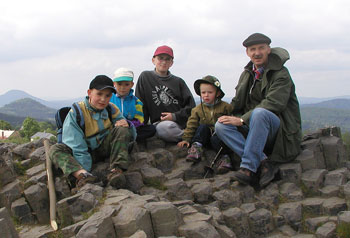
Teaching about creation plays a large role in this pioneer mission work.
Although the wonder and complexity of the natural world shout the Creator’s existence, the monotonous drone of evolutionary humanism drowns out this message. So the Karáseks must patiently point people to creation and the Creator.
Despite being wary of attending meetings, Czechs will discuss God on their own ground. So Zdeněk is regularly out and about, talking to people and handing out evangelistic materials, such as the Czech translation of the [creationist] pamphlets Is there really a God? and What really happened to the dinosaurs? ‘The initial response is always blank astonishment,’ notes Zdeněk. It is a response that he can readily identify with.
The study of origins extends to their church classes. ‘It’s crucial,’ they say. ‘In our Sunday school we begin with Genesis 1:1. We use simple illustrations, such as those found in D is for Dinosaur, to explain that nothing develops out of chaos. They desperately need to hear these basic scientific concepts, which even a child can understand and appreciate.’
Young people also take home a worksheet each week, with a special ‘Window on Creation’ section adapted from Creation magazine.
As Zdeněk learned in his own life, the hammer that can shatter an atheist’s granite heart is the true history of the Bible, beginning in Genesis. Teaching God’s creation and a worldwide Flood instills in atheists a fear of their Maker and Judge (making it easier to introduce Him as their loving Saviour). These miracles of Genesis are inextricably linked with the historic reality of Christ’s Resurrection. The faith required to believe in the creation of the first man, Adam, is much the same as the faith required to believe in the saving work of ‘the last Adam’, Jesus Christ (1 Corinthians 15:45).
Let the ‘ruling classes’ tremble. A ‘Velvet Revolution’2 is afoot in Europe, exposing the rotten foundations of atheism and proclaiming a revolutionary idea—that the Bible’s history is true from the beginning! Atheists have nothing to lose from the truth that can set them free—nothing but their chains.
References and Notes
- See Dr Werner Gitt’s biography. Return to text.
- Popular name given to bloodless fall of communism in Czechoslovakia in 1989. Return to text.
Getting right to the top Zdeněk Karásek’s story shows how an atheistic worldview, imposed by an evolutionary education, can shackle a person’s thinking. Having broken those chains, the Karáseks take every opportunity to help others break free. In May 2005, Václav Klaus, the President of the Czech Republic, visited their town of Liberec. They had prepared a small gift package for him of creationist materials, plus a photo of their Sunday school children and a personal letter telling of their work. They later wrote to him to ask permission for Creation magazine to use their photo of the presentation (shown here, with the President seated). The permission was freely granted, along with his expression of gratitude for the gift of the creation materials. Who knows how God may use such channels? |
Readers’ comments
Comments are automatically closed 14 days after publication.