
Feedback archive → Feedback 2011
Apartheid, racism, and biology
Does biology have a place in our understanding of apartheid in South Africa?
André F. from South Africa reacted to Carl Wieland’s recent web article on interracial marriage. He wrote:
I read the article from Dr. Carl Wieland about racial equality e-mailed to me recently. I absolutely do not agree with him. He obviously has not enough experience of my country South Africa.
At present the white man in SA is going through a survival struggle, with a low intensity, undeclared, elimination war against him, especially the white Afrikaner and white farmer. That is why so many of us have left SA to, amongst others, go and live in Australia.
Dr. Wieland obviously has not followed the situation in SA carefully enough to realize that there are characters like youth league leader Julius Malema, who openly propagates killing white people in SA and the ANC government quietly supports him.
Now the question can be asked why this is so and then one realizes that there are big differences between white and black people, mentally and culturally, differences that always have been very difficult to reconcile and still are to this day. That is why separation of the races was instituted in SA, initially by the colonial English and carried on by the Nationalists after 1948. Dr. Verwoerd felt that by separating the races and helping them all to develop along their own lines of ability, pace and culture, was the best for all in SA in those days. That is why he had to be taken out of the way, because the drivers towards a One World Government could not allow him to succeed. He did more for the black people in SA than anyone else before or after him, including the corrupt ANC government of today.
Measurable, observable biological facts need to be incorporated into our understanding of any issue, regardless of how we might be emotionally, politically or culturally wedded to a particular view.Now, whether one can prove biologically that all races are equal or not, hoping for them to, or forcing them to integrate is the worst thing that can happen today. Whether we like it or not, the differences are so big, ethically, culturally and mentally, that we have to allow space for each other to live next to each other and until the black man learns to grow up and become the responsible citizen he should be, SA will stay in the mess it is in today and it will become worse. The question is, can he?
I invite Dr. Wieland to stay long enough in SA to study this problem and see for himself the reality of SA.
The diversity of the peoples that God planted on this earth, should be cherished and respected and biological equality is of little importance here.
Maybe Dr. Wieland should pay more attention to the diversity than the equality, biological or otherwise, of the races on earth to better understand the purposes of God in his Creation. That may prove to be more meaningful in the evolution/creation debate and towards solving problems on earth and especially in SA.
André F.
Pretoria.
SOUTH AFRICA(I allow CMI to publish this only in its unaltered form, to make certain that no misunderstandings creep in. If they can better word it, it is fine, but make very certain that nothing of what I conveyed here is lost or misrepresented.
Please also note, I am not a racist at all, but only a realist. I daily work and associate with black people at my work and I love them all and have a lot of things in common with them, but unfortunately black people are aroused to hate white people by evil doers and some politicians and it is always slumbering under the surface. That is the reality of SA! The majority of whites wish the blacks no harm, but unfortunately the converse is not true. I know this is a political debate, but CMI is not helping much with their viewpoints on biological equality. We have to take note of the differences first to understand the reality around us.)
Dr Wieland replies:

Dear André F.
Baie dankie for your email, including the PS. (Not a jot or tittle has been altered.) I will assume from some of your comments that you are not antagonistic to other aspects of CMI’s ministry, and so might well be a fellow believer in the Bible as God’s authoritative Word.
My answer to your suggestion that my understanding on race, as revealed in the article on interracial marriage to which you refer, is inadequate and inappropriate when applied to South African culture and history, will be somewhat lengthy. This is for one thing because of the importance of the issues and beliefs you have raised. And also, because I think you have jumped to conclusions (perhaps understandable from a brief excerpted article such as you have read) about what I might write and say if I were specifically addressing apartheid and South Africa.
In fact, I have covered that subject at length in a major chapter in the book from which the article was extracted, my recently published c. 400-page One Human Family: the Bible, science, race and culture. Because this racial policy arose in a culture that was self-consciously Bible-believing, it had to be tackled in-depth in a book like this. And the result is, I think, anything but some ‘politically correct’ approach that has no understanding of the complex issues, such as the Afrikaner concerns for cultural survival, self-determination, and more.
However, before going further, I think it important to state what I think are the self-evident ‘ground rules’ in such a matter.
- Your and my knowledge of any culture, including our own, is always going to be limited, by definition, and we all need to be open to facts and reality.
- Science is a useful tool, but it has huge limitations, especially when it comes to the unobservable, unrepeatable events crucial in the creation/evolution discussion. Nevertheless:
- Truth is vital. Measurable, observable biological facts need to be incorporated into our understanding of any issue, regardless of how we might be emotionally, politically or culturally wedded to a particular view.
- The Bible is infallible and without error. It is crucial to strive to ‘get it right’ when using it in any discussion. Note the Apostle Paul’s instruction in 2 Timothy 2:15 (bold emphasis added): “Do your best to present yourself to God as one approved, a worker who has no need to be ashamed, rightly handling the word of truth.” Sound exegesis has to be permitted to trump, if required, even our most cherished sociological/political/cultural beliefs and biases—and we all have them, I as much as you.
- The Bible gives true truth, but not exhaustive truth. Appealing to it on matters it does not directly cover can be risky. For instance, one might be convinced about how some present-day phenomenon fits into a preferred eschatological framework. It may in fact do so, but the text does not actually deal directly with such things. One needs to be super-careful before claiming such things as if they had biblical authority.
These are complex and powerful issues, and they are very emotionally, politically and spiritually charged. A simplistic approach from either of us on the matter is not appropriate, but I think you will find that the extensive chapter on apartheid and its background is anything but that.
During the course of research and writing the apartheid section, I found out how little I knew when I had numbers of South Africans review the early drafts. But I also found out that the ‘view’ (even the memory) that various South Africans have of the ‘facts’ of the apartheid era is hugely different, depending on their background. That seems obvious for indigenous (black) Africans vs European-background (white) Africans. But what was striking was the huge discrepancy between whites of British extraction, vs those of Afrikaner (Boer/Huguenot) background (like your own, judging by both your name and your comments).
It was also interesting to see how much each of these groups could potentially contribute to each other’s understanding of the issue, if only the threads could be drawn together. It was almost like the story of the three blind men who each thought differently about what an elephant looked like, depending on whether they had grasped its trunk, tail or leg.
Anyway, as a result of this multi-faceted input from South Africans from many differing ‘starting points’, the chapter underwent substantial and repeated, often painful, alteration. I even had the valuable opportunity to have a conference by Skype with a very pleasant man who happened to be the Bible-believing son of apartheid ‘founder’ HF Verwoerd himself, whom you mention. And the son is a lifelong missionary to a black African group whose language he learned—and he was encouraged to do so by his father. That will likely not be a surprise to you, but it will to many readers of this site.
At the same time, there are things that will almost certainly be a surprise to you, and things that will be less welcome for you in the light of your comments. It was very important to me to have a proper balance and nuancing of the very crucial issues involved (which is definitely not achieved by striking some sort of ‘halfway’ pose or ‘a pox on both your houses’.)
The process was also substantially aided by input from two individuals who were from neither of the above groups, but have lived in your country for many years, each involved in ministry to Afrikaner churches. Both had differing perspectives, but both were anything but naïve, either about what occurred during the apartheid era, or indeed about what has gone on under ANC governance since.
I am actually very happy with the chapter as it now is, by God’s grace. It includes anecdotes of the actual responses and reactions of Afrikaners from my several speaking tours over the years in your country. This included a meeting attended by over 600 students at the university in Potchefstroom, which I was assured was in the heart of conservative Afrikaner ‘territory’.
To return to the earlier metaphor, I’m not suggesting that I have somehow ‘arrived’ at the perfect understanding of the elephant. But I think that this lengthy section has several very substantial things to contribute to the understanding of many from all South African groups. There will likely in the process be some painful truths that have to be faced by some folk within each of your country’s people groups—the particular issue will depend on the group concerned. For some it might be at best a grudging acknowledgement, but I dare to suggest that almost all will find the chapter at the least stimulating and thought-provoking. And definitely not pandering to fashion or ‘politically correct’ notions.
Provided, of course, that they (you) read that section in its proper turn towards the book’s end, so that they don’t skip the huge (and to me, hugely fascinating) amount of scientific and biblical documentation and discussion that precedes it. This covers a great range of relevant and important issues concerning science, race, culture and our shared human history, across many different parts of the world, giving important framing and perspective to the apartheid chapter. I think the ‘penny will drop’ for you in relation to some of the positions you hold vis a vis whether differences are biological or cultural, or both.
The early responses so far have certainly given me reason for encouragement, if I may be permitted that foray into immodesty. After reading the final version of the apartheid chapter, a former South African policeman (now a pastor) wrote to thank me for how much ‘I’ had taught him about his country (in reality a lot of other people were involved as well).
You don’t have to have bought the book yet to be able to read his comment, along with other pre-publication endorsements, and see the extensive table of contents (including the list of topics covered within each chapter, including the apartheid one). You can even read substantial sections of the book itself; simply go to either:
or
I hope that you would at least consider that there may be things you are unaware of, too. If you take the trouble to read the whole thing, resisting the temptation to ‘skip’ straight to the section in which you have personal knowledge, there will likely emerge a surprising ‘big picture’. I mean one that can do justice to not only scientific fact and sound biblical exegesis, but ‘on the ground’ realities, too. I trust and pray that it might also contribute to a lessening of the painfully wide gaps in perspective and understanding of this issue between the various people groups, such as your email reveals. Not only in your country, but communities worldwide.
A challenge and an offer
I did not start out my reply intending it to come over like a ‘commercial’, but there were so many issues raised by your email that I would love to be able to deal with patiently and in depth, that I really believe that any exchange will be best served by first seeing exactly where I am coming from in this, which can only happen by reading the book.
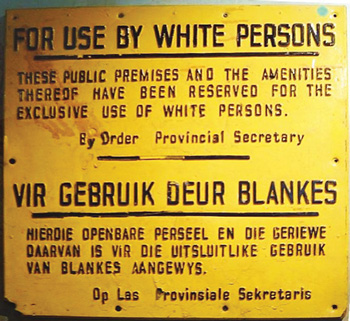
I therefore issue the challenge for you to read it, carefully and in its entirety, and with an open mind. I believe it addresses your understanding head on. As part of that challenge, before reading it, I would ask you to reflect on your own comments in the light of the sign photographed here from that era. Then ask yourself honestly how, if you were a member of a group thus legislated against, you could possibly not consider that your basic dignity as a human being, created in the image of God, has been trampled on? Such were the daily humiliations, and much worse, that people in your group never had to endure.
Consider: is it just possible that anti-white campaigns (a form of equally unbiblical ‘reverse racism’, addressed in depth), do not reflect innate differences so much as they do a desire for payback, and a belief (equally false and racist) that whites are somehow intrinsically and incorrigibly evil?
I extend this offer to you; if after following all these suggestions, you truthfully believe I have substantially and significantly overstated the book as a whole, and you let me know that, I will fund the cost from here to CMI-South Africa permitting you to purchase, free of charge, any other creation resources of any type they stock on their webstore, up to a value double your purchase price for the book One Human Family.
Sincerely yours,
Carl W.
Readers’ comments
Comments are automatically closed 14 days after publication.