
Blind fish, island immigrants and hairy babies
For some time now, the growing effectiveness of the creation movement has been reflected in the increasing frequency (and shrillness) of the attacks on it. A recent book by renowned evolutionary fossil expert, Niles Eldredge, has joined the chorus with the chest-thumping title, The Triumph of Evolution, subtitled The failure of creationism.
Eldredge is known for co-sponsoring, with Harvard’s Stephen Jay Gould, ‘punctuated equilibrium’. This idea is that the alleged history of the evolution of life on Earth is characterized by long periods of ‘staying the same’, punctuated by short bursts of rapid change.
It was an attempt to reconcile evolution with the overall reality of the fossil record, namely that organisms either stay the same or ‘come and go’ abruptly. This is of course what one might expect from a record which reflects not a succession of vast ages, but mostly catastrophic burial in a global watery cataclysm and its aftermaths.
Eldredge was also one of the paleontologists whose damaging recorded admissions on the true nature of the fossil record were one of a number revealed in Luther Sunderland’s brilliant book, Darwin’s Enigma. So he might be expected to react strongly to what he would see as growing creationist defilement of his ‘turf’.1
What triggered this article, however, is not Eldredge’s book, but a review of it by Jerry Coyne, another well-known evolutionist.2
Coyne is a professor in the department of ecology and evolution at the University of Chicago. While enthusiastic about Eldredge’s anti-creationist foray, he expresses disappointment that its author ‘fails to mention, however, some of the classic and most powerful arguments for evolution’.
This grabbed my attention for more reasons than one. Coyne is the biologist who called the peppered moth argument ‘the prize horse in our stable’. When he found out that it was bogus,3 he said it was like finding out that Santa Claus was not real.4
So what did he now think were evolution’s ‘prize horses’, I wondered? His three ‘classics’ reward a closer look.
1. SIGHTLESS EYES
Coyne’s list starts with ‘the presence of vestigial organs (including the nonfunctional eyes of cave organisms, which evolved from sighted creatures).’
Citing organs which are allegedly useless vestiges or ‘left-overs’ from some evolutionary ancestry has always seemed a strange way to promote the idea that microbes have gradually turned into mice, marigolds and musicians. A loss of function (e.g. from harmful mutations) sits well with the biblical teaching of a fallen, cursed creation.
Then there is the logical problem—how do you establish that something has no function (as opposed to our not having yet discovered the function)? Evolutionary enthusiasm led to well over 100 organs in the human body being declared ‘vestigial’ at the beginning of last century. Advancing knowledge has whittled this list down so relentlessly that now only the boldest evolutionary diehard would insist on any vestigial organs in our body.
However, Dr Coyne is on safe ground in assuming that blind cave creatures descended from ones that had eyes. There are cave fish, for instance, often the same species as ‘seeing’ ones above ground, who start to develop eyes as embryos. But then the process halts and they end up with scar tissue where their eyes were evidently meant to be (see aside below). But what does that have to do with what is usually meant by ‘evolution’? Had he bothered to read the mainstream creationist literature, Coyne would have realized that we delight in using blind cave fish as examples of ‘downhill’ or ‘information-losing’ mutations causing ‘devolution’.
Consider a fish, one of many swept into an underground waterway, which inherits a defective gene for eye development (because of a mutation—an error in copying the DNA code during reproduction). Should the fish survive to reproduce, this defect will be passed on to all of its descendants.
Above ground, such a mutation would be very quickly ‘selected against’, as any fish inheriting it would be less likely to find food and evade predators, so would be less likely to survive and pass on the mutational defect. But in a totally dark environment, any blind fish are not at a disadvantage to their sighted fellows—in fact the opposite. Without light, there are no visual warnings when cave fish are about to scrape into a sharp rock, for instance.
Eyes are delicate and thus easily injured in darkness, allowing the entry of potentially lethal bacteria. So, in total darkness, eyes are no longer an asset, but a handicap. On average, the eyeless fish will be more likely to survive and reproduce. It would not need many generations before all the fish in that environment were of the ‘eyeless’ type.
Evolutionists believe that eyes arose from a world filled with only eyeless creatures. Their whole system involves a massive net gain of genetic information, over millions of years. To attempt to give credibility to that idea by pointing to how genetic accidents have caused a loss of eyes is hardly playing fair. The evidence from blind cave fish continues to give a great illustration of mutational loss and natural selection, i.e. informationally ‘downhill’ change.
2. HAIRY EMBRYOS
Number 2 on Coyne’s list of ‘classics’ is ‘the recurrence of ancestral features in development (such as the coat of hair that forms briefly on the human embryo as a legacy of our primate ancestors)’.
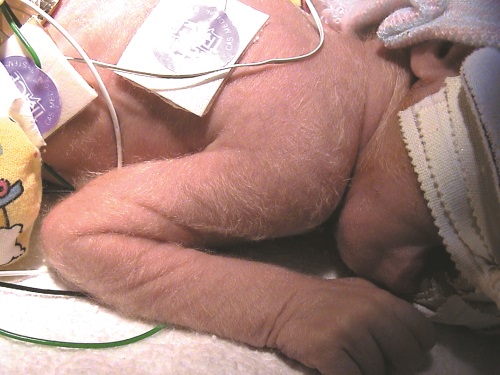
The idea that the human embryo expresses some of its past evolutionary stages during development has an ignoble history. ‘Embryonic recapitulation’ was bolstered by massive fraud,5 and has been repeatedly discredited. Yet it still rears its head occasionally from those who should know better. It is well known that in the womb, the human embryo develops a soft, downy covering of special hair known as lanugo, often still visible in premature babies. The argument has an emotional simplicity—isn’t it ‘obvious’ from the photo that this is a temporary ‘throwback’ to our ‘hairy ape ancestors’? But on closer inspection the argument falls short.
Such arguments imply that some dormant ancestral genetic information causes the temporary development of something which became unnecessary during an organism’s evolutionary ancestry, and so it fades away again prior to reaching adulthood. Hair grows from structures called follicles. The more follicles per unit area there are, the greater the resultant density of hair. So if there really was an embryonic stage reflecting a ‘hairier’ ancestor, investigation should reveal that at some stage in the womb we have a larger number of hair follicles than in later life. At the least, evolutionists should be able to point to hair follicles which function as such in the womb, but not later.
However, this is not so. Surprising as it may seem, the number of hair follicles is the same at every stage of our life. Former anatomy professor David Menton says: ‘Humans have three basic types of hair shafts, which may grow from any follicle depending on hormonal and other controls—the lanugo hair, the vellus hair and the terminal hair.’6
Terminal hairs, he says, are the ‘obvious’ ones, like on our scalp. Vellus hairs are extremely fine, colourless and very short. A woman has the same number of hairs on her face as a man. When males reach puberty, the follicles in the ‘beard’ areas stop producing vellus hairs and grow terminal hairs instead.
Starting at 12 weeks of development, says Dr Menton, ‘The human fetus produces a type of hair called a lanugo hair from the same follicles that will produce both terminal and vellus hairs on the arms, legs and trunk (the foetal scalp generally produces terminal hairs from the beginning of hair growth). Lanugo hairs are similar to vellus hairs in that they are small and colourless, but they are clearly longer, and thus more visible than vellus hairs. They are usually shed (into the amniotic fluid) before birth, but the same follicles will produce vellus hairs, and for many follicles eventually terminal hairs.’
Balding hippies
Our body hair … is it a useless leftover?
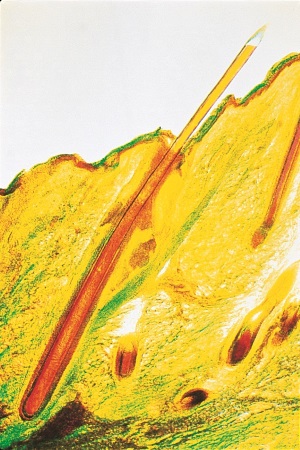
The late Douglas Dewar, tireless UK crusader against evolution, pointed out many years ago the fallacy in the common assumption that human body hair was ‘functionless’. The ‘goose-pimpling’ effect in response to cold is caused by tiny erector pili muscles tugging each hair shaft upright. This allows the hairs, together, to trap more air and thus insulate better against loss of heat. Even where there is not enough body hair for this to be a significant effect, hair shafts have an important role in keeping the skin’s oil (sebaceous) glands unblocked.
All bald men have as many hairs as at birth. Their scalp follicles still produce hair shafts, only now of a different, microscopically small type.
Imagine you could see a normal, preborn baby boy covered in soft lanugo hair, in say the early 1950s. At birth, the lanugo having been largely shed, his smooth baby’s body looks anything but hairy. The child then becomes a stubbly-chinned teenager; years later, as a full-fledged hippy, say, he sports waist-length hair and beard. Much later, male pattern baldness causes his head to resemble a bowling ball rather than Bob Dylan.
What happens in this condition, says Dr Menton, is that terminal hairs are replaced by vellus hairs. So the number of hairs on the person in our example has actually never changed along the way. The ‘hairy’ fetus has no more hairs than the newborn, who has no less hairs than the hippy. And the bald man still has as many hairs as he ever did, at any stage of his life! Thus there never is a ‘hairier’ embryonic stage. The idea of lanugo reflecting a hairier evolutionary past clearly lacks scientific support.
3. ISLAND MIGRANTS
The final argument in Dr Coyne’s list is ‘the geographical distribution of organisms on our planet (if species were created, why did the creator fail to stock oceanic islands with mammals, freshwater fish and reptiles?).’
This is an amazing statement. Is it too much to ask that knowledgeable people who review significant books, in a substantial forum, on a major controversy, should at least know the rough outlines of the other side of the argument? Genesis has never taught that each creature was created more or less where it is now found. In fact, there are three whole chapters referring to the global Flood mentioned earlier. As a result, land vertebrates were forced to repopulate, from one location, a devastated and totally different earth. Plants would have regrown from windblown, bird-dispersed or floating seeds (or cuttings).
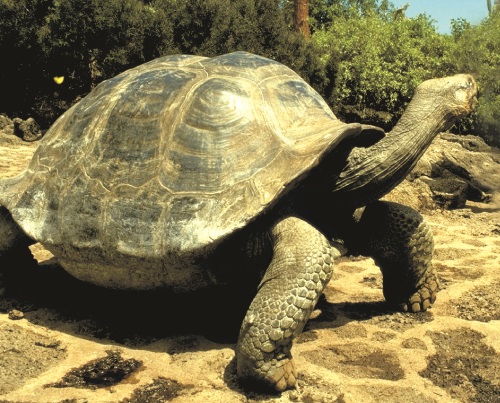
Coyne seems to be following in the footsteps of his mentor, Darwin, who despite having studied to be a minister seemed incredibly ignorant of what Genesis actually says about the real history of the world. When coming upon islands such as the Galápagos, Darwin saw evidence which indicated that certain creatures on them were the descendants of similar ones on the mainland. Since the Bible was widely (and incorrectly) assumed to teach that each species was created more or less in its present-day environment, any evidence to the contrary seemed to speak against the Bible’s credibility.7
However, Christians should be delighted at evidence of animals having migrated and dispersed, with natural selection facilitating some limited adaptive change along the way (without adding any information—in fact, selection culls information). Even the differential survival and post-Flood adaptation of fresh and saltwater fish is not difficult to explain through the ‘glasses’ of biblical understanding.8
Ironically, to support his notions of island colonization, Darwin even performed experiments which showed that floating seeds could survive months in saltwater. He was apparently oblivious to how these results could support the notion of post-Flood colonization of this ‘new world’.
It seems that even Darwin’s latter-day disciples find it easier to erect an easily demolished straw-man notion of what the Bible actually teaches than to engage it in any serious fashion.
Sadly, people are continually exposed to such disparaging and poorly informed attacks on the veracity of the Bible, based mostly on discredited arguments like these. Like water dripping on a stone, the impressions such fallacies create lead to most people not even being willing to seriously consider the Gospel, which is why we have such a passion in this ministry for getting the materials—books, videos, audio tapes and web information—out as far and wide as we can. Because Christianity and the Bible are ‘truly true’ in the deepest sense. They are not just ‘something you believe inside your head’, but something which connects to all of reality. Forever.
Growing eyes in eyeless fish

As embryos, eyeless cave fish do start to develop recognizable eye structures for a while, which then regress. In fact, recent work shows that when lenses from ‘sighted’, above-ground fish are transplanted under the skin of young ‘eyeless’ fish of the same species (Astyannax mexicanus, both varieties shown inset below), a seemingly complete eye develops to incorporate the lens, with iris, retina and visual pigment.1
This indicates that the original mutation, rather than totally ‘deleting’ the information for eye development, ‘switched off’ part of the eye’s developmental pathway. Somehow the presence of the lens induces these ‘switched off’ pathways to turn on again.2
This evidence is consistent with the explanation given in the main text for how eyeless cave fish arose—the result of a downhill change in which information, or the ability to express it, has been corrupted or lost.3 This does not support the idea of evolution; such a degenerative process could not, for example, generate seeing eyes in the first place.
- <www.sciencedaily.com/releases/2000/07/000728082041.htm> August 9, 2000. It is not known at the time of writing whether these ‘regained’ eyes have full visual connections to the brain.
- In some animal embryos in which the lens normally develops first, if the lens is then transplanted to another site on the embryo, an eye will form there instead. The lens acts as an ‘inducer’ for development of the rest of the eye.
- An analogy may be with a computer’s delete function which initially deletes hard disk addresses, not information—which is why undelete functions can work.
References and notes
- In his book, Eldredge in fact tries to explain away some of his comments to Sunderland. Return to text.
- Coyne, J., A paleontologist makes the case for evolution and against creationism. Chicago Tribune, July 30, 2000, Sunday Books; p. 4. Return to text.
- Wieland, C., Goodbye peppered moths, Creation 21(3):56, 1999. Return to text.
- Coyne, J.A., Not black and white, Nature 396 (6706):35, 1998. Return to text.
- Grigg, R., Ernst Haeckel: Evangelist for evolution and apostle of deceit, Creation 18(2):33-36, 1996 and Fraud Rediscovered, Creation 20(2):49-51, 1998. Return to text.
- A personal communication from Dr Menton, August 1, 2000 provided the information on hair, plus the quotes attributed to him. Return to text.
- This was thanks to Christians who compromised the truth of biblical history, not unlike those evangelical leaders who have been influenced by Dr Hugh Ross today. Return to text.
- See the new, expanded The Creation Answers Book, Triune Press, Brisbane, Australia, 1999, Chapter 14, ‘How did fresh- and salt-water fish survive the Flood?’
Return to text.


Readers’ comments
Comments are automatically closed 14 days after publication.