
Bugs, baramins and beauty
Carl Wieland chats with insect expert Gordon Wilson

Dr Gordon Wilson (pictured left) has a Master’s degree in Entomology, and a Ph.D. in Environmental Science and Public Policy. He is currently a Senior Fellow of Natural Philosophy (a.k.a. biology professor) at New Saint Andrews College in Moscow, Idaho, USA—a classical liberal-arts college that he says takes an unashamedly biblical, young-earth creation position.1
When Gordon Wilson was only five or six years old, he already had a passion for the world of living things—but it was not insects that grabbed his interest. His ‘first love’ in biology, he says, was and really remains reptiles and amphibians. As he grew a little older, this developed into a fascination with dinosaurs, and from that, fossils.
I asked him how he became an entomologist, someone interested in bugs. He replied that when looking for a master’s degree program with a research stipend, there were none available in herpetology (reptiles and amphibians) at the University of Idaho. He wanted to do something practical, and was advised to look into entomology. When he spoke to some entomologists he fondly remembered an undergraduate elective called ‘Insects and Man’ which had fascinated him. After that visit, he says, ‘God opened the doors—I have no regrets, even though reptiles remain a great interest.’
Mind-blowing insects

Gordon said that insects have ‘the most fascinating, bizarre, even mind-boggling natural histories that will blow most vertebrates out of the water, especially in terms of their “gee-whiz” impact on the lay person.’
Asked for an example, he mentioned a parasitic wasp from the family Chalcidae. It actually lays its fertilized eggs in the ‘neck’ of a carnivorous predatory insect larva, the antlion.
‘It flies right into the jaws of death, as it were,’ says Gordon. ‘Its specially enlarged hind legs are powerful enough to hold the base of the antlion’s jaws open while it deposits its eggs into the membrane between the head and thorax of the antlion. They hatch, and the larvae feed on the antlion’s tissues. They are then nourished to maturity as they eat the creature from the inside out.’
This would seem a big problem for evolution to explain. Assume a mother wasp had a mutation that somehow initiated the strange practice of laying its eggs dangerously close to the predator’s mouth. Unless the design features which prevented the female wasp from becoming just one more meal were already in place, extinction of the line would be certain—the behaviour would not get passed on.
Design and the Curse
But this amazing, exceedingly complex design presents an obvious problem for creationists, too, that of ‘natural evil’. Darwin himself used a similar situation (a wasp whose larvae feed on the body of a still-living caterpillar) to ask, what sort of Creator would design such a seemingly cruel and horrible thing?

I found that Dr Wilson has not only thought about this sort of thing at length, but written and presented papers on the topic. He agreed that if insects are not what the Bible refers to as truly living creatures or nephesh chayyah (having the nephesh or ‘soul’—plants do not, so are not truly living in the biblical sense) then the problem goes away.2 First, not being alive in the biblical sense, such things in the insect world might have been going on pre-Fall already. And second, without the nephesh, the insect would not be capable of suffering as such. Dragonflies can eat their own abdomen. Whether it seems emotionally abhorrent to humans is irrelevant to the question, since we are likely to automatically imagine how ‘we would feel’.
But while it’s very clear that plants, for example, are not nephesh chayyah, Gordon feels it’s hard to be as certain in the case of insects. So he likes to also consider the alternative. He says, ‘If they do have nephesh life, then biblically there could not have been insect death pre-Fall, either. So they must have been designed for a completely benign life. For two contingencies, actually—one for a benign unfallen world, the other for the world we have now. God frontloaded various kinds with the genetic information to code for both. But of course I believe that God foreknew the Fall.’
He used the example of the completely herbivorous tadpole, with physiology for eating only plants and algae. But the adult frog is a predatory animal, and the genes for such different anatomy, physiology, and behaviour obviously must already exist in the tadpole, but are not expressed or ‘switched on’ till later.
Creationist classification
Dr Wilson is also involved in the Baraminology Study Group, a fellowship of creationist biologists and thinkers who consider the issues of taxonomy and classification, in particular which creatures were part of the same original kind, or baramin (from the Hebrew for ‘create’ and ‘kind’).

Creationist taxonomists, like their evolutionary colleagues, also fall into distinct camps, depending on whether they like to ‘split’ things into many categories, or to ‘lump’ separate groups together into the same group. Gordon said, ‘I tend to be a splitter, rather than a lumper’. His ‘gut feeling’ is that the baramin mostly tends to be at the genus level, rather than the family.
There are of course many instances where creatures from different genera can hybridize together, even producing fertile offspring. For example, camels and llamas giving rise to camas. Many creationist scientists and thinkers (including from CMI) would, based on the biblical ‘after their kind’, see this as an indicator that the entire family Camelidae likely represents the offspring of the original created kind.
Gordon respects this view (he’s comfortable with family-level baramins when the disparity between genera isn’t too huge), but says, ‘While I think the hybridization criterion is an OK assumption, it’s not possible to prove it from Scripture definitively. I tend to think that God could have made some different types genetically compatible.’
One case where he would definitely find it hard to swallow a ‘family = kind’ identification is the grass family. He says, ‘The grass family includes lawn turf, the corn we eat, and huge bamboo forests. All play a different role in a fully functioning ecosystem. Did God have to start with middle-of-the-road grass, then wait till it diversified? It seems more reasonable to believe that grass started with a lot of different morphotypes from the beginning.’
Dinosaurs vs the Bible
Growing up in a Christian home, Gordon says he prayed to receive Christ at age 6. In going through his ‘dinosaur phase’ in elementary school, he started realizing that there was a contradiction between what he was learning at church and in his dinosaur books.
A small comic booklet by ICR’s Dr Duane Gish set him ‘on the right course’. He says, ‘I saw intelligent, educated Christians who were not going to “sell the farm” by accepting the word of man over the Word of God.’
Where he now teaches is a conser vative evangelical college. Being a liberal-arts school, it does not aim to produce biology majors. As the only scientist/biologist there, Gordon aims to make his students scientifically informed laypeople. He wants them to understand what evolution is all about, while ensuring they are grounded in a strong biblical worldview.
He says, ‘I don’t want them to reject evolution in some sort of “strawman” fashion, nor do I make fun of evolution or make it look stupid. If I do, and they then go out and encounter an intelligent evolutionist, he will make a meal out of their position.’
In his scientific apologetics courses, he gets students to read not only creationist books, but also such evolutionist classics as Jonathan Weiner’s The Beak of the Finch, so that they really understand the sorts of arguments people are being exposed to.3
Aesthetic arthropods
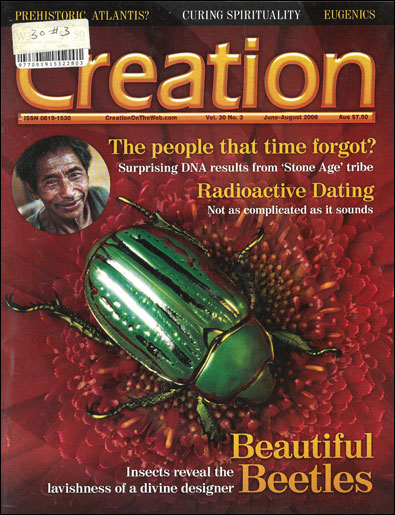
I asked Dr Wilson about the mocking evolutionist comment (by JBS Haldane, as he reminded me) that God must have an inordinate fondness for beetles, he made so many of them. There are over 350,000 described species and probably many more yet to be discovered. Does that cause Gordon to be more of a ‘lumper’ when it comes to beetles at least? Not necessarily. He replied, ‘When God makes the kinds, there are many roles for them, only one of which is ecological. It’s easy for biologists to miss other things, like the creativity and lavishness of God. And the aesthetic value—they exist for His pleasure as well as ours. Many beetles are incredibly beautiful.’ (See front cover photo of the amazing scarab beetle.)
He went on to provide what seems a great ‘last word’ for this interview: ‘I like to teach my students that biology is not just a pile of dry, boring facts. We are studying the direct handiwork of God, and it gives us insight into His creative and artistic character, so biology is part of theology. God is a God not just of truth, but also of goodness, and beauty.’
References and notes
- Affiliated with the Confederation of Reformed Evangelical Churches. Return to text.
- This is what CMI currently holds as being the most likely situation, that insects do not qualify as having nephesh life. See Sarfati, J, Refuting Compromise, ch. 6. Also The Creation Answers Book, Creation Book Publishers, Georgia, USA, ch. 6, 2006. Return to text.
- See CMI’s review of this book at <creation.com/beak_finch>. Return to text.
Readers’ comments
Comments are automatically closed 14 days after publication.