

Bunchberry bang!
Strolling through one of the vast spruce-fir forests in north America on a sunny summer’s day, you might think that, in the green world around you, nothing ever happens in a rush.
However, researchers have discovered that the bunchberry dogwood plant (Cornus canadensis), which carpets the ground of these forests, doesn’t dawdle when it comes to flower opening.
Using a high-speed video camera, researchers have shown that the bunchberry flower can open its petals, catapulting its pollen into the air, in under 0.4 milliseconds!1,2 That’s faster than the leap of spittle bugs / froghoppers (0.5–1.0 milliseconds),3,4 the strike of the mantis shrimp (2.7 milliseconds),5,6 the opening of Impatiens / ‘touch-me-not’ fruits (2.8–5.8 milliseconds),2 the strike of a chameleon’s tongue (50 milliseconds),7,8 and the snap of venus flytraps (100 milliseconds).9,10
‘Most people think of plants as stationary and sedentary,’ said Joan Edwards, one of the researchers. ‘We were even surprised how fast this flower opens.’11 Indeed they were. The researchers had started out using a high-speed video camera that takes 1,000 pictures every second—but the images were blurred, indicating the camera was too slow! It was only when they used a superfast camera that takes 10,000 pictures every second that they were able to capture on film exactly what happens when a bunchberry flower ‘explodes’.12

As the flowers burst open, the petals quickly (within the first 0.2 milliseconds) separate and flip back, out of the way of the pollen-bearing stamens. The stamens then unfurl and accelerate at 2,400 times that due to gravity—approximately 800 times the force astronauts experience during take-off—catapulting the pollen granules into the air ‘to an impressive height of 2.5 cm’ (1 inch). While this at first might not sound like much, the flowers are only a few millimetres tall (less than 1/10 of an inch). So it’s been said that an equivalent achievement for us would be throwing a rock onto the top of a six-storey building!11
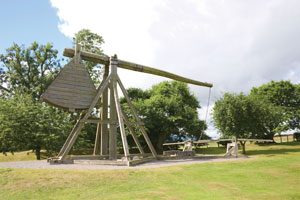
Actually, people have indeed learned to achieve such feats—through the use of tools such as the trebuchet (pictured above), a specialized projectile-launcher used in medieval wars.13 The trebuchet is ingeniously designed, using principles of physics (leverage) to propel objects (and sometimes, reportedly, an unfortunate negotiator14) much further and faster than would a simple catapult.
It turns out that the bunchberry stamens resemble, and function as, miniature trebuchets. The payload (pollen in the anther) is attached to the throwing arm (filament) by a flexible ‘hinge’ connecting the anther to the filament tip. After the petals open, the bent filaments unfold, releasing elastic energy, and the rotation of the anther about the filament tip accelerates pollen to its maximum vertical speed then releases it, flinging the pollen upward.2
Surely, given the medieval trebuchet was intelligently designed, then so too was the bunchberry flower? (And the Designer of the bunchberry flower thought of it first!) In fact, the researchers’ paper in the journal Nature apparently couldn’t help but use such language: ‘Bunchberry stamens are designed like miniature medieval trebuchets … ’2 [our emphasis].
It’s certainly difficult to imagine how each of the floral components could have possibly come together in working synchrony through step-by-step evolution. ‘Petals open independently of stamen activity,’15 the researchers point out—but why would there have been a need for rapid petal opening if the fully-functioning stamen ‘trebuchet’ was not already in place? Conversely, a rapid-fire pollen launcher would be useless if the petals didn’t spring open in time.16
All of this points (Romans 1:20) to the logical conclusion that the bunchberry’s ‘bang’ did not come about by accident.
References and notes
- Angell, S., Professors record the world’s fastest plant, Oberlin College News & Features, <www.oberlin.edu/news-info /05may/expflower.html>, 12 May 2005. Return to text.
- Edwards, J., Whitaker, D., Klionsky, S., Laskowski, M., A record-breaking pollen catapult, Nature 435(7039):164, 2005. Return to text.
- Burrows, M., Froghopper insects leap to new heights, Nature 424(6948):509, 2003. Return to text.
- See also Catchpoole, D., In leaps and bounds—the amazing jumping prowess of frogs and froghoppers, Creation 30(4):40–41, 2008; <creation.com/leaps>. Return to text.
- Patek, S., Korff, W. and Caldwell, R., Deadly strike mechanism of a mantis shrimp, Nature 428(6985):819–820, 2004. Return to text.
- See also Sarfati, J., Shrimpy superboxer, Creation 30(2):12–13, 2008; <creation.com/shrimpy>. Return to text.
- Snelderwaard, P., de Groot, J. and Deban, S., Digital video combined with conventional radiography creates an excellent high-speed X-ray video system, Journal of Biomechanics 35:1007–1009, 2002. Return to text.
- Sarfati, J., A coat of many colours—captivating chameleons, Creation 26(4):28–33, 2004; <creation.com/chameleon>. Return to text.
- Forterre, Y., Skotheim, J., Dumais, J. and Mahadevan, L., How the Venus flytrap snaps, Nature 433(7024):421–425, 2005. Return to text.
- See also Sarfati, J., Venus flytrap—ingenious mechanism still baffles Darwinists, Creation 29(4):36–37, 2007; <creation.com/flytrap>. Return to text.
- Schirber, M., World’s fastest plant: New speed record set, Live Science, <www.live science.com/othernews/050512_exploding_pollen.html>, 12 May 2005. Return to text.
- Sohn, E., Fastest plant on Earth, Science News for Kids, <www.sciencenewsforkids.org/articles/2005 0615/Note3.asp>, 24 August 2006. Return to text.
- Trebuchet.com—the atomic bomb of the Middle Ages, <www.trebuchet.com>, 1 December 2006. Return to text.
- All about catapults, <www.catapults.info>, 1 December 2006. Return to text.
- Again, our emphasis in bold font. Ref. 2. Return to text.
- The catapult mechanisms of chameleon tongues and horse legs are similarly irreducibly complex. That is, both ‘spring’ and ‘release’ systems must be fully in place for the catapult to work—evolution’s hypothetical small intermediate steps would have no advantage by themselves, therefore natural selection would not favour them. See ref. 8—Box: ‘Chameleon catapult’; and Sarfati, J., Horse legs: the special catapult mechanism, Creation 25(4):36, 2003; <creation.com/horselegs>. Return to text.
Readers’ comments
Comments are automatically closed 14 days after publication.