
Chinese feathered dinosaurs, where are the skeptics?
13 July 2004
After hearing paleontologist Paul Willis debate Carl Wieland in August 2003,1 it was with great interest that I visited the travelling display of dinosaur fossils from China. In the debate, we were told that Dr Willis had said, ‘God created Liaoning [the area of China, where the so-called feathered dinosaur fossils were found] because He hated creationists.’ Of course such statements are meant to mock, because Paul Willis does not believe God created anything. Yet, he was keen to tell the mainly Christian audience that they could believe in God and in millions of years. We would expect, however, that, as Australian Skeptic of the Year, belief in the God of the Bible would receive the same amount of scorn in a different venue.

View more information and resources on Chinese Dinosaurs
So finding out what Paul has put his faith in was a question in the back of my mind as we entered the display at the Queensland Museum.
The exhibit
After being overwhelmed by the size of the large sauropod and theropod dinosaurs, my attention was captured by the incredibly colourful models of the ‘feathered’ dinosaurs. These were at the feet of their supposed ancestor, a large theropod named Yangchuanosaurus huopingensis, said to be 160 Ma (million years) old.2
The creativity of the models’ sculptors was evident. The faces and colours they produced showed a strong Chinese influence, similar to the stylized dragons often seen in Chinese art. However, I was struck by the likeness of several of the models to modern ground-dwelling birds, such as the roadrunner and cassowary, though much more colourful (figure 1). Given the authoritative presentation and visually understandable ‘evidence’, it was clear that the exhibit would convince most people that dinosaurs evolved into birds hundreds of millions of years ago.
The fossils
The real ‘bones’ of the exhibition, the fossils, were displayed opposite the models. They were under further interpretative drawings presumably showing, via a line of arrows, the lineage of evolution from dinosaurs to birds (figures 2 and 3). Unfortunately not all the specimens were on display at the Queensland Museum but one would expect that the fossils presented some of the best examples of the available fossil data.


The interpretive sequence of drawings above the fossil slabs. Note the line of arrows implying an evolutionary relationship.
The fossil slabs showed a progression:
- Sinosauropteryx prima (date not given in the display but others have placed it at 125 to 135 Ma),
- Caudipteryx zoui (125 Ma),
- Protarchaeopteryx robusta (125 Ma),
- Velociraptor mongoliensus (80 Ma),
- Sinornithosaurus milleni (125 Ma) and
- Archaeopteryx lithographica (150 Ma).
The only bird in this sequence is Archaeopteryx from Germany, while the ‘feathered’ dinosaurs are all from China. Three smaller Chinese bird fossils Sinornis santensis, Changchengornis hengdaoziensis and Confuciusornis sanctus (all ‘125 Ma’) were shown after Archaeopteryx, and were described as ‘lacking the long bony tail of their [supposed] ancestors’ and having ‘larger keeled breastbones’.
The feathers?
The first obvious inconsistency came to mind while looking at the evidence for feathers. Sinosauropterxy prima had what appears to be a dark fuzzy outline surrounding the bones, apparently interpreted as the trace of hair-like filaments. I must confess that it looked much like the shading artists will often do around pencil drawings to emphasize the outline of an important object. The guidebook describes these ‘proto-feathers’ as feather-like structures.3 It explains that they appear as impressions in the fine-grained matrix or as a halo of darker, fibrous-like areas, usually at right angles to the bones, although not always contacting them. Certainly this evidence is vague. Did some dinosaur have a furry coating, or is this ‘fuzz’ just an artefact of the preservation or recovery process?
Caudipteryx (‘Caudi’, as Dr Willis affectionately nicknamed it) showed some long fibrous-looking traces in the area of the tail, similar to fossils of thin reed-like plants. To claim that they are feathers is clearly a statement of faith in a worldview, not a scientific observation.

Click here for larger view
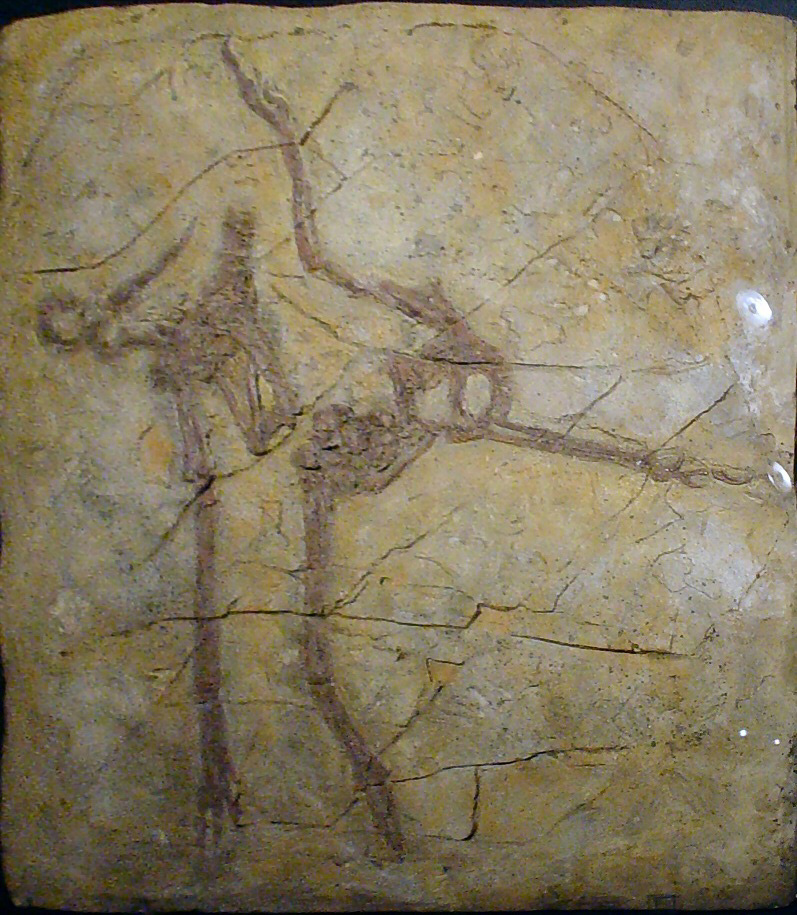

The information displayed below Protarchaeopteryx robusta indicated that detached feathers could be seen in the top left of the slab, but no matter how closely I looked, I could see no markings in that area consistent with the claim (compare figures 4 and 5).
The only evidence presented for the ‘feathered’ dinosaur, Velociraptor mongoliensus was a skull. The evolutionary just-so story beneath was amazing. ‘Velociraptor has not yet been found in the Liaoning deposits and its feathers are not preserved in the Mongolian and Chinese deposits where it occurs. However, because all its close relatives had feathers, it is most likely that Velociraptor did too.’
Finally, the reproduction of Sinornithosaurus milleni again left me wondering how anyone could conclude that the linear scratched traces surrounding the bones were feathers.
Family trees
The exhibition displayed a family tree alongside each of the models and alongside the larger dinosaur fossils. These trees showed that the closest relative to the supposed ancestor of both birds and theropods was the 5-metre-tall Yangchuanosaurus huopingensis. All the so-called feathered dinosaurs were further along the same branch of the tree (later) away from this supposed family split. So, in this scenario, feathers must evolve twice, once for the birds and once for the feathered dinosaurs, not once as implied by the sequence from Sinosauropterxy to Archaeopteryx. This sequence also completely ignores the dating of the fossils. Not only is Archaeopteryx 25 million years older than the oldest of its supposed ancestors, but evidence for birds from footprints dates back to 225 Ma, according to their own evolutionary dating.
In the debate,1 Dr Willis quickly passed off the obvious discrepancy of dating as an issue of relation, but not direct lineage. Dr Willis argued that man and modern apes both evolved from ape-like creatures, and there are still apes today. However, there are no living examples of these supposed ape-like ancestors, and evolutionists can’t decide if it looked more like an orangutan or a chimpanzee. But even further, the explanation of relation and lack of fossils does not wash with all evolutionists:
‘Cladograms which depict birds diverging from theropod stock just in the nick of time to show Archaeopteryx on a separate lineage (I am thinking of a recent Scientific American article) are mischevious [sic]. Archaeopteryx is a highly specialised, and therefore highly derived, creature possessing, apparently, a fully developed flight plumage. Any explicit or implied suggestion that it arose overnight is simply ridiculous. Archaeopteryx had avian history and I, for one, cannot imagine it being any shorter than 20 million years or more. … the real problem here is not that dromaeosaurid fossils appear so late; it is the temporal coincidence of a stem group [bottom of the family tree] organism, Compsognathus, [found in the same geological formation as Archaeopteryx and very similar to Sinosauropterxy prima]with a highly derived crown member [top of the family tree] of the same lineage, Archaeopteryx. This problem requires more than a glib appeal to sampling inadequacies.’4
Regarding the claims of birds evolving from dinosaurs, this anti-creationist goes on to say:
‘Presumably this kind of over-zealous interpretation is being advanced by lay people [it’s not lay people, but professional palaeontologists]; one sincerely hopes that the professional researchers graduating from our universities today would not make such elementary errors of logic. … the evidence is complex and appears, in light of the present state of our knowledge, contradictory. The point to draw is not that the “popular” hypothesis is wrong, but that the jury is still out. Claims that birds arose from the Maniraptora [dinosaur classification including theropods, defined by the closeness of the fossil to modern birds5] are just Bad Science: we simply do not know.’4
So who are the real skeptics? Obviously not the Australian Skeptics who sponsored the guidebook published by the Australian Museum.3 One suspects that their anti-creationist agenda is clouding their objectivity.
What’s next
The guidebook for the exhibition mentions the exposed fraud, ‘Archaeoraptor, which so badly fooled National Geographic in 1999’.3 A review of the literature for the recent discovery of a supposed four-winged dinosaur, Microraptor,6 reveals that all the fossils of Microraptor showing feathers were purchased, as was Archaeoraptor, rather than being found in-situ by paleontologists. I can’t help wondering how valid Microraptor is and whose face may end up with egg on it this time. Certainly it is not the kind of evidence I would want to stake my faith on.
[View more information and resources on Chinese Dinosaurs.]
References and notes
- Available on DVD: The Great Genesis Debate: Wieland vs. Willis, Creation Ministries International, 2003. Return to text.
- Ma—millions of years. The dates shown are given in the exhibit. Such dates are not accepted within a biblical framework. Return to text.
- Lavarack, J.W. (ed.), Chinese Dinosaurs: Dragon Bones & Dragon Birds; in: Riversleigh Notes, Issue No. 53, 2nd Ed., The Riversleigh Society and The Australian Museum, 2003. Return to text.
- Dinosaur Myths and Misinformation, <www.peripatus.gen.nz/Paleontology/DinMyt.html>, 7 June 2004. For further doubts about the feathered dinosaurs see: Richard Hinchliffe, The forward march of the bird-dinosaurs halted? Science 278(5338):596–597, 1997; Sarfati, J., Skeptics/Australian Museum ‘Feathered Dinosaur’ display: Knockdown argument against creation? Return to text.
- Maniraptora (‘Seizing Hands’) Birds and their Closest Relatives, <www.ucmp.berkeley.edu/diapsids/saurischia/maniraptora.html>, 7 June 2004. Return to text.
- Microraptor was announced in January 2003 after the travelling Chinese exhibit was put together. No fossil evidence was available to view, but is discussed in the guidebook. Return to text.
Readers’ comments
Comments are automatically closed 14 days after publication.