

Copying confusion
Does duplication of existing DNA help evolution?
Molecules-to-man evolution requires the production of large amounts of new genetic information. In searching for possible mechanisms, evolutionists have sometimes pointed to the ability of cells to make, and retain, multiple copies of their DNA. Every time a cell divides, the DNA is copied and the new copy is usually passed on to the daughter cell. But it can sometimes happen that the copy remains in the parent cell. When a whole set of chromosomes is copied and retained in this way, the condition is called ‘polyploidy’. Some defenders of evolution have tried to claim that this is an example of the ‘new information’ creationists ask (so far in vain) to see proof of, if evolution is to have credibility. However, informed evolutionists generally realize that photocopying a page adds no new information; it just duplicates it.
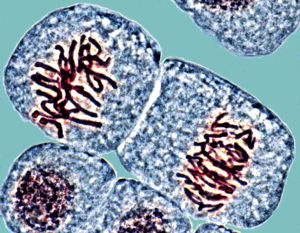
However, many evolutionists have argued that this ‘extra’ DNA from chromosome duplication can provide at least the raw material for mutations to work on. The ‘extra copy’ is supposedly liberated to produce new genetic information by accidental change, in addition to the standard information in the original.
If this process had been an important factor in the ‘evolution’ of life, then we should find that the number of chromosomes and/or the mass of DNA per cell would increase as you move up the Tree of Life. The organisms with the most DNA should have had the greatest exposure to mutation and thus the greatest opportunity for evolutionary advancement. Bacteria and other single-celled organisms should have the least amount of DNA, and complex organisms like man should have the most.
Is that what we find? Not at all. Some microbes have more chromosomes and more DNA than man. Man has only a modest 46 chromosomes, falling somewhere in the middle of the range that goes from 1 chromosome in an ant (quite an advanced organism compared to a microbe) to over six hundred in some plants.
Some ‘variation within a kind’ can occur by this mechanism. In chrysanthemums,1 for example, the regular number of chromosomes is 18, but 27, 36, 54, 72, 90 and 198 also occur, together with odd combinations like 19, 26 and 37. However, a chrysanthemum with 198 chromosomes is still a chrysanthemum. The variation appears to be limited to species differences within the genus. Within the palm family Arecaceae2 the standard chromosome number ranges between 26 and 36, except for one genus, Voanioala, which has around 600. It is not unreasonable to suppose that such extraordinary polyploidy has contributed to the separation of this genus from its related genera within the family—all from the one original created kind.3
But surprisingly, the all-time champion of genetic multiplication is a super-giant bacterium. Epulopiscium fishelsoni is the world’s largest bacterium. It is half a millimetre long and weighs in at a million times the mass of a typical bacterium. In fact no-one believed it was a bacterium until genetic tests proved it. And it has a whopping 25 times as much DNA as a human cell. The number of multiple copies of one of its genes has been counted and found to be no less than 85,000.4
It is hard to comprehend such numbers, and to think that it all happens inside a tiny little dot of one of the world’s ‘simplest’ organisms. But it is much easier to comprehend the fact that, even with genes copied 85,000 times, Epulopiscium fishelsoni is still a bacterium. Multiple copies of DNA do not explain the difference between the microbe and the man. It is the information contained in the genes, not the opportunities for mutation, that makes the difference. And that points to an intelligent Designer!
References and notes
- Fedorov. A. (Ed.), Bolkoskikh, Z., Grif, V., Matvejeva, T. and Zakharyeva O., Chromosome Numbers of Flowering Plants, V. L. Komarov Botanical Institute, Leningrad, p. 83, 1969 [Reprint Koenigstein 1974]. Return to text.
- Röser, M., Trends in the karyo-evolution of palms. In: Brandham, P.E. and Bennett, M.D. (Editors), Kew Chromosome Conference IV, Royal Botanic Gardens, Kew, pp. 249–265, 1995. Return to text.
- In contrast to plants and microbes, animals do not tolerate chromosome duplication well, even in part. For example, in humans, an extra chromosome number 21 results in Down’s syndrome. Plants seem to have been created with the capacity for spontaneous polyploidy and many of our most useful agricultural plants are polyploid (e.g. wheat). Return to text.
- Randerson J., Record breaker, New Scientist 174(2346):14, 8 June 2002. Return to text.


Readers’ comments
Comments are automatically closed 14 days after publication.