
Review of Creation the movie
—Sanitizing evolution
With the US film distributor overturning their original decision to “pass” on the film Creation, instead allowing it to hit the US box office last weekend, we felt it important that we again highlight Dominic Statham’s review of this movie.
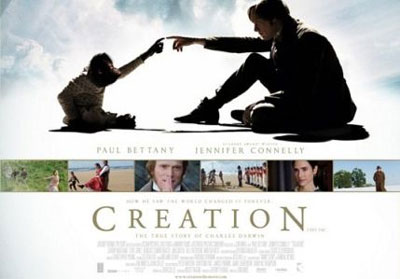
Creation (Hanway Films and BBC Films1) is John Collee’s screen adaptation of the book, Annie’s Box, by Charles Darwin’s great-great-grandson, Randal Keynes.2 Its title is deliberately equivocal, and does not refer to the biblical account of creation, but to the creation of Darwin’s book, the Origin of Species.3 It is a skilful, imaginative and powerful production, with outstanding performances by Paul Bettany as Darwin and Jenny Connelly as his wife, Emma.
Annie’s box was a writing case into which had been placed some personal items of Darwin’s beloved daughter, Annie, after her tragic death, aged only 10 years. Not surprisingly, given its title, the book dwells particularly on the close relationship between Darwin and Annie, and the effect that her death had upon him and his growing secular view of the world. It pictures Darwin as a man of great virtue and honesty, and strongly committed to his family. As one reviewer commented, “The Darwin of these pages is an almost saintly figure: patient, reasonable, freethinking, only angered by cruelty.”4 The film also portrays Darwin as a dedicated father and family man, wise and considerate towards his servants, and whose life was greatly affected by the loss of his daughter. Moreover, he is depicted as someone torn between his commitment to his deeply religious wife, Emma, and his scientific theory of evolution, which he felt contradicted so much of what she treasured and believed in.
It is probably not unreasonable to portray Darwin as a very human, sensitive and caring man. As a youth, his endearing qualities caused him to gain favour with leading men of his day, such as Adam Sedgwick and John Henslow, both of whom were his Professors at Cambridge University. In later life, he gave to charitable causes and energetically supported a petition to obtain a government pension for the impoverished Alfred Wallace, who was a serious contender for priority for his own theory. One visitor to his home at Downe described him as “the dearest, sweetest, loveliest old grandpa that ever was”.5 The portrayal of his wife, Emma, as an intelligent, talented and attractive woman is probably also fair.
Unfortunately, the film uses these qualities of Charles and Emma to sanitize a theory about life which is very unsanitary. Darwin’s theory of evolution by natural selection is a story of violence, suffering, death, desperate competition and extinction of the unfit. Such a view of the natural world has caused many to question the goodness of God and, in some cases, to categorically deny His existence. Yet, in the context of Darwin’s idyllic family life, and his wife’s loving support for him in finally agreeing to the publication of his theory, the unacceptable is made acceptable. This view is powerfully presented in the final minutes, when he walks towards his family, with his resurrected daughter, Annie, by his side, following the reading of the final sentences of the Origin of Species: “Thus, from the war of nature, from famine and death, the most exalted object which we are capable of conceiving, namely, the production of the higher animals directly follows. There is grandeur in this view of life … from so simple a beginning endless forms most beautiful and most wonderful have been and are being evolved.” Randal Keynes writes, “There is a widely held belief that the Darwinian view is one of struggle, suffering and heartless selfishness, but the point of the book and the film is that they show Darwin and Emma as real people—like you and me.”6 Darwin and his theory certainly get the sympathy vote.
According to the film’s official website7 Creation tells “[t]he true story of Charles Darwin”, a great scientist “caught in a battle between faith and reason and truth and love”. While it may well be true that he was a devoted husband and father, his life was not characterised by conflicts between either faith and reason, or truth and love. Firstly, from his autobiography and notebooks, a strong case can be made that his evolutionary beliefs grew out from his rejection of Christianity and his embracing of deism,8 rather than from scientific inference (see Darwin, Lyell and Origin of Species). Secondly, the idea that he procrastinated over the publishing of his theory out of concern for the offence this might cause his wife (or society in general) is questionable: as early as 1844 (fifteen years before the publication of his Origin of Species) he had documented his theory in an essay and left instructions that, in the event of his death, this should be published posthumously—with no delay sought.9 (Those potentially offended would presumably have no reason to be less affected because of his death—Darwin himself would have avoided the fallout from any such offence, of course.)
The film has a number of inaccuracies, most of which are insignificant. Some, however, are important. It contains no hint that Darwin had largely abandoned the idea of biblical creation early in his life, and long before he could have amassed evidence for evolution. Rather, in the scene where Thomas Huxley pressures him to publish quickly, he is seen to be cautious, arguing that more time is needed to be sure of the facts. Similarly misleading is the implication that it was overwhelming scientific evidence that caused him, slowly and methodically, to reject a belief in creation. In fact, he had discarded the Bible as a reliable document and embraced evolutionary ideas within two years of his return from the Beagle voyage.10,11 The scene where Darwin’s friend, Hooker, attempts to rouse him from his sick bed, in order to join his fellow scientists in the “battle for truth”, peddles the popular myth that the creation/evolution debate is about science versus faith, rather than one faith against another. Indeed, at times Darwin is portrayed as a martyr to truth, suffering much ill health due to his concerns about the social implications of his theory. At one point, almost in despair, he laments, “I dare not study for the fear of seeing what is already as plain as day.”
After the death of Annie, we see Charles seeking to rationalise the loss and turning to science, whereas Emma retreats into the “irrationality” of her religion. Finally, however, we see her reading the manuscript of the Origin of Species, and actively supporting its publication. The implication, surely, is that all reasonable people will eventually make their peace with evolution.
I would recommend that Christians watch the film so that they can discuss its message with friends in an informed way. Some parents may feel that it is unsuitable for young children, as it deals with intense adult emotions and includes a short section where Thomas Huxley blasphemes horribly. Those interested in Darwin’s life and legacy will appreciate the CMI production, Darwin: The Voyage that Shook the World, now available on DVD.
Re-featured on homepage: 27 January 2010
References
- The film appears to have been financed by “Pathé Productions, Film Finance Corporation Australia, BBC Films and the UK Film Council … in association with the New South Wales Film and Television Office and Hopscotch International”; www.bbc.co.uk/bbcfilms/2009releases/creation.shtml. So it seems that taxpayers’ money largely funded this production. Return to text.
- Keynes, Randal, Annie’s Box: Charles Darwin, his daughter and human evolution, Fourth Estate, 2001. Now republished by under the title, Creation: The true story of Charles Darwin, John Murray, London, 2009. Return to text.
- Amiel, Jon, cited in, “Creation” tells of Charles Darwin’s war between science and love, Los Angeles Times; www.latimes.com/entertainment/news/la-ca-creation6-2009sep06,0,1320146.story. Return to text.
- Turney, Jon, Darwin’s lost daughter, The Guardian, 8 June 2002; www.guardian.co.uk/books/2002/jun/08/featuresreviews.guardianreview42. Return to text.
- Desmond, Adrian and Moore, James, Darwin, p. 604. Penguin, London, 1991. Return to text.
- Cited by Katbamna, Mira, Creation From Book to Screen, Daily Telegraph, 12 September 2009. Return to text.
- <http://creationthemovie.com>. Return to text.
- A theist believes in a creator who intervenes in the universe, whereas a deist believes in a creator who does not. Return to text.
- Ref. 5, pp. 316–317. Return to text.
- Barlow, Nora (ed.), The autobiography of Charles Darwin, pp. 85–86, Collins, St James’s Place, London, 1958. Return to text.
- Ref. 10, p. 124. Return to text.

Readers’ comments
Comments are automatically closed 14 days after publication.