
Feedback archive › Feedback 2006
Creation science does not meet the standards for secular publications?
This feedback comes from Jeffrey O., a high-school physics teacher and self-described evangelical Christian from Ontario, Canada. He questions some of our astrophysical claims, but his main problem is the old canard of lack of publication in secular journals and the misunderstanding of the role of the paradigm in interpreting data. Dr Jonathan Sarfati responds point-by-point.
‘there is evidence that the dwarf companion of Sirius formed from a red giant in just 1,000 years.
Donald B. DeYoung doesn’t provide evidence that Sirius B was a red giant. Certainly this would be recorded in history. What is the source of this evidence?
When someone—no matter what kinds of degrees, qualifications, prestige, or honors he has—is quoted to support a proposition, it does not imply that the proposition is true. To imply otherwise is a common fallacy called the ‘argument from authority.’ What should matter is not who agrees with one of your points but rather what evidence you can provide that supports it. [Website deleted as per feedback rules].‘
One must wonder about a professing evangelical Christian who uses an essentially atheistic site for his authority. Mr O. has not understood the fallacy of argument from authority (argumentum ad verecundiam), something we leave to the evolutionists—see The fallacy of arguing from authority. And for more, see my article on logic.
In short, we were not saying, ‘believe Dr DeYoung because he is a Ph.D physicist.’ In reality, the article you object to comes from a book, Astronomy and the Bible. The blurb on our store states:
The book’s convenient question-and-answer format makes it practical in the classroom and ideal for homeschooling.
So it was unreasonable to expect a dissertation on all ‘110 questions on astronomy and the universe’ for a book aimed at high school students. One must judge a book by its intended audience.
To answer your question, Dr DeYoung’s evidence was based on historical records, e.g. Ptolemy’s Almagest describes Sirius as red, as well as legendary writers such as Homer. The astronomer Thomas Jefferson Jackson See (1866–1962), of the United States Naval Observatory, collated ‘Historical Researches Indicating a Change in the Color of Sirius Between the Epochs of Ptolemy, 138, and of Al Sûfi, 980, A. D.’, 1927. This seems to indicate that there was a very bright red star very near Sirius’ position. Note that a red main sequence star could not explain these historical observations because they have about 10–5 of Sirius’ luminosity.
It seems that the main reason that evolutionists reject the historical statements is their a priori belief that the transition from red giant to white dwarf must take millions of years. But as your fellow Canadian Dr Emil Silvestru is fond of quoting, ‘In theory, theory and practice agree; in practice, they don’t!’ However, observational evidence has shown that stars can change far more rapidly. The following comes from my book Refuting Compromise, pp. 166–7:
Rapid ‘stellar evolution’
Creationists don’t necessarily disagree with ‘stellar’ evolution, because, unlike biological evolution, it does not involve the claim that naturalistic processes generate new information. But we would not agree with most of the theories of stellar origins, or the timescales. In fact, there is much observational evidence that stars can change very quickly:
Sakurai’s Object: this was discovered in the constellation of Sagittarius by the Japanese amateur astronomer Yukio Sakurai, in February 1996.1
In 1994, this star was most likely a white dwarf in the centre of a planetary nebula, with a diameter about the same as Earth’s, though enormously denser. But a team of astronomers, including Bengt Gustafsson at McDonald Observatory in Texas and Martin Asplund, of the Uppsala Observatory in Sweden, have observed it change to a bright yellow giant. This was about 70 million km in diameter, 80 times wider than the sun. This means the diameter has increased by a factor of 8,000, and the volume by a factor of over 500,000 million. The astronomers expressed great surprise at the rapidity at which this change had occurred.2
But this wasn’t the end of it. In 1998, it had expanded even further, to a red supergiant with a diameter of 210 million km, 150 times that of the sun. But as fast as it grew, it shrank, releasing much debris. By 2002 the star itself was invisible even to the most powerful optical telescopes, although it is detectable in the infrared, which shines through the dust.1
Sakurai’s Object is an example of what evolutionary astronomers call a ‘born-again’ star. They presume that all white dwarfs are collapsed remnants of stars that have burnt (by nuclear fusion) nearly all their hydrogen and helium fuel. But when first formed, they should have an outer layer of hydrogen unused by fusion, although this is sometimes not observed. So one model proposes that instabilities might reignite fusion of unused helium. These would be so violent that the resulting convection would drag hydrogen into the core. In turn, already-existing metals would be dredged up from the core, and more would be generated from the intense nuclear reactions.1
This seems to broadly explain Sakurai’s Object. Astronomers analyzing the star’s spectrum could see only the surface, and they observed the hydrogen drop by 80%, and heavy elements such as lithium, zinc, strontium and yttrium appear.1
However, the speed was 50 times greater than what the theory predicted in the 1980s, as Asplund says:
‘There were predictions that born-again giants would evolve quickly, but most people thought the timescale would be 10 to 100 years, not a mere few months.3
Don Pollaco, an astronomer at Queen’s University, Belfast, agreed:
‘The timescales are just crazy.’3
This is a good lesson that there is still much to learn about stellar evolution. Astronomers have not observed stars changing over millions of years, but now they have observed them changing over months!
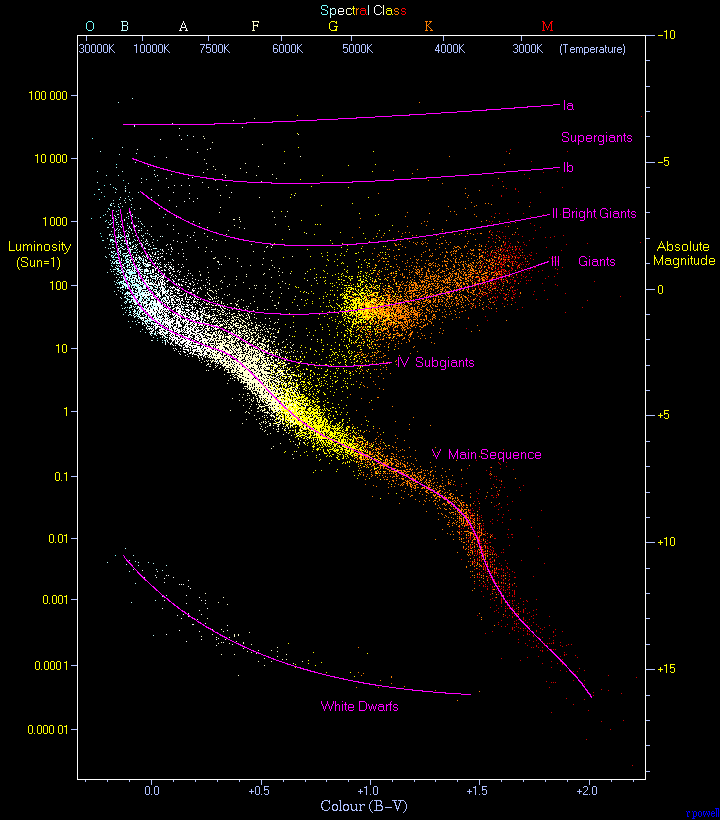
Hertzsprung–Russell Diagram presented by Richard Powell. This is a logarithmic
plot of the luminosity of stars against their colour. However, this plot of real
observational evidence says absolutely nothing about how quickly
stars change from one type into another.
FG Sagittae: this star has changed from being a blue star (with a temperature of 12,000 K) to a yellow star (temperature 5,000 K) in only 36 years of observation.4
Similarly the physics of a white hole to explain the time for light travel has been ‘screwed up’. A white hole is not so simple as [CMI] claims it is.
I don’t know how simple we claim it to be, and it will take more than your bald assertions of being ‘screwed up’ to prove it. Gravitational time dilation has been proven by atomic clocks, and secular relativity experts agree that near a black hole, time is very much slowed.
It is also accepted that the equations of general relativity are time-symmetric, i.e. that for every solution there is a mathematically valid ‘mirror’ solution where the time flows backward rather than forward. So if a black hole is a valid solution, and this is not disputed by relativity theorists, then so is a white hole. That is, whereas a black hole sucks in matter and the event horizon expands (the Schwartzschild Radius is proportional to the mass), a white hole expels matter and its event horizon shrinks.
The only difference is that there is a known naturalistic explanation for the formation of black holes—the collapse of massive stellar remnants (above the Tolman–Oppenheimer–Volkoff limit of about 3–5 solar masses); but none for white holes. But if a white hole were created, then it would behave as we suggest. Try refuting Starlight Wars instead of making unsupported assertions.
Why does John Woodmorappe … claim to be a scientist (eg. no relevant Ph.D and not on staff) see: [Website deleted as per feedback rules]
He has a relevant Masters degree (geology) and two relevant bachelor’s degrees (biology and geology). He is most likely more qualified than the typical high-school physics teacher.
see: [Website deleted as per feedback rules]
It’s pointless to cite an online encyclopedia that almost anyone can edit.
his major work is on the feasibility of the Ark, more of a biological exploit than geology.
He has a degree in biology. Furthermore, he thoroughly documents his arguments with primary sources, showing for example that applied low-tech farming techniques made it possible for Noah to have taken care of the animals. I thoroughly recommend it. Have you actually read it?
There are many articles by scientists on your web site, but what percentage of these articles have withstood peer-review?
Most of them! Journal of Creation is formally peer-reviewed, and even the Creation magazine articles are reviewed by several Ph.D. scientists.
Most come from books, which could just as easily contain fiction.
Actually, most cite primary sources. So it is up to you to demonstrate that they contain fiction instead of simply poisoning the well.
TJ [now Journal of Creation] is not an open forum journal.
What journal is an open forum journal? Secular journals censor challenges to naturalism, so they are not open. See Do Creationists Publish in Notable Refereed Journals? (as you should have done according to our feedback rules about checking our site content first). Creationists can publish only if they hide their creationist conclusions. This is reasonable, since the main difference between creationists and evolutionists is not the data but its interpretation—see Evolution & creation, science & religion, facts & bias and Presuppositionalism vs evidentialism. We have also shown that many papers by evolutionists have outstanding presentation of data but a completely vacuous evolutionary ‘explanation’, e.g. chameleons, powerful-toothed Giant Rat-kangaroo and double-sieve enzymes. We have also documented that biologists make no use of evolution in their practical research.
If we as Christians do not follow these ‘rules of Science’ in publishing our work, then we are worse than the speculative evolutionists, that is how pre-Christians would view it.
What rules of science are they? You mean the presuppositions required for science to work, that are deducible from Scripture but not from atheism? The rules that enabled most branches of modern science to be founded by creationists? Or is it more like The rules of the game: As the ‘rules’ of science are now defined, creation is forbidden as a conclusion—even if true.
If God did creation the way you say, then it should stand up to the scrutiny of examination.
It does. But if people are determined to accept only materialistic explanations regardless of how absurd, and reject a designer a priori, then the problem is not inability to stand up to scrutiny but the unwillingness to scrutinize it.
Let’s get publishing without error.
Maybe you could demonstrate any error-free publishing as an example?
[Website deleted according to feedback rules]
For someone claiming to be an evangelical Christian, it is strange that Mr O. again cites an overtly atheistic website. Similarly strange that he should lecture us on science, yet cite a site by a non-scientist.
I am an evangelical Christian and a general science, physics teacher and dept. head at Listowel District Sec. School.
However, one has to wonder whether what Mr O. means by ‘evangelical Christian’ is the commonly accepted meaning. That is, one who accepts the Bible as inerrant and authoritative. As a corollary, the famous 20th century preacher Dr D. Martyn Lloyd-Jones said that an evangelical must accept ‘Creation, not evolution’, ‘the fact of the historical fall of the first man, and that it happened in the way described in the third chapter of Genesis,’ and ‘ assert the fact of the flood.’
My concern is that creation science is not meeting the standards and this is why they aren’t published.
Then prove it! Obsession with lack of publication in secular journals is mainly a device for avoiding dealing with the strong creationist arguments that should stand or fall on their own merits.
Sure there is some discrimination involved too,
Aye, there’s the rub. What is the point in even trying to submit to the establishment journals when they have explicitly stated that they will not publish creationist, or even Intelligent Design, papers. We have already explained the hypocrisy of this.
but let’s get the ‘science’ up to par so there is no excuse for them (the secular journals).
There is an excuse—the stipulative definition of science as naturalism! But I agree that we need to do good science—and peer-reviewed journals like Journal of Creation encourage this.
Jeffrey O.
Jonathan Sarfati, Ph.D.
CMI–Australia
References
- Muir, H., Back from the dead, New Scientist177(2384):28–31, 1 March 2003. Return to text
- New Scientist154(2085):17, 7 June 1997; referring to Astronomy & Astrophysics321:L17, 1997. Return to text
- Cited in Muir, Ref. 60, p. 31. Return to text
- New Scientist, pp. 28–41, 14 September 1991. Return to text
Readers’ comments
Comments are automatically closed 14 days after publication.