
C.S. Lewis and the Great Myth
They love the Myth so take care how you expose it
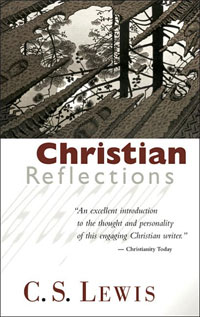
Last vacation, I was dipping into the writings of C.S. Lewis in a volume called Christian Reflections. (It’s also published under the title of Fern Seed and Elephants and for those in ministry the essay in the collection by that title is a ‘must-read’.)
He has an essay called The funeral of a Great Myth. While researching another topic I detoured to see what the myth was. To my surprise it was on evolution. Here’s a summary of the key points he makes:
(1) The idea emerged before the scientific research had been done! … in English literature as the brain child of Keats the poet, in his Hyperion (II. 206–15). Lewis adds that ‘in making [the myth] imagination runs ahead of science.’1
(2) ‘In the sciences, Evolution is a theory about changes: In the Myth it is a fact about improvements … In the popular mind the word “Evolution” conjures up a picture of things moving “onward and upward”, and of nothing else whatsoever … If science offers any instances to satisfy that demand, they are eagerly accepted. If it offers any instances that frustrate it they will simply be ignored.”2
(3) After a significant look at the issue of whether we should trust our reason (when the Myth affirms that the mind is the product of an irrational process), Lewis quotes two processes that are sometimes taken as ‘proofs’ of evolution: the acorn and the steam engine. He notes that these aren’t instances of the Myth. Neither the growth of a tree from a seed nor the development of better machinery is random chance in action.3
However since we are dealing with a product of the imagination—not a deduction from the data using accepted methods—the mind is all too easily convinced. This is the more so, since we like to think that we are better than our parents and a theory that seems to reinforce this has ego appeal.4
(4) I was surprised by the next reason he gives namely that the advertisers welcome the Myth because it reinforces the lie that the new model must always be superseding the old.5 My ‘68 Holden still has its original door handles and hub caps—my ‘81 Ford needed replacements of both more than once! Perhaps my bias is showing here, and yet, is this not the point? We humans believe what we want to believe and the issue of evidence is (to our fallen minds) secondary!
(5) Lewis has an even more powerful reason why the politicians want to keep the Myth alive. They want us to believe that their package is better than any previous one.6
From a truth-based perspective, I would want to add that it is naïve to expect rebellious sinners to give preference to a world view that says they must one day give account to a holy God for their actions and sins. Until the Holy Spirit has done His gracious work of conviction, I would think an explanation of the world’s origin that makes God merely an optional extra would have considerable appeal.
(6) His final point however is perhaps the most important of all, if we take seriously our obligation to share our Christian faith meaningfully. And make no mistake about it, the Myth is a very real issue behind the scenes in evangelism today. Lewis observes that ‘It appeals to the same innocent and permanent needs in us which welcome Jack the Giant killer. It gives us almost everything that the imagination craves—irony, heroism, vastness, unity in multiplicity and a tragic close. It appeals to every part of me except my reason. That is why those of us who feel that the Myth is already dead for us must not make the mistake of trying to debunk it in the wrong way. We must not fancy that we are securing the modern world from something grim and dry, something that starves the soul. The contrary is the truth. It is our painful duty to waken the world from an enchantment … .’7
‘That is why we must treat the myth with respect. It was all (on a certain level) nonsense but a man would be a dull dog if he could not feel the thrill and charm of it.’8
So what does this have to do with our interaction with a world that is being bombarded with the Myth in a 1000 ways, at school, in national parks, in news-telecasts etc. etc.
Remember his advice: ‘treat the Myth with respect’.9
I try to ask a question like ‘Did you know that the Mt St Helens volcano resulted in a mud flow that carved a complete canyon system in just one day?’ Then I might add, ‘That made me start wondering whether the Grand Canyon really needed millions of years.’ I may refer to the excellent CMI DVDs on the subject. My aim is to get my hearers to think, so that they will not take all the media ‘hoo-haa’ at face value.
I have a special love for, and interest in, history and, if the conversation allows, I might comment, ‘I wonder whether the legends of the bunyip in Australia and a monster in Loch Ness or the dragons of Chinese fame weren’t evidence that dinosaurs were on the earth at the same time as our first parents and much more recently. There are certainly some amazing similarities!’
(You’ve probably got your favourite area(s) you can develop but I hope this gives you the idea.)
In today’s world, Lewis’ counsel is indeed apt: ‘Be gentle. They love the Myth!’ Take their blindfold off carefully as there will be a measure of pain in the process as they adjust from the darkness to the light. The apostle Peter said it so well, ‘If you are asked about our Christian hope always be ready to explain it, but you must do this in a gentle and respectful way’ (1 Peter 3:15–16).
References
- Page 113. Return to text.
- Page 114. Return to text.
- Pages 118–119. Return to text.
- Page 121. Return to text.
- Page 122. Return to text.
- Ibid. Return to text.
- Page 123. Return to text.
- Ibid. Return to text.
- Ibid. Return to text.
Readers’ comments
Comments are automatically closed 14 days after publication.