
Spot the Spin:
A review of Darwin’s Brave New World, Episode 1

Darwin’s Brave New World is the title of a three-part TV series on the life of Charles Darwin, shown in Australia on ABC1 in November 2009. The credits show it to be a joint Canadian CBC television and Australian ABC Television venture, partly funded by the Australian Government.
Episode 1 is titled “Origins”. It is mostly factual when it shows the places around the world, the people, and the animals Darwin saw on his ocean voyage in HMS Beagle (1831–36) which influenced his thinking about change in species. The comments by various professors on these incidents are sometimes factual and sometimes spin. For example, the emphasis in this episode is on “struggle” and “change” including extinction. The program uses these words often, but they do not of themselves equate to “evolution”.
The Maori and the Aborigines
In New Zealand, in 1835, after his visit to the Galápagos Islands,1 Darwin sees warlike Maori performing their haka (war dance) and Prof. Iain McCalman tells us, “The missionaries have been struggling hard to domesticate the Maori. And the white settlers themselves are extremely violent, so he’s seeing not a stable society but a kind of vortex of struggle.”
Then in Sydney Cove, Darwin sees the social elevation of the former convicts and the dying out of the Aborigines by their being shot by the white farmers and soldiers, and from succumbing to white-man’s diseases. Prof. McCalman then says. “At the very heart of Darwin’s theory of natural selection lies the idea of species struggling with each other … it’s not crystallized in his mind as a theory but he’s using it to analyze the fate of the Aboriginal people, and to analyze the triumph as it were of settler society in Australia.”
The Announcer says, “He is astonished that many of Australia’s supposedly unique creatures bear a striking resemblance to those in England.”

True, though not the ones most people think of, e.g. Australia’s kangaroos and koalas. And surely the only resemblance between Australia’s platypus (a mammal that lays eggs, has a bill like a duck’s, a tail like a beaver’s, webbed feet for swimming, claws for digging, and poisonous spurs on its hind legs) and the English water rat, as highlighted in this episode, is that they both live in the water.
The Announcer tells us, “In Darwin’s day, scientific thought is dominated by the belief that God has not only created every single species, but has placed them in just one particular location. If this is the case, then why has God placed animals that look similar or behave in a similar way in two different places?”
Well, that’s an interesting question, but I doubt if those of us who are going to “Heaven” will be asking it of God when we get there. It’s an idea that owes more to the teaching of Aristotle than to the Bible—the Bible doesn’t say this. A more interesting question for Darwin would have been: If species are the result of evolution, why are they the same in different locations? So-called convergent evolution (i.e. the development of similar features independently in different evolutionary lineages) is a common cop-out in evolutionary theory, but the number of instances in which evolutionists are having to resort to it is embarrassingly large.2
Corals and islands
In the Cocos Keeling Islands Darwin sees corals, and we are told, “Corals are struggling against other organisms, they struggle towards the light, they struggle to survive at a particular depth. In many ways corals exemplify the sorts of struggle in nature that Darwin documented so handsomely in his volume, Origin of Species.” Then we are given this gem, “The land and the sea are here struggling for mastery. The ocean all powerful is resisted and even conquered [presumably by a rock covered in limpets pictured]. Is this metaphor a way of suggesting, without your realizing it, that “struggle” means “evolution”?
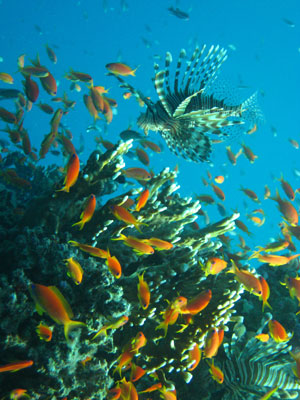
Then Prof. McCalman tells us that, here in the Pacific, drifts of sand build up and an island is formed; then seeds and birds arrive, and “a new creation has come into being in entirely natural ways. We see a perfect example of the theory of natural selection.”
Did you spot the spin? An island, formed by whatever means, equates to evolution. Well, why didn’t he use the spectacular example of Surtsey Island, off the coast of Iceland, which formed by volcanic eruption in 1963, and by 2008 had 69 species of plants growing in the soil there? Probably because Surtsey became an ecosystem too quickly for the long ages of evolution.3
Armadillos and finches
Back in England, Darwin is shown with his armadillo fossils from South America. Prof. Michael Archer says, “Clearly they were ancient fossil armadillos, and they looked broadly like living armadillos. This wasn’t a different creation he saw in the fossil record; it seemed to be a vertical relationship between the past and the present. It was not something that the biblical model predicted at all.”
The Bible puts forward a short age for the earth of about 6,000 years. So according to the biblical model the fossil and the living specimens should be virtually identical. Which they were. So Darwin’s armadillo fossils were not evidence for evolution, but evidence for the truth of Genesis!
We then see Darwin showing his Galápagos finch specimens with their different beaks to ornithologist John Gould, who pronounces them to be 13 different species from different islands. Prof. Richard Dawkins tells us, “Because there are islands within reach, it is a recipe for the division of species. Every now and again one or two finches get blown across. Because that happens rather seldom, there is time for it to evolve in a different way on the new island, and they evolve in a different way for sufficiently long that if they may be united again with the old island they can’t interbreed. Now we’ve got two species.” And the Announcer chips in with, “Finches change by natural means; not by the miracle of God.”4
Then Prof. Dawkins lets fly with this gem, “The idea that something could change into a different species was entirely foreign to the way people thought. Not only can rabbits change into something a bit different from rabbits, but given enough time, bacteria could change into humans, and that’s what happened over 31/2 billion years.”
Whoa, Richard Dawkins! What did those finches evolve into—eagles, sparrows, or something else? How does the fact that Darwin’s finches had beaks appropriate to the food supply on different islands (where they remained finches) show that bacteria have evolved into humans? Or for that matter, that rabbits have evolved into non-rabbits?
Prof. Jerry Coyne then tells us, “There was no view before Darwin that species actually descended from other species or that they split. The purpose of splitting is extremely important in evolution because it generates the biodiversity of different species that we see around us. We have now probably 50 to 60 million species on Earth, and that all reflects the process of splitting.”
So the information in the original species in Prof. Coynes’ example has now been split 50–60 million times—right? But bacteria-to-man evolution requires immense amounts of new information, not a smaller and smaller and smaller … division of the old information.
Darwin’s illness
The program moves on to discuss Darwin’s “strange illnesses”. Prof. Janet Browne suggests that much of this could be due to some kind of psychological tension. She says, “Darwin knew these were dangerous ideas and he writes about what the impact might be if the views that he is thinking become generally accepted. At one particular point he says, ‘The whole fabric will totter and fall.’”
Then a little later in the program when Darwin’s illness is depicted again, Prof. Browne says, “I think there’s a combination of real physical disorder of some degree and a psychological stress, in the way that we now know stress often takes physical form in people. … I think the causes of it were in part mental tension.”
We agree.5 Darwin’s real aim was to explain the design he saw in nature, without the need for a divine Designer. To Darwin, evolution by natural selection was something that was utterly plan-less and purposeless. He knew that this was an idea which could and would destroy the faith of millions of believers, as he had lost his.6—And he was the one who was about to unleash it on an unsuspecting world. Furthermore, Darwin knew his views were atheistic, and so therefore opposed to Christian morality. Although he could not have foreseen the awful consequences of his theory of survival of the fittest by the elimination of the weakest, in the Holocaust,7,8 nevertheless he rightly had some premonition.
The Announcer tells us that “to Darwin it is increasingly obvious that humans, as part of nature, are evolved from an ape ancestor”. And Dawkins pitches in with, “People have been brought up to think that there is something unique, almost angelic, about humans. They feel insulted by the idea that we are animals.” To which we reply, “Of course. Humans are made in the image of God (Genesis 1:26–27), not in the image of an ape.”
Prof. McCalman says, “This is an absolutely dangerous and heretical idea, particularly because it is un-provable at this point. Had he put it up at this point it would have been seen as ludicrous and slammed into the ground.” Quite so.
Darwin’s reading of Malthus gets a brief mention, with the latter’s theory that population tends to outstrip food production, resulting in conflict and struggle and competition.
Darwin and Emma
The scene shifts to Darwin’s devoutly religious fiancée, Emma. He tells her, “There is a widening gap between established theology and my changing view of the world. Genesis and geology cannot go hand in hand. … As to a God that has intervened in creation over millennia or that has intervened in our lives with miracles and suchlike, in that my dear Emma, you may find me wanting.” Emma replies, “I am of the belief that honest and conscientious doubts cannot be a sin.”
Just to set the record straight, Emma was a Unitarian; this is belief in the single personality of God, in contrast to the doctrine of the Trinity (three persons of Father, Son, and Holy Spirit in one God). Unitarians believe in the moral authority of Jesus but not His divinity. As to what is sin and what is not, sin can be defined as “anything in mankind that does not express, or which is contrary to, the holy character of the Creator”, or put more simply, “sin is moral evil”. As to who are sinners and who are not, God tells in His Word, “All have sinned and come short of the glory of God” (Romans 3:23).
The Announcer tells us that Darwin is now famous after the publication in 1839 of his Beagle Journey.9 However, he needs to know more about plants and how they evolve. Help comes from botanist Joseph Hooker. We are told that Hooker’s knowledge of botany will provide Darwin with a crucial missing link in his theory. Just what this is and how it will prove his theory, we are not told in this episode.
Summary
This episode of the TV program has sought to show that struggle is ubiquitous, even to such nonsense as, “the land and the sea are struggling for mastery”. The aim seems to be to seduce viewers into thinking that this means that evolution too is ubiquitous. Thinking viewers will see the casuistry of this method of arguing.
Re-featured on homepage: 3 November 2010
References
- Wieland, C., Darwin’s Eden. Return to text.
- See Are look-alikes related? Return to text.
- Catchpoole, D., Surtsey still surprises. Return to text.
- For an in-depth discussion on these finches see Wieland, C., Darwin’s finches. Return to text.
- Grigg, R., Darwin’s mystery illness. Return to text.
- Brentnall, J., and Grigg, R., Darwin’s slippery slide into unbelief. Return to text.
- Bergman, J., Darwinism and the Nazi race Holocaust. Return to text.
- Grigg, R., Spin from the BBC about Darwin. Return to text.
- For our article on Darwin’s visit to Tierra del Fuego see Darwin and the Fuegians. Return to text.


Readers’ comments
Comments are automatically closed 14 days after publication.