
Natural selection and change, yes; Evolution, no
A Review of Darwin’s Brave New World, Episode Three1
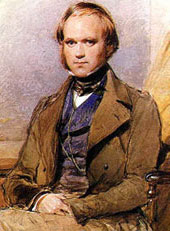
Episode Three of the TV series Darwin’s Brave New World, shown in Australia on ABC1 in November 2009, is titled “Publish and Be Damned”. In this episode, the speakers bang a drum with “natural selection” on one side and “change” on the other. They make a lot of noise, but none of it equates to evolution.
Alfred Russel Wallace trumps Darwin
The film opens with a few snippets from the previous episodes, including Prof. Richard Dawkins’ gratuitous comment that “Darwin’s theory of evolution by natural selection explains everything about life; its complexity, its beauty, its diversity.” Then we see Darwin completely frustrated because another naturalist, Alfred Russel Wallace, living in the jungles of Malaya, has just come up with a theory similar to his own—conceived during a bout of malarial fever, and in the space of a couple of hours.2
Prof. James Moore tells us that before this, Wallace had “converted to evolution without having a theory; it was just kind of one of the things you converted to if you were a radical young man. You did phrenology, you did mesmerism, you did evolution, you did all the heresies!”
Prof. Iain McCalman summarizes Darwin’s problem, “Darwin is in the biggest moral dilemma of his life. He oscillates between wanting to do the honourable thing and give Wallace his due, but also of having some kind of solution to this problem.”
Lyell, Hooker and Huxley trump Wallace
Darwin’s solution is to call for help from his friends, Lyell and Hooker, and the latter enlists Huxley. Lyell, who was a lawyer by profession,3 voices the crucial point, “Wallace has published”, to which Hooker replies, “And Darwin has not.” End of story? By no means. The three friends now conspire to give Darwin the credit, as Prof. McCalman explains,
“The dilemma is that on the one hand they are ethical people. They don’t know Wallace, but they know he has done the right thing. On the other hand, he’s a nobody; he’s completely obscure. Their best friend, Darwin, has been working on this for 20 years, he’s already a famous scientist, he has amassed a lot of information. So they justify to themselves that ‘in the interests of science’ they must publish Darwin alongside Wallace.”
They persuade Darwin to write a short paper, and then arrange for a public reading of this, together with the paper Wallace had sent to Darwin, at the Linnean Society in London on 1 July 1858. They euphemistically call this “a joint paper”, although Wallace knows nothing about it. As a result of this subterfuge, Darwin gets priority from “alphabetical order by author”. Darwin wasn’t there. On that same day, the Darwins bury their two-year-old son, the third child they have lost.
Writing the Origin
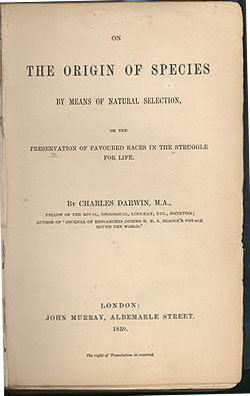
Darwin now sets to work to write what will become his Origin of Species book. The narrator tells us that “at the heart of his book is the idea that since the earth came into existence life has been in a state of constant change”. Note that last word; it is about to be equated with evolution, as if mere change justifies the belief that every living thing has descended from the same ancestor.
Prof. Jared Diamond tells us, “The view of species prior to Darwin was that species were fixed; they did not change; and they were one-by-one created by God.” Then Prof. Dawkins pontificates, “People believed that rabbits were rabbits and they never changed into anything else; shrews were shrews … and so on. Not only can rabbits change into something a bit different from rabbits but given enough time bacteria can change into humans, and that’s what happened over 31/2 billion years.”
The narrator tells us that at the beginning of his book Darwin uses pigeons as examples of change—the original rock pigeon has been modified by breeders to produce the varieties pictured. Then we are told that in the wild some individuals of animals survive while others perish. Then, “In this struggle for survival, Darwin sees how evolution occurs. He calls it ‘natural selection’. This is what produces new species.” And Prof. Dawkins chips in with, “The whole idea of natural selection is about how individuals within a species out-compete rival individuals in the same species to reproduce. That is what drives evolution in the Darwinian model.”
However, no one has ever turned a pigeon into a non-pigeon by interbreeding pigeons, because like always produces like.4 Darwin’s pigeon examples actually highlight the fact that variation has limits. Natural selection, as we have often stated, (see Natural selection Q&A) is an easily understandable fact, but it does not of itself create new things. It operates by culling genetic information. For microbes to turn into microbiologists, new genetic information is needed. Natural selection does not supply this,5 and the modern evolutionary answer (mutations, of which Darwin knew nothing) does not work either (see Mutations Q&A).
The narrator declares that “over vast stretches of time traits [such as sharper claws, faster legs, better camouflage, different beak shapes] add up until the descendants are very different from their ancestors. They have evolved by means of natural selection into a new species.”

Did you spot the sleight of hand? First, long ages are assumed;6 then “change” is all that is needed to form “very different” kinds of living things—with no indication of what could provide the needed new information to specify how an organism is to make the new features (like reptiles growing feathers).
Prof. Dawkins finally gives us one example of natural selection. He tells us, “The beauty and elegance of a cheetah chasing a gazelle has been bought at the cost of generations of suffering gazelles, and generations of cheetah ancestors starving to death if they didn’t manage to make enough kills.”
In a fallen world, the cheetah’s blinding speed may have been fine-tuned by such a process, as it descended (with the aid of natural selection) from an original “cat kind” on the Ark, (along with lions, tigers, etc.). But all of this would have mostly been within the limits of the (created) information already present in that ancestral kind’s pool of DNA. Breeders’ experience confirms that selection for one trait is often at the expense of other traits. Cheetahs may be able to run incredibly quickly, but they also tire very rapidly.
The narrator claims that according to Darwin “all species on Earth are modified versions of what has gone before, endlessly reshaped over time by natural selection, and the evidence is there every time you look at it”.
So what is this evidence? According to Prof. Dawkins, “What Darwin noticed is that if you compare say the hand of a man, the flipper of a whale, they all have the same structure. All these creatures have their limbs, their hearts, their kidneys, their skulls, their backbones, modified from a common ancestor.”
A better explanation is that all these features show design, and design points to an Intelligent Designer, God.7 The reason why creatures have similar limbs and such things as hearts, kidneys, skulls, etc. is that these features function well, and so the Creator used His design many times. There are many instances in which such “homologies”, as they are called, could not have arisen from common ancestry.8,9 For example, frogs and humans each have five digits. Evolutionists believe that this is because they each descended from a common ancestor with five digits, but common ancestry implies common genetic and developmental pathways. Yet human and frog digits develop in the embryo in radically different ways.10 Ironically, the several-times-repeated clip in the film series of Darwin daydreaming about his own hand morphing into a webbed hand, as if human and frog limbs shared similar processes of formation, is plainly scientifically wrong; propaganda, not science.
Prof. Jerry Coyne than tells us that his ability to wiggle his ears comes from muscles that were in our ancestors like cats, dogs, and horses, or species descended from them, and presumably the kangaroo shown doing this. But this presumes that these muscles have no function in humans today—news to those who can move them to help clear water from the ear’s external canal, and more.
The narrator makes the statement that in Origin Darwin says how “the ever-changing surface of the earth, land isolated by water, and high mountains all influence how plants and animals evolve through the struggle to survive in these environments”. This time, struggle for survival within (and against) the environment has been equated with evolution. Only one example is given—that of corals, which Darwin observed at the Cocos Keeling Islands on the Beagle voyage, where he noted that some corals were dead and some were living. But just how this equates to evolution we are not told.
And then, “As the book comes to a close, Darwin shows there is no need to invoke God to explain why plants and animals appear in various different parts of the world. They arrived courtesy of wind, ocean currents, even with the help of human beings.” Yes, that’s how they dispersed over the earth after Noah’s Flood.
Are humans merely animals?
The Origin is now ready for publication. Prof. Michael Ruse tells us,
“Darwin deliberately didn’t talk about humans in the Origin, until right at the end, where he said, ‘Light will be thrown on man and his history.’ Darwin made it very clear in the Origin that humans are part of the picture, but at the same time, tactically, if you like, he wanted to get the theory out on the table first.”
Interestingly, the film tells us that Lyell, who supported the Origin as it dealt with nature generally, stopped short of including humans in Darwin’s evolutionary scheme. “He cannot bring himself to admit that man is not of divine origin.11 And this was always a distressing thing for Darwin.”
Prof. McCalman says, “Victorian people started to debate whether man was a beast or a divinely endowed creature. Is man an animal with animal lusts, with no morality—that was the central debate that Darwin didn’t want, and it became the focus of his Origin of Species.” And Prof. Ruse says, “The reason why evolution does play into crises of faith, into religious issues, is because evolution is about human beings, where humans came from, where humans are now, and where humans are going to go. So evolution plays into the crisis of faith because it’s offering an alternative picture. … Huxley basically said, ‘Well what can we do with evolution? It can be our kind of background ideology, our Christianity substitute.’ ”
Interestingly, the film notes that, after publication of the Origin on 24 November 1859, most of the newspaper reviews were critical, except for one in The Times—it was ghost-written by Huxley.
The debate between Wilberforce and Huxley
The scene shifts to the confrontation between the Anglican Bishop of Oxford, Samuel Wilberforce, and Huxley, at the annual meeting of the British Association for the Advancement of Science on June 30, 1860. The debate was held in the Oxford Museum library before an audience of over 700 (not just the 50 shown in the film), and was rather like an open forum, where several speakers gave their views.
The film depicts Wilberforce as asking Huxley whether he was related to the ape on his grandfather’s side or his grandmother’s side or both. And Hooker is depicted as jumping to his feet and shouting, “It is patently obvious that the Archbishop has never read the book.”
The kindest thing to say about this acted outburst from Hooker is that it shows a shocking lack of research on the part of the film producers. Wilberforce was not the Archbishop of anywhere; he was the Bishop of Oxford. And as to whether Wilberforce had read the Origin, some five weeks previously he had written a review of it, consisting of about 19,000 words, and this was published on pp. 225–264 of the July 1860 issue of The Quarterly Review. Wilberforce’s speech was a condensed version of this review. His review shows that he did not prejudge the issue, and most of it was an entirely scientific assessment of Darwin’s theory. Here is a sample (from p. 231 of The Quarterly Review).
“But we are too loyal pupils of inductive philosophy to start back from any conclusion by reason of its strangeness. Newton’s patient philosophy taught him to find in the falling apple the law which governs the silent movements of the stars in their courses; and if Mr. Darwin can with the same correctness of reasoning demonstrate to us our fungular descent, we shall dismiss our pride, and avow, with the characteristic humility of philosophy, our unsuspected cousinship with the mushrooms … only we shall ask leave to scrutinise carefully every step of the argument which has such an ending, and demur if at any point of it we are invited to substitute unlimited hypothesis for patient observation, or the spasmodic fluttering flight of fancy for the severe conclusions to which logical accuracy of reasoning has led the way.”

For the benefit of readers who would like to read the rest of Wilberforce’s review, here it is (it’s readily available on the internet): Review of Darwin’s Origin by Samuel Wilberforce.
As to the alleged question about Huxley’s ape ancestry, and the film’s claim that immediately it became a media event, again the facts are considerably different from those depicted. It is highly unlikely that the incident occurred at all. For a full discussion, see our earlier article: “ What did Wilberforce really say to “Darwin’s bulldog”?”
Final scenes
The film reverts to nature and there is a brief mention of how various people have thought evolution occurred—such as “by jumps” (i.e. saltation), or “by a kind of momentum”, or that “God directed the variation”. Note that this latter was a view that was totally and absolutely rejected by Darwin.12

Prof. Coyne assures us, “We have ample evidence for natural selection … it is occurring daily in nature as Darwin said it did” (so far we agree) “and it’s changing organisms in the way that Darwin said it would”. (Not so, and the film has been unable to provide proof of this—it is a faith statement, as shown by what follows). Prof. Diamond tells us, “An example is an island off New Guinea where I worked in the 1970s. This island was a volcano that blew up in the 1600s. It was colonized by two species of honeyeaters, one a little bigger than the other, and over the course of the following 300 years the big one got bigger and the small one got smaller to avoid competing with each other. That’s natural selection within modern times.”
Natural selection, yes. But to infer that this equates to evolution, in the sense in which we are meant to take it (microbes-to-microbiologists), no.13,14
After a decade, evolution has been accepted sufficiently for Darwin to write The Descent of Man (1871), in which he says specifically that man is descended from the apes. The film closes with the following comments, before it announces that Darwin died at the age of 73 and was buried in Westminster Abbey, due to the intervention of the unbeliever, Huxley.15
Prof. Browne (who also features heavily in our CMI documentary Darwin: The Voyage that Shook the World): “He changed the way human beings thought about themselves. We’re just part of nature.”
Dr Suzuki: “The Origin of Species gives me a sense of humility, humility that I am another species like all the others It give us a true understanding of our interrelatedness with other life forms.”
Prof. Ruse: “Darwin changed the world that we live in. … ”
Prof. Dawkins: “ … he provided the explanation for my existence, yours, and the existence of every living creature. You can explain everything about life. Now that’s a powerful idea.” (But Darwinism does not provide any explanation for how life started.)
Summary
- This episode talks much about change and natural selection, but fails to give any evidence that these produce evolution, other than for the various professors who assert that it does.
- Darwin’s theory promoted the idea that man is “a beast with animal lusts and no morality”, and this has been gleefully accepted by much of modern society.
- We might well ask: Why would any sane professor adopt and propagate a theory for which there is such paltry scientific evidence, which is an expression of hatred of God, and which demotes man to the level of a beast? For the answer, we quote the words of another 19th century atheist philosopher, Friedrich Nietzsche, who pronounced God to be “dead”, and gave as his reason, “We deny God; in denying God, we deny accountability.”16
Re-featured on homepage: 17 November 2010
References
- See also A Review of Darwin’s Brave New World, Episode 1; and A Review of Darwin’s Brave New World, Episode 2. Return to text.
- Grigg, R., Alfred Russel Wallace, co-inventor of Darwinism, Creation 27(4):33–35, 2005. Return to text.
- See Statham, D., Darwin, Lyell and the Origin of Species. Return to text.
- Cf. Batten, D., Dogs breeding dogs? That’s not evolution, Creation 18(2):20–23, 1996. Return to text.
- Williams, A., Meta-information An impossible conundrum for evolutionists Return to text.
- See Young age for the Earth and Universe Q&A. Return to text.
- See Grigg, R., A brief history of design, Creation 22(2):50–53, 2000. Return to text.
- See Batten, D., Are look-alikes related? Creation 19(2):39–41, 1997; Bergman, J., Does homology provide evidence of evolutionary naturalism? Journal of Creation (formerly TJ) 15(1):26–31, 2001. Return to text.
- See also, The Creation Answers Book, chapter 7, What about similarities and other such arguments for evolution? Return to text.
- See Sarfati, J., Refuting Evolution 2, chapter 6, Argument: Common Design Points to Common Ancestry. Return to text.
- Cf. Grigg, R., Made in the image of God, Creation 16(4):42–45, 1994. Lyell was no Christian; he was a deist. Return to text.
- See: Wieland, C., Darwin’s real message: have you missed it? Creation 14(4):16–19, 1992. Return to text.
- See Lightner, J., Separating the sheep from the goats, Creation 29(3):43–45, 2007. Return to text.
- See Sarfati, J., Loving God with all your mind: logic and creation, Journal of Creation (formerly CEN Tech. Journal) 12((2):142–151, 1998. Return to text.
- For an account of how the liberal clergy, so despised by Huxley for their readiness to compromise, gave the remains of the agnostic Darwin spiritual recognition, see Grigg, R., Darwin’s Bulldog Thomas H. Huxley, Creation 31(3):39–41, 2009. Return to text.
- Nietzsche, F., Twilight of the Idols, trans. by R.J. Hollingdale, Penguin Books, 1990, p. 65. See also Grigg, R., Nietzsche: the evolutionist who was anti-God and anti-Darwin, Creation 33(1):50–52. Return to text.


Readers’ comments
Comments are automatically closed 14 days after publication.