

Dead whales: telling tales?
How did over 300 whales, porpoises, turtles, seals, fish, and land animals such as ground sloths and penguins end up being catastrophically buried together?
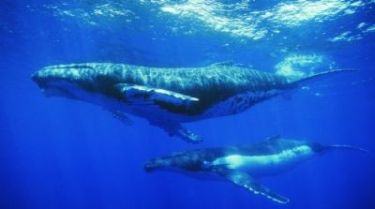
‘We knew it was a great find,’ said paleontologist Leonard Brand about the fossil whales he saw in Peru in 1999, 350 km (200 miles) south of Lima, the capital. Eagerly he organized a team of creationist research scientists. They recently published their findings in the secular journal Geology.1,2,3
Overall, they found 346 whales within a 1.5-km2 (370-acre) area, buried in an 80-m (260-ft) thick layer of sedimentary rock called diatomite. This layer is part of the Pisco Formation, which varies in thickness from 200–1,000 m (650–3,300 ft).
Diatomite is sedimentary rock containing a high percentage of fossil diatoms—small single-celled algae, which commonly live near the ocean surface. The layer of diatomite in Peru has 5 to 10% clay and abundant volcanic ash.
Today, when diatoms die, their silica skeletons accumulate on the ocean floor. One gram (0.035 oz.) of diatomite may contain up to 400 million skeletons.4 Diatomite sediment normally accumulates slowly—only a few centimetres per thousand years.1 Even where the rate is higher, such as in some shallow-water areas, accumulation is still slow. For example, in the fjords of British Columbia, diatoms and clay accumulate at 2.5–5.0 mm (0.1–0.2 inches) per year.2
Also today, when a whale carcass sinks to the bottom of the ocean, many kinds of scavengers quickly attack and colonize it. And in their quest for food, some scavengers churn up the adjacent sediments.5
However, in Peru, the fossilized whales and diatoms were well preserved and the whale skeletons were mostly intact. There was no evidence of normal decay, such as wormholes, barnacle encrustations or general degradation. Neither was there any sign that organisms had churned up the adjacent sediment.
The whale skeletons were partially mineralized, and, remarkably, baleen from five whales was preserved. Baleen forms the comb-like structure in the whale’s mouth that filters its food. This is remarkable because it is softer than bone—the same composition as our human fingernails.
There is no doubt that these well-preserved whales, entombed in diatomite, indicate rapid burial. After eliminating other possibilities, Brand and his coauthors concluded:
‘The most viable explanation for whale preservation seems to be rapid burial, fast enough to cover whales 5–13 m [16–42 ft] long and approximately 50 cm [20 in] thick within a few weeks or months, to account for whales with well-preserved bones and some soft tissues.’1
These burial times are probably a maximum, based on a comparison with modern environments. It could have been even faster than a few weeks.
Remarkably, these rapidly buried fossil whales contradict one of the ruling principles of modern geology, uniformitarianism—i.e. rocks formed slowly in the past similar to what we observe in the present. Interpreted according to that principle, the whales were buried over a period of two million years about 10 million years ago. However, the fact that 80 m of sediment buried 346 whales within months or weeks (or less) creates a problem for those who believe in millions of years. Where do they put the time? There is nowhere for it in the rocks.
The whale graveyard fits much more comfortably with the biblical timescale of thousands of years.
So, instead of uniformitarianism, we adopt the biblical framework. But that raises another question. Did the Genesis Flood bury these whales or was it a local catastrophe after the Flood?
From the report in Geology, we know that there were strong water currents in the region, since there are abundant, small channels that have been scoured out and refilled with sediment in the Pisco Formation. There was also time for sharks to scavenge, since the scientists found shark teeth with the skeletons. In fact, they noticed some whale bones embedded with the tips of shark teeth. The team found other vertebrates in the deposit besides sharks and whales. These included marine animals such as fish, turtles, seals and porpoises, and land animals such as ground sloths and penguins.
Brand and his team favour a post-Flood shallow marine environment. They suggest the whales and marine vertebrates died when a massive bloom (multiplication) of diatoms, thickened by lateral water currents, poisoned the water.6 There is no evidence that the whales beached. Ash from volcanic eruptions could have provided the nutrients for a diatom population explosion. However, the existence of land vertebrates, especially the ground sloths, seems to be a problem here. A similar post-Flood scenario was applied to a whale found in diatomite at Lompoc, California.7
On the other hand, the whales may have been buried late in the Genesis Flood.8 Rapid deposition of 80 m of diatomite filled with skeletons of marine and land animals seems more like a Flood signature. Ground sloths are associated with the post-Flood Ice Age9 but they also lived before the Flood. The diatomite and whales could have accumulated by a comparable flood process as suggested for the chalk in southern England.10 Chalk is similar to diatomite in that it consists of shells of countless microorganisms (but calcium carbonate instead of silica).
To distinguish between the Flood and post-Flood possibilities, we would need more information on the deposit.
Either way, the 346 fossil whales buried in thick, muddy, diatomaceous sediment graphically illustrate the accuracy of biblical history. The remarkable find points to rapid, catastrophic burial, which is consistent with the timeframe of the Bible—a timeframe covering thousands of years.
References and notes
- Whale fossils in the desert, Scope, Loma Linda University, llu.edu, accessed April 2004. Return to text.
- Brand, L.R., Esperante, R., Chadwick, A.V., Porras, O.P. and Alomia, M., Fossil whale preservation implies high diatom accumulation rate in the Miocene-Pliocene Pisco Formation of Peru, Geology 32(2):165–168, 2004. Return to text.
- Esperante, R., Brand, L., Chadwick, A. and Poma, O., Taphonomy of fossil whales in the diatomaceous sediments of the Miocene/Pliocene Pisco Formation, Peru; in: De Renzi, J. et al. (Eds.), Current Topics on Taphonomy and Fossilization, Ajuntament de Valencia, International Conference, Valencia, Spain, pp. 337–343, 2002. Return to text.
- Brasier, M.D., Microfossils, George Allen & Unwin, London, p. 41, 1980. Return to text.
- Walker, T., Whale explodes fossil theory, Creation 24(2):25–27, 2002. Return to text.
- A ‘bloom’ of single-celled plankton often produces a brownish-red sheen on the water, which is called a ‘Harmful Algal Bloom’ (HAB). They occur in such diverse places as Japan, the Caribbean, Scandinavia and the South Pacific. HABs kill fish, whales, dolphins and shellfish, sometimes over hundreds of square kilometres, and cause respiratory problems for humans on shore. Return to text.
- Snelling, A.A., The whale fossil in diatomite, Lompoc, California, J. Creation 9(2):244–258, 1995. Return to text.
- Harrub, B., What can explain hundreds of fossilized whales? apologeticspress.org, accessed April 2004. Return to text.
- Oard, M.J., An Ice Age Caused by the Genesis Flood, Institute for Creation Research, California, USA, 1990. Return to text.
- Snelling, A.A., Can Flood geology explain thick chalk beds? J. Creation 8(1):11–15, 1994. Return to text.

Readers’ comments
Comments are automatically closed 14 days after publication.