

‘Early’ galaxies don’t fit!
Seeing the distant past?
Using infrared photography, a team of astronomers at the European Southern Observatory have taken pictures of what are said to be extremely distant galaxies. Their press release of 11 December 2002 assures us that ‘The resulting images reveal extremely distant galaxies, which appear at infrared wavelengths, but are barely detected in the deepest optical images acquired with the Hubble Space Telescope (HST).’1
These galaxies are so far away from us that, according to normal theories of how light travels in space, it would have taken many billions of years for their light to have reached us. According to God’s revealed Word, the Bible, the whole universe was made only a few thousand years ago.2
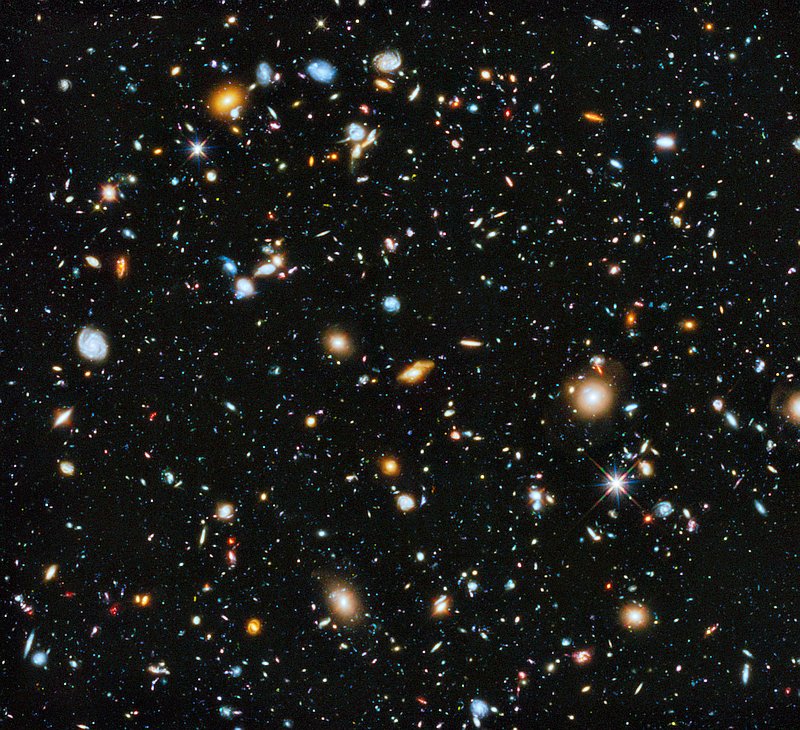
There are different models to explain how the light could have reached us in such a young universe,3 but the bottom line is as follows. If the evolutionary astronomer’s ‘big bang’ hypothesis is correct, then light from the most distant galaxies has taken the longest to reach us. Therefore, galaxies billions of light-years away would also be billions of years closer to the time of the proposed primordial ‘explosion’.4 Thus, since we are seeing these galaxies not as they are now, but as they were when the light left them, ‘big bang’ believers expect us to be observing them as being in much earlier stages of their alleged evolution than ones near to us.
In fact, these recent findings fit well with a Biblical viewpoint, i.e. a young universe. One of the most telling admissions in the recent article was the following:
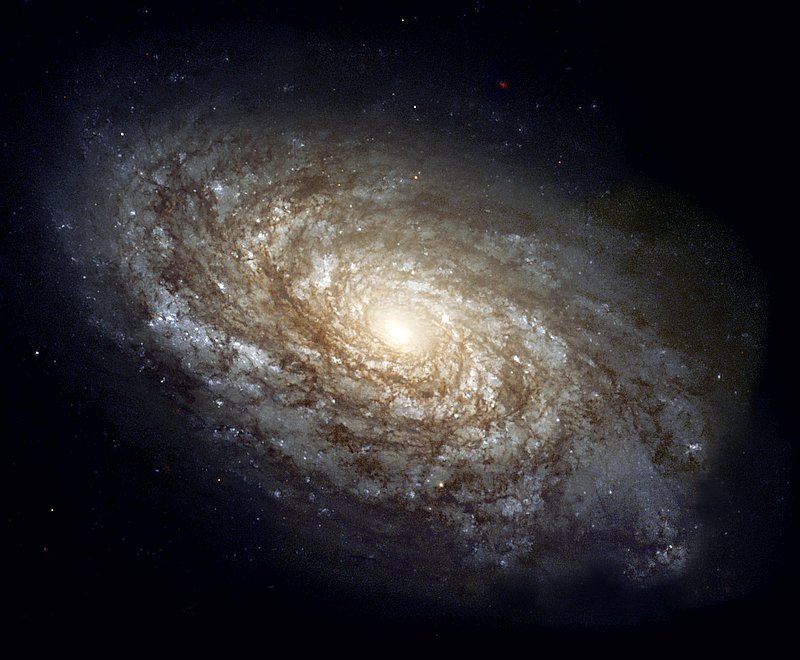
‘… a few of [the galaxies] are clearly rather large and show spiral structure similar to that seen in very nearby galaxies [see photo opposite]. It is not obvious that current theoretical models can easily account for such galaxies having evolved to this stage so early in the life of the Universe … .’ [Ed.: according to the big bang scenario, these galaxies are less than two billion years old, in a universe that is currently said to be 13.7 billion years old.1]
Spiralling problems
Galaxies are rotating, and the outer parts rotate more slowly than the inside. They commonly show a spiral structure, which is supposed to be the result of this rotation, starting from a simple bar structure. But this means that after a few rotations, galaxies will ‘wind themselves up’ so as to destroy the spiral structure.
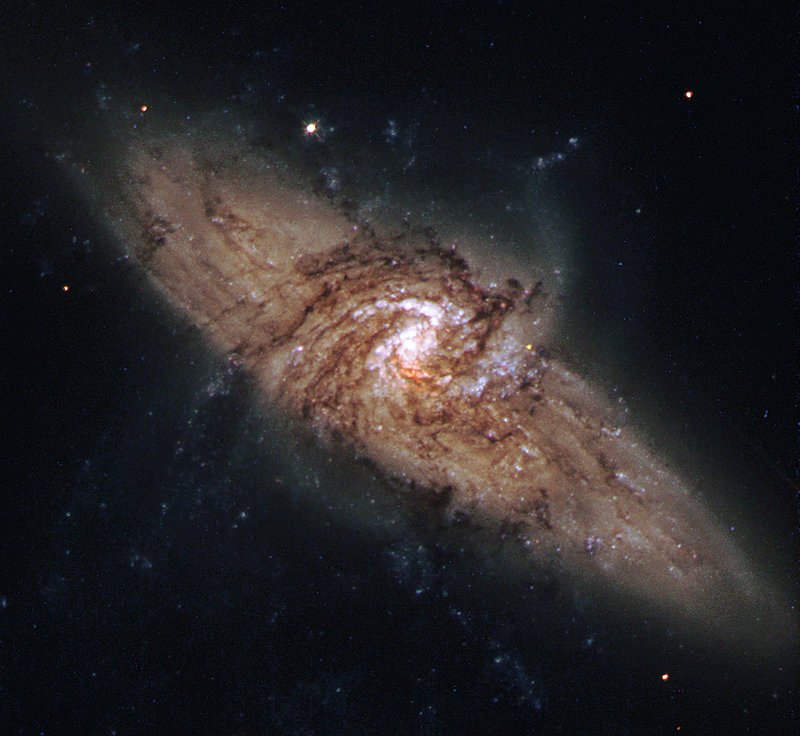
Both nearby galaxies and these faraway ones show the same sort of spiral structure. The evolutionist astronomer is thus ‘caught’ in two ways:
- The nearby galaxies should not be spirals anymore, because in the time that is supposed to have elapsed, they should have wound themselves up long ago, blurring the spiral appearance.5,6
- These recently-observed galaxies are ultra-young (according to ‘big bang’ belief) because they are so far away. So they should not have had time to develop even the beginnings of a spiral.
The article further highlighted the confusion facing long-age astronomers by saying:
‘… in contrast to the galaxies at similar redshifts7 (and hence, at this early epoch) found most commonly in surveys at optical wavelengths, most of the “infrared-selected”? galaxies show relatively little visible star-forming activity. They appear in fact to have already formed most of their stars [italics added] and in quantities sufficient to account for at least half the total luminous mass of the Universe at that time. Given the time to reach this state they must clearly have formed even earlier in the life of the Universe and are thus probably amongst the ‘oldest’ galaxies now known.’1
The results seem consistent with the notion that the Lord, who spoke the stars into existence, made the galaxies much ‘as is’. He may well have had some unwound, some not and some fully, and the variety would ‘declare the glory of God’ (Psalm 19:1). In an instant, He spread out the heavens (Isaiah 48:13) and on Day 4 of Creation Week, just as He says in His Word, ‘He made the stars also’ (Gen. 1:16).
References and notes
- Deepest Infrared view of the universe—VLT images progenitors of today’s large galaxies, ESO Press release 23/02, 11 December 2002, eso.org. Return to text.
- Since Einstein, one has to specify a frame of reference, as time has been shown to flow differently for different observers/locations. In particular, gravity slows time. So here the Earth is the reference frame. For further information, see Humphreys, R., Starlight and Time, Master Books, Arizona, 1994. Return to text.
- See Batten, D. (Ed.), The Creation Answers Book, Creation Ministries International, Queensland, Australia, chapter 5, ‘How can we see distant stars in a young universe?’ 1999. Return to text.
- ‘Big bang’ cosmologists don’t conceive of this as an explosion in the usual sense, but as a rapid expansion of space itself from a point of infinite density. Return to text.
- Scheffler, H. and H. Elsasser, Physics of the galaxy and interstellar matter, Springer–Verlag, Berlin, pp. 352–353, 401–413, 1987. However, this postulates a complex theory of spiral density waves as a solution to the problem. But this is an ad hoc solution, i.e. there is no evidence for it, and it is an arbitrary assumption merely concocted to solve the problem, and requires much fine-tuning. Return to text.
- This is compatible with Humphreys’ time dilation ideas—see How do spiral galaxies and supernova remnants fit in with Dr Humphreys’ cosmological model? Return to text.
- When a light source is moving away from the observer, the lines are shifted towards the lower frequency (red) end of the spectrum, hence the term Red Shift. But for distant objects, the red shift is mainly caused by the expansion of space itself which carries these objects. The famous lawyer-turned-cosmologist Edwin Hubble (1889–1953), after whom the HST is named, discovered that distant objects had red shifts approximately proportional to distance from us. Therefore, according to ‘big bang’ dogma, objects with similar red shifts should have been formed at about the same time. Return to text.


Readers’ comments
Comments are automatically closed 14 days after publication.