
Ediacaran ‘explosion’
Another thumping headache for evolutionists
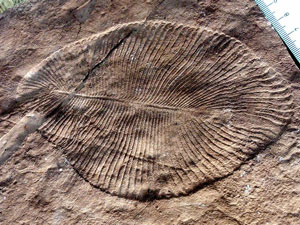
One of the most famous features of the fossil record that evolutionists have a hard time explaining is the ‘Cambrian explosion’. Most extant basic animal bodyplans simply appear in the fossil record in the Lower Cambrian rocks with next to no antecedent evidence of their existence in the rocks.1 Therefore, the major bodyplans of animals all had to evolve very quickly, which is stretching the bounds of plausibility. However, paleontologists have recently identified another ‘explosion’ in the fossil record in the Ediacaran ‘period’, which they dubbed the ‘Avalon Explosion’ (‘dated’ 635–542 Ma ago).2
The Ediacaran biota is a group of fossils of multicellular organisms that are found directly below the Cambrian (‘dated’ 542–488 Ma), and they consist of a wide range of morphologies. However, both their origin and relationship to Cambrian animals is a complete mystery to evolutionists. They are typically divided up into three major fossil assemblages: the Avalon (575–565 Ma), White Sea (560–550 Ma) and Nama (550–542 Ma) assemblages.3 All these assemblages display an incredibly wide array of morphology, and there is no trace of them in the fossil record above the Ediacaran period.
Shen et al. point out that though there is a wide variety of morphology in the Ediacaran biota, all the different fossil assemblages have a similar range of morphology. Since they believe these different assemblages represent different time periods within the Ediacaran period, they believe that there is little evolution shown in the Ediacaran fossils. As Shen et al. report:
‘A comprehensive quantitative analysis of these fossils indicates that the oldest Ediacara assemblage—the Avalon assemblage (575 to 565 Ma)—already encompassed the full range of Ediacara morphospace.’4
Therefore, they conclude that the rise of the Ediacara mirrors the Cambrian explosion, with all its attendant problems for evolution. So now evolutionists have got not one but two ‘big bangs in biology’5 to deal with within 50 million years of each other!
The Cambrian and Ediacaran explosions present a massive problem for evolution because each records a wide variety of morphologies that come onto the scene practically immediately according to the fossils, with no identifiable ancestors. Darwinian evolution, on the other hand, would expect such widely disparate body plans to emerge only after a long geological history.6 No known or accepted mechanism can account for such rapid evolution.
What’s worse is that the Cambrian and Ediacaran explosions bear no relationship at all to one another. Therefore, this sort of ‘evolutionary explosion’ had to happen twice. Once stretches credulity to breaking point—twice blows it out of the water completely.
The sudden appearance of this diverse assemblage of Ediacaran biota, of course, provides no problem for a creationist understanding of the fossils. They are simply another grouping of organisms that were overwhelmed and fossilized by the Flood.7,8
References
- Marshall, C.R., Explaining the Cambrian ‘explosion’ of animals, Annual Review of Earth and Planetary Sciences 34:355–384, 2006. Return to text.
- Shen, B., Dong, L., Xiao, S. and Kowalewski, M., The Avalon explosion: evolution of Ediacara morphospace, Science 319:81–84, 2008. Return to text.
- Waggoner, B., The Ediacaran biotas in space and time, Integrative and Comparative Biology, 43:104–113, 2003. Return to text.
- Shen et al., ref. 2, p. 81. ‘Morphospace’ is a spatial representation of the morphological range in a given classification of organisms. Return to text.
- Berardelli, P., Another big bang for biology, ScienceNOW Daily News, 3 January 2008. Return to text.
- Wells, J., Icons of Evolution, Regnery Publishing, Washington, DC, pp. 41–42, 2000. Return to text.
- Wieland, C., Holy Grail or another evolutionary tale? Creation 27(3):20–22, 2005. Return to text.
- Froede Jr, C.R., Precambrian metazoans within a young-earth Flood framework, Journal of Creation 13(2):90–95, 1999. Return to text.


Readers’ comments
Comments are automatically closed 14 days after publication.