
Journal of Creation 15(3):76–78, December 2001
Browse our latest digital issue Subscribe
Eggceptionally different
Scanning electron microscope comparisons between dinosaur fossil egg shells and recent, unfossilized eggshells from modern reptiles and birds show that dinosaur eggs are unique. Dinosaur eggs are dramatically thicker, more crystalline in their construction, and remarkably patterned across their outer surfaces. Reptile and bird eggs are much thinner and smoother and, in the case of the avian eggs studied, constructed by a meshwork of collagen or fibrin. If dinosaurs were related to lizards, as evolutionists claim, their eggs should be similar in such details as large bumps on the exterior surface and a thick, crystalline egg wall, yet such is not the case. If birds were descended from dinosaurs then bird eggs should preserve some hint of the unique aspect of dinosaur egg morphology, yet none is seen. Egg morphology supports the concept that reptiles, dinosaurs and birds are not related by common descent.
 Figure 1. Iguanodon egg, France, scale bar = 400 µm. |
 Figure 2. Saltasaurus robustus egg, Salta Argentina, scale bar = 400 µm. |
 Figure 3. Unidentified dinosaur egg, Patagonia, Argentina, scale bar = 400 µm. Click here for larger view |
A comparative scanning electron microscope study was performed between several dinosaur fossil eggshells1 and recent, unfossilized eggshells from modern reptiles and birds. Dinosaur fossil eggs were acquired from collectors who stated that they came from well-known digs in France and Argentina (Jurassic sedimentary layers) and were completely mineralized due to the fossilization process. According to Mr Joe Taylor, who provided samples for this study, none of these dinosaur eggs ‘… have ever appeared to be thin or even squashed flat. They appear to have been thick and hard prior to any breaking or fracturing, like chicken eggs.’1 For scanning electron microscopy, samples were gently cleaned with compressed air, affixed to microscope stubs and sputter coated with gold. They were observed and photographed on a JEOL scanning electron microscope.
It is well known that dinosaur egg preservation is remarkable, even down to molecular details.2–4 Therefore, it is reasonable to assume that the fossilization of these dinosaur eggs preserved macroscopic details, if not microscopic ones as well (see reference 5 for remarkable preservation of ultrastructural details in dinosaur bone). It could be argued that fossilization has erased, or otherwise altered, unique features in dinosaur eggs, but the literature supports the commonly held theory that fossilization often preserves even the most minute of morphological structures.5
 Figure 4. Modern lizard egg, scale bar= 200 µm. |
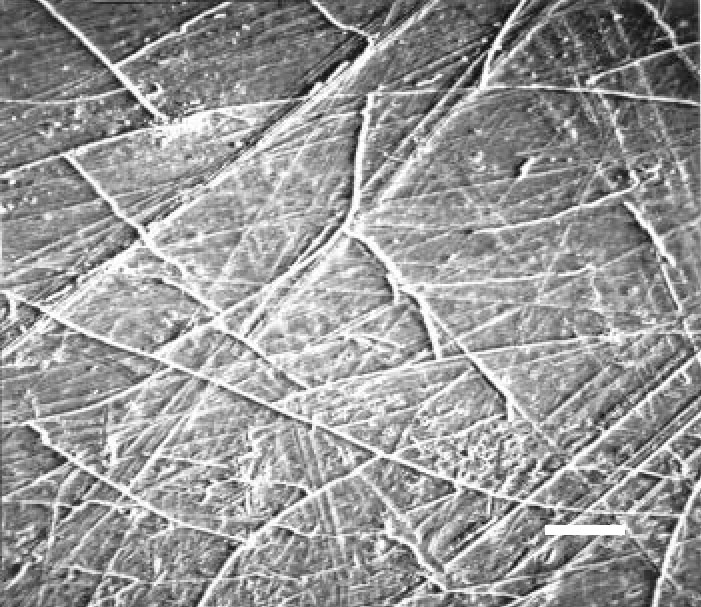 Figure 5. Modern ostrich egg, scale bar = 40 µm. |
 Figure 6. Modern chicken egg, scale bar = 20 µm. |
This study in no way reflects a comprehensive comparative review of avian, reptile and dinosaur eggshells. Additionally, this study does not concern itself with cross-sectional comparisons between these types of eggs, as has been done before,2,4 although such a comparative study is warranted and is forthcoming. A pattern definitely emerges, however, from this small sample set. Since dinosaurs, birds and reptiles all seem to share certain morphological similarities, it would be reasonable to assume that their eggs would likewise be similar in construction. The purpose of this ongoing study will be to determine if the eggs of dinosaurs, reptiles and birds examined show any visual hint at high magnification of an evolutionary progression, or even similarities, as would be expected on the basis of evolution from reptile to bird.
Outer surface
It is clear that the dinosaur egg shells (Figures 1, 2, 3) have significantly rougher surfaces than the reptile egg (Figure 4) on their respective exterior faces, and even more so than those of the chicken (Figure 5) and the ostrich (Figure 6). The distinct pattern evidenced by the three dinosaur samples is that of regularly spaced bumps emanating from a flat surface. The avian eggs appear as fairly flat surfaces otherwise crisscrossed with a meshwork of a collagen matrix and some cracks and crevasses.
 Figure 7. Iguanodon egg, France, scale bar = 400 µm. |
 Figure 8. Saltasaurus robustus egg, Salta Argentina, scale bar = 800 µm. |
 Figure 9. Unidentified dinosaur egg, Patagonia, Argentina, scale bar = 400 µm. Click here for larger view |
No such cracks (even very small, isolated ones) are evident at all on any of the dinosaur exterior egg surfaces.
It could be argued that the fossilization process may have occluded such cracks and crevices in mud and debris, if they existed at all between the bumps on these dinosaur eggs (and some debris does seem to exist between the bumps on Figure 3), but in general, these eggs seem to be free of such material.
| Table 1. Shell thicknesses of eggs studied. | |
| Specimen | Thickness (mm) |
|---|---|
| Iguanodon | 2.5 |
| Saltasaurus | 5.5 |
| Patagonia | 5.0 |
| Lizard | 0.1 |
| Ostrich | 2.2 |
| Chicken | 0.6 |
Additionally, one might expect such cracks or collagen networks, if they existed, to extend to the upper ‘knoll’ portion of the bumps. Yet clearly none are there. There does not appear to be any loose, unfossilized debris whether on the bumps or the valleys between them, which could cover these features. Therefore we conclude that we are actually looking at the outer surfaces of dinosaur eggs. From this comparison, therefore, it appears that the bird eggs differ from the dinosaur eggs in that their outer surface is flatter, and is covered by cracks, crevasses, collagen fibres laid down in a mesh, and delaminations of the surface material.
Further, the dinosaur eggs are thicker by 2–5 mm on average (see Table 1) than are lizard and chicken eggs, which is well known from the literature.2,6,7 The only resemblance between the dinosaur eggs and the modern specimens is found in the ostrich egg which has a thickness approaching that of the Iguanodon. Finally the bird eggs do not exhibit the regularly spaced pattern of bumps that are characteristically shown by all three dinosaur eggs.
The lizard specimen also has a rough exterior. However, its woven almost linen-like appearance under magnification is much smoother than the dinosaur eggs and it looks as pliable as it actually is in reality. As discussed previously, the dinosaur eggs all have a similar bumpy pattern in common which extends across the surface. No such pattern of bumps is evident on either of the bird specimens or the lizard sample.
Interior surface
The dinosaur eggs diverge somewhat in their similarity when examined from the inside. The Iguanodon (Figure 7) and the Saltasaurus (Figure 8) samples show rough surfaces on their inner aspect, with somewhat of a regular, crystalline texture to the Saltasaurus specimen not exhibited in the other dinosaur eggs. The Patagonia sample (Figure 9) is dramatic in that a clear pattern of large bumps again appears. Otherwise, the dinosaur eggs are fairly smooth inside with absolutely no hint of the dense matrix of collagen fibres exhibited on the avian eggs (Figures 11, 12). The reptile egg (Figure 10) is also again unique from all other samples in that a fine carpet of shallow bumps is displayed.
 Figure 10. Modern lizard egg, scale bar = 200 µm. |
 Figure 11. Modern ostrich egg, scale bar = 10 µm. |
 Figure 12. Modern chicken egg, scale bar = 10 µm. |
Conclusions
It seems that if dinosaurs were related to lizards, as our evolutionary colleagues would remind us, their eggs would have similarities in such details as large bumps on the exterior surface, and a thick, crystalline egg wall. Yet here we clearly see that such is not the case. If birds were descended from dinosaurs, then some hint of the unique aspect of dinosaur egg morphology might be preserved in bird eggs. Yet none of that is seen as well. It will be argued that there was sufficient geologic time for such anomalous morphological differences to have been smoothed out in transition, but this is obviously an argument from lack of evidence. It is perfectly reasonable to assume that what we are looking at in this preserved material is the real morphology that existed in the past. It is equally reasonable to assume that since no transition eggs have been found at any dinosaur egg site to date, none therefore exist. As scientists, we are compelled to report on and surmise about what is found in nature and what is observed under our microscopes. The hand waving and conjecture we leave to the non-scientists.
It is evident from this limited study, that dinosaur eggs appear to be unique and quite different from avian and reptile eggs. Dinosaur eggs are dramatically thicker, more crystalline in their construction, and remarkably patterned across their outer surfaces than either reptile or bird eggs, which are both much thinner, smoother and, in the case of the avian eggs studied, constructed by a meshwork of collagen or fibrin. Further study is warranted to determine if this pattern is consistent with a larger sample population.
References
- My thanks to Joe Taylor, curator, Mount Blanco Fossil Museum, Crosbyton, Texas for dinosaur material, and for background information on the material. Return to Text.
- Grine, F.E. and Kitching, J.W., Scanning electron microscopy of early dinosaur egg shell structure: comparison with other rigid sauropsid eggs, Scanning Microscopy 1(2):615–630, 1987. Return to Text.
- Wang, H., Re-analysis of DNA sequence data from a dinosaur egg fossil unearthed in Xixia of Henan Province, Yi Chuan Xue Bao 23(3):183–189, 1996. Return to Text.
- Palmer, B.D. and Guillette, L.J., Alligators provide evidence for the evolution of an archosaurian mode of oviparity, Biology of Reproduction 46(1):39–47, 1992. Return to Text.
- Armitage, M., A Scanning electron microscope study of mummified collagen fibers in fossil Tyrannosaurus rex bone, CRSQ 38(2):61–66, 2001. Return to Text.
- Jones, J.C., Greenberg, W. and Ayers, M.S., Computed tomographic evaluation of dinosaur egg shell integrity, Veterinary Radiology & Ultrasound 39(2):133–136, 1998. Return to Text.
- Floinsbee, R.E., Fritz, P., Krouse, H.R. and Robblee, A.R., Carbon-13 and oxygen-18 in dinosaur, crocodile and bird eggshells indicates environmental conditions, Science 168(937):1353–1356, 1970. Return to Text.


Readers’ comments
Comments are automatically closed 14 days after publication.