
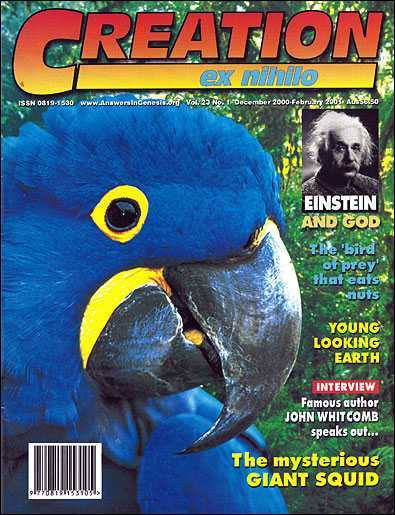
Einstein, the universe, and God

Chosen by Time magazine to be their ‘Person of the Century’,1 Albert Einstein2 is famous for many things (apart from his shaggy visage). His theories of special and general relativity and his formula for the equivalence of mass and energy, E = mc2, changed forever our views on time and space, light and gravity, matter and energy. He is somewhat less well-known for his remark ‘God does not play dice with the universe.’ But what did Einstein really mean by ‘God’? Was his ‘God’ anything like the God of the Bible?
Childhood influences
Although born in 1879 of German-Jewish parents, Albert was not brought up in the Jewish faith. He attended a nearby Catholic elementary school in Munich and then the local high school. A rather slow and dreamy student, Albert was bored with non-scientific subjects,3 and learned little under the harsh military-style 19th century German education system. He grew up with an aversion to discipline, and a life-long suspicion of all authority.
At age 11 he went through an intense religious phase during which he ate no pork and composed songs to God, which he sang to himself on the way to school.4
From age 12 Albert read popular books on science, taught himself algebra, geometry and calculus, and studied Immanuel Kant’s anti-theistic Critique of Pure Reason. Concerning this time in his life, Albert later wrote, ‘Through the reading of popular scientific books I soon reached the conviction that much in the stories of the Bible could not be true. The consequence was a positively fanatic (orgy of) [sic] freethinking coupled with the impression that youth is intentionally being deceived by the state through lies; it was a crushing impression. … It is quite clear to me that the religious paradise of youth, which was thus lost, was a first attempt to free myself from the chains of … an existence which is dominated by wishes, hopes, and primitive feelings.’4
Albert’s anti-authoritarianism, and probably also his desire to escape compulsory military service at age 17, led him to renounce his German citizenship. On January 28, 1896 he became a stateless person at the age of 16. His application for Swiss citizenship was approved February 21, 1900.
Tertiary studies, fatherhood and marriage
Einstein’s belief in ‘the divinity of nature’
Pantheists believe that everything is God. It means that ‘God’ just becomes another word for ‘everything’ and loses any real meaning—saying that everything is ‘zinquth’ is just as meaningful. Albert Einstein explicitly shared the pantheism of Spinoza, of whose views The Hutchinson Softback Encyclopedia, 1996, writes: ‘Mind and matter are two modes of an infinite substance that [Spinoza] called God or Nature, good and evil being relative.’ Like New Age and Eastern thought, this is a ‘monistic’ belief, which explicitly denies a Creator in the normal meaning of the word, i.e. one who pre-existed (and is thus independent of, or ‘outside’) that which was created.
From 1895 to 1900 Albert attended the Zurich Polytechnic in Switzerland,5 then the finest technical school in Europe. He seldom attended lectures, but spent much of his time doing his own experiments in the excellent physics laboratory, and reading about the latest advances in physics by Hertz, Helmholtz, and other pioneers in science. He also learned about revolutionary socialism from his friend, Friedrich Adler (who in 1918 achieved fame by assassinating the Prime Minister of Austria).
Albert fell in love with Mileva Maric, a Hungarian and the only woman student in his class who, though rather plain, afflicted with a limp, and not in the least flirtatious, knew enough physics to be able to have intelligent conversations with him. In 1901 he fathered an illegitimate child with her. He married Mileva in 1903, after he had secured a job as patent examiner at the Swiss Patent Office in Berne.6
In 1905, the prestigious Berlin journal Annalen der Physik published four papers written by Albert between March 17 and June 30 of that year in his spare time!7 The first, for which he received the Nobel Prize 16 years later, described how light could behave as both a wave and a stream of particles. The second, on the size of atoms, earned him a doctorate from Zurich University.8 The third, on Brownian motion, is the foundation of modern statistical mechanics, and the fourth became the basis for his Special Theory of Relativity. This was based on Albert’s ‘thought experiments’, such as what he might or might not see if he were in a space ship travelling at the speed of light.
In 1916 Albert published ‘The Foundation of the General Theory of Relativity’. This was based on more ‘thought experiments’ that gravity and acceleration produce identical effects, and that this is a consequence of gravity warping (distorting) both space and time. Scientists were both bedazzled and bewildered. Then the theory appeared to be confirmed during an eclipse of the sun in the West Indies, on May 29, 1919.9 The world’s press started referring to Albert as ‘the greatest genius on earth’.

Albert and Elsa
Albert and Mileva’s marriage had gradually fallen apart and in 1914 they had separated. In 1918, divorce proceedings were set in motion, based on the adultery of Albert with his divorced cousin Elsa Löwenthal,10 who had cared for him during a period of illness. The Zurich court granted the divorce on February 14, 1919, and ordered inter alia that Albert should give the monetary reward from a Nobel Prize, if and when he should receive it,11 to Mileva.12
Albert married Elsa on June 2, 1919, but again he was unfaithful.13 He wrote that he admired a deceased friend for having lived for many years in peace and ‘lasting harmony with a woman—an undertaking in which I twice failed rather disgracefully.’14
The Nobel Prize
In 1922 Albert received official news that he had been awarded the 1921 Nobel Prize for Physics for his work in theoretical physics and his photoelectric law. Relativity, still highly controversial, was specifically excluded.15
People now wrote to Albert from all over the world; some of his answers revealed his wry sense of humour. In Berlin, he received a letter from New York asking, ‘Would it be reasonable to assume that it is while a person is standing on his head—or rather upside down—that he falls in love or does other foolish things?’ Albert wrote, ‘To fall in love is by no means the most stupid thing man does—gravitation cannot be held responsible, however.’16
On another occasion, he was asked his formula for success. He replied, ‘If A is success, I should say the formula is A = X + Y + Z, X being work and Y being play.’ ‘And what is Z?’ ‘Keeping your mouth shut.’17
In 1933, after Adolf Hitler had come to power, the Nazis launched a campaign against ‘Jewish science’ and offered a 20,000-mark reward for Albert’s assassination.18 He emigrated to the USA and settled in Princeton, New Jersey, a scientific super-celebrity, becoming a US citizen on October 1, 1940.
Relativity and Morality
Some people have mistakenly blamed Einstein’s theory of relativity for the decline in morality seen today. In fact, Einstein proposed a view of nature in which absolute space and time were replaced by absolute velocity of light. He preferred to call his theory the ‘invariance’ theory, but the term ‘relativity’ stuck.
The basis for morality is the absolute truth of the Word of God, which contains God’s rules for holy living. These have been undermined, not by Einstein’s theory of relativity, but by the teaching of evolution, wherein man rejects the absolute truth about God and our need to live in a right relationship with Him, and man himself decides how he wants to live.
Science can only tell us what is, not what ought to be. For example, science tells us that shooting a man in the heart will (normally) kill him, and that certain sexual practices promote the spread of AIDS, but it cannot tell us whether these actions are right or wrong. For this we need a divine Lawgiver.
Albert and ‘the bomb’
For most of his life Albert was a gentle pacifist. However, on August 2, 1939, after learning that German scientists were working on splitting the uranium atom, he signed a letter to President F. D. Roosevelt which stated, ‘This new phenomenon would also lead to the construction of bombs,’ and urged ‘quick action’ on the part of the United States in atomic bomb research.19
The Manhattan Project, which produced the world’s first atomic bombs, got under way two years later. Albert, regarded as a security risk, was excluded from participation in this.20 After the bombs had exploded on Hiroshima and Nagasaki, he considered this letter one of his greatest mistakes.
In November 1952 Albert declined an offer by David Ben-Gurion, Prime Minister of Israel, to be that country’s president.21
For most of the last 30 years of his life, Albert tried, unsuccessfully, to establish a mathematical relationship between electromagnetic forces (such as light) and gravity. His aim was to find a single formula to explain the behaviour of everything in the universe, from electrons to stars, called a Unified Field Theory. He died in his sleep on April 18, 1955, from a ruptured defect in the main abdominal artery.
Einstein and ‘God’
Albert Einstein was not a Christian. He had no concept of the God of the Bible or trust in Jesus Christ as his Lord and Saviour. His views on religion and ‘God’ were evolutionary and pantheistic.
He wrote,
‘I cannot conceive of a God who rewards and punishes his creatures, or has a will of the kind that we experience in ourselves. Neither can I nor would I want to conceive of an individual that survives his physical death; let feeble souls, from fear or absurd egoism, cherish such thoughts.’22
‘The desire for guidance, love, and support prompts men to form the social or moral conception of God. … The man who is thoroughly convinced of the universal operation of the law of causation cannot for a moment entertain the idea of a being who interferes in the course of events. … A God who rewards and punishes is inconceivable to him … .’23
‘During the youthful period of mankind’s spiritual evolution human fantasy created gods in man’s own image. … The idea of God in the religions taught at present is a sublimation of that old concept of the gods. … In their struggle for the ethical good, teachers of religion must have the stature to give up the doctrine of a personal God … .’24
Relativity and distant starlight
Einstein’s General Theory of Relativity (GR) is the most experimentally vindicated theory of gravity in existence. It has not ‘disproved’ Newton’s laws, but has absorbed them within a larger framework, being a more accurate description under certain conditions.
GR involves many counter-intuitive notions, such as black holes—regions of space with so much mass that even light rays cannot escape. Another of its implications is that gravity distorts time itself, so there is no such thing as ‘absolute time’.
A leading creationist model, by physicist Dr Russell Humphreys, of how distant starlight could reach the earth in a young universe, relies heavily on GR. This is explained in detail for the layperson (with technical appendices) in Dr Humphreys’ book, Starlight and Time.
Many ‘progressive creationists’ have strongly attacked Dr Humphreys’ work, but to date he has been able to soundly answer them. For those familiar with the book, the controversy has been documented in our Journal and in our Q&A section, ‘Astronomy and Astrophysics’.
Answering a Japanese scholar who asked him about ‘scientific truth’, Albert wrote,
‘Certain it is that a conviction, akin to religious feeling, of the rationality or intelligibility of the world lies behind all scientific work of a higher order. This firm belief, a belief bound up with deep feeling, in a superior mind that reveals itself in the world of experience, represents my conception of God. In common parlance this may be described as “pantheistic” (Spinoza).’25
It is thus clear that when Albert mentioned ‘God’, e.g. ‘God does not play dice with the universe’, and ‘The Lord God is subtle, but malicious he is not’,26 he was referring to something like rationality in the universe. He is recorded as saying that a ‘deeply emotional conviction of the presence of a superior reasoning power, which is revealed in the incomprehensible universe, forms my idea of God’.27 However, he certainly was not referring to anything like the God of the Bible, who is Creator, Lawgiver, Judge and Saviour.
Addressing Princeton Theological Seminary on May 19, 1939, Albert said, ‘[A] conflict arises when a religious community insists on the absolute truthfulness of all statements recorded in the Bible.’25,28
Christian apologist Dr Hugh Ross claims that, despite not believing in the biblical God, ‘Einstein held unswervingly, against enormous peer pressure, to belief in a Creator.’29 However, in the normal meaning of these terms, Einstein believed no such thing (see aside above on starlight). Thus, Christians who inappropriately invoke Einstein in their preaching, writing or witnessing do so to the detriment of their cause.

Note: As Einstein wrote his scientific papers and most of his correspondence in German, translations used above vary slightly among his biographers.
Update, 2011: After this article was published, physicist Dr John Hartnett produced another model based on Einstein’s theory, but in a refinement called Carmelian Special Relativity. Here is a summary Has ‘dark matter’ really been proven?, and his book is Starlight Time and the New Physics. You can see Drs Humphreys and Hartnett dialogue on their models in the DVD on the right.
References and notes
- Time, pp. 42–67, December 1999. Return to text
- Albert was born in Ulm, Germany, on March 14, 1879. The family moved to Munich in 1880. Return to text
- His interest in science stems from age five. His father gave him a compass. ‘Why does the needle always point one way?’, Albert wanted to know. ‘Magnetism.’ ‘How does an invisible force pass through space?’ Albert lay awake that night pondering the mystery. His life-long interest in asking and solving scientific questions had been awakened. Return to text
- Pais, A., Einstein Lived Here, Oxford Uni. Press, New York, NY, USA, pp. 114–15, 1994. Return to text
- Eidgenossische Technische Hochschule or ETH (the Federal Institute of Technology). Return to text
- This lasted from June 1902 to July 1909. Return to text
- Translated titles: 1. On a Heuristic Viewpoint Concerning the Production and Transformation of Light. 2. A New Determination of the Size of Molecules. 3. On the Motion of Small Particles Suspended in a Stationary Liquid According to the Molecular Theory of Heat. 4. On the Electrodynamics of Moving Bodies. Return to text
- He received the first of his many honorary doctorates in 1909. Return to text
- According to Einstein’s theory, light from distant stars should be deflected when it passed through the strong gravitational field of the sun. During the eclipse, the light from stars previously not visible because of the sun’s brilliance appeared to be bent, i.e. the stars appeared to be in a different position from when their light did not pass close to the sun. The amount that the starlight was bent by the sun’s gravity agreed with Einstein’s predictions. Return to text
- Ref. 4, p. 19 states that Albert ‘admitted adultery’ in a letter dated August 31, 1918. Return to text
- Albert was nominated for the Nobel Prize for Physics every year from 1910 to 1921, except 1911 and 1915.Return to text
- This he did in 1923. It was then worth about US$32,000. Mileva bought a house in Zurich and lived there for most of the rest of her life. She died in 1948. Return to text
- Ref. 4, p. 20 states that one ‘extramarital affair came to an end in 1924. Several others appear to have occurred in later years.’ See also p. 38. Return to text
- Ref. 4, p. 25. Return to text
- Ref. 4, p. 63. Return to text
- Ref. 4, p. 88. Return to text
- Ref. 4, p. 152. Return to text
- Ironically, this anti-Semitism may have kept the Nazis from developing an atomic bomb. Return to text
- He signed another letter about the atomic bomb, intended for Roosevelt, on March 7, 1940. Return to text
- Ref. 4, pp. 218–19. Return to text
- Fölsing, A., Albert Einstein, Viking, New York, NY, USA, p. 734, 1997. Return to text
- Ref. 4, p. 118. Return to text
- Ideas and Opinions by Albert Einstein, Crown Publishers, New York, NY, USA, pp. 36–39, 1954. Return to text
- Ref. 23, pp. 46, 48. Return to text
- Ref. 23, pp. 261–62. Return to text
- He was objecting to the random unpredictable element in quantum mechanics, where one cannot calculate what will happen, only what will probably happen. Return to text
- Barnett, L., The Universe and Dr. Einstein, Victor Gallancz Ltd, London, UK, p. 95, 1953. Return to text
- Albert overlooked Psalm 14:1. Return to text
- The Creator and the Cosmos, Navpress, CO, USA, p. 49, 1993. Return to text

Readers’ comments
Comments are automatically closed 14 days after publication.