

Focus: news of interest about creation and evolution
Waxing cold on old dates for Aboriginal art
There is an unusual form of Australian Aboriginal art found on rocks in Australia’s northern Top End, involving delicate figures made out of the somewhat unusual wax from native bees.
In a recent five-year study of beeswax figures by an international team of academics, several of the figures were carbon dated as older than 4,000 years. However, the team was unsure as to what any of the figures meant and exactly how they were produced until Aboriginal elder ‘Big Bill Birriya-Birriya’ came to their rescue.

Big Bill could tell them exactly how they were made, and the meaning of the figures, because he was still involved in making them. Previous to that, it was assumed that the practice had died out.
Big Bill showed them how artists would first scoop a mix of honey and wax from native beehives, then suck the honey out, leaving a putty-like substance which they pressed against the rocks to make designs.
The Sydney Morning Herald, 10 February 1996, p. 9.
It stretches credulity (and may be more than a little patronizing to Aboriginal interests) to believe that this technique was practised in the same way, with the same rituals and designs, unchanged for the incredible span of 40 centuries. Yet this is what the researchers must (and do) now accept, since they would not contemplate abandoning the thousands of ‘radiocarbon years’.
The biblical concept of a far shorter time for Aboriginal occupation makes much more sense, especially when one of the academics says about the figures they studied that Big Bill actually ‘made some of those figures’.
‘Clock’ theory causes controversy
One often hears about how molecular biologists claim they are able to determine the timing of certain evolutionary events (e.g. when A split from B, or when modern humans arose) very precisely, using a ‘molecular clock’ concept. A recent occurrence shows how vague the assumptions in such a clock really are. When the results don’t suit fellow evolutionists for other reasons, they are attacked.
Biochemist Russell Doolittle and his colleagues have claimed to have shown by such an approach that one-celled creatures with nuclei split off from those without nuclei (such as bacteria) two billion years ago. However, Norman Pace, an evolutionist microbiologist at another US university, responds ‘forget it’. Using a different ‘clock’ , he sets the same event at a mere two billion years earlier, a difference of 100 percent!
Microfossil expert William Schopf also says ‘no’ to these results, on the basis of bacterial fossils in some of the ‘earliest’ rocks, allegedly 1.5 billion years before Doolittle’s date. Doolittle in turn raises doubts over whether these fossils are real.
Science 271:448, 470-477, 26 January 1996.
A simple resolution to the controversy would be to admit that such ‘molecular dates’ can only ever be untestable speculations.
Turtle scientists shellshocked
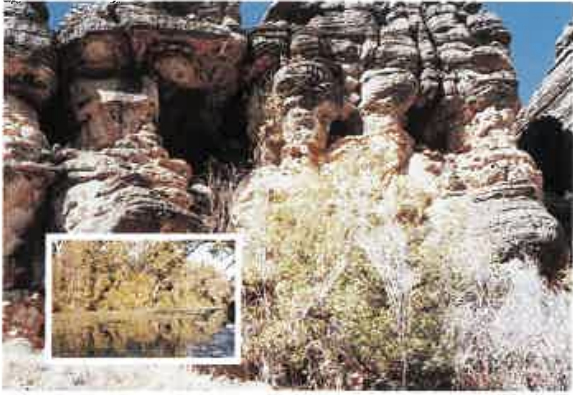
When the rich, diverse and significant Riversleigh fossil deposits in North West Queensland were excavated, scientists found what they described as a new species of ‘ancient turtle’, believed to have gone extinct in the Pleistocene, as long as 50,000 years ago in the evolutionary timescale.
About 90 kilometres (56 miles) downstream from Riversleigh, in Lawn Hill Creek, divers have recently discovered a new turtle species (Lavarackorum elseya) which is the same as the fossil Riversleigh one. By having the ‘real thing’, Australian scientists saw that they had ‘wrongly identified’ (classified) the fossil turtle, and the living turtle showed no evolutionary change had taken place in all those alleged tens of thousands of years.
The Sydney Morning Herald, 19 June 1996.
Superstrong beetle puzzle
Rhinoceros beetles are remarkably strong insects they can carry loads which are tens of times their body weight without even breaking their stride. A US scientist now says that when they do this, they don’t use the energy they should.
During experiments, the beetles were able to carry lead weights as much as 100 times their own. This would be like a strapping man carrying a load of around 8 tons and still walking along! Yet the beetles were consuming only one-fifth as much energy, for each extra gram they carried, as the energy they consumed to move each gram of their own weight.
The beetles do not change the way they walk when they carry loads, and they have no unusual anatomical features to account for this mystery.
New Scientist, 10 February 1996, p. 17.
Challenge to Stonehenge theory
Engineer Mark Whitby has labelled the traditional view of how the Stonehenge blocks got into place unscientific and wrong. Archaeologists have generally believed that to move these giant stones into position must have been a huge effort, requiring 500 to 1,000 men using rollers.
However, Whitby says they have not done the experiment, whereas he has. Using only ‘stone age’ tools, he had a team of 120 laborers erect an exact replica of the biggest section (involving moving two 40-ton stones into position and placing a 10-ton stone on top of them) in only five days.
He used what he believes was the most likely method, involving greased planks, and having each hole precut to be an exact fit. In other words, he assumed a high level of intelligence in the builders.
Sunday Telegraph (UK), 26 May 1996, p. 10.
The demonstration shows that ideas suggesting such things as help from ‘spacemen’ are not required. All one needs to assume is that the early post-Flood inhabitants of Britain, though lacking access to the technological inventions of today, were no less clever than people nowadays. Not surprisingly, the archaeological establishment has attacked Withy’s idea, suggesting that people then were probably too weak from an inadequate diet, or (here is the evolutionary bias) may not have even had greased planks.
Missing link dismissed
Fossilized bones of a hominid, which was said to be ancestral to the famous ‘Lucy’ skeleton, were found in late 1994 in Ethiopia. The creature was categorized as Australopithecus ramidus, and was hailed in newspapers as the oldest human ancestor. The discoverer, Tim White, and his Ethiopian colleagues, have since unearthed a nearly complete skeleton of the same creature. It can now be seen to be too chimp-like to be claimed as a human ancestor, and has been renamed Ardipithecus ramidus and put in a completely new genus.
National Geographic, March 1996, p. 117.
Creation (Journal of UK Creation Science Movement), May 1996, p. 8.
As so often happens with ‘missing links’, when there are few bones there is a lot of imagination, but when there are a lot of bones it becomes clear that they belong to either a human or an ape.
‘Fountains of the Deep’ on Mars?*
Creationists have often noted a certain irony in the beliefs of many geologists about Mars.
On a planet (Earth) which is largely covered in water, they deny that there ever could have been a global flood. Yet the majority believe that on Mars, a planet on which we have yet to detect any liquid water, many of its surface features formed by massive, global (or near-global) flooding!
Michael Carr of the US Geological Survey estimated that the amount of water needed to carve the Martian flood channels was ‘the equivalent of a layer of water several tens of meters deep covering the entire surface of the planet.’
A recent journal report states: ‘This suggests that there may still be a layer of water up to half a kilometer thick in the crust.’
New Scientist, 4 May 1996, pp. 39–42.
Not surprisingly, the same people who accept the possibility of huge underground water reservoirs on Mars, capable of flooding the whole planet, generally scoff at the idea that this was once the case on Earth.
(*Genesis 7:11.)
‘Blood chemicals’ found in dino bone
Montana State University’s Mary Schweitzer featured in an earlier Creation magazine when she announced that she could see obvious, fresh-looking blood cells under the microscope in bone from a Tyrannosaurs rex. Now Schweitzer and her colleagues have isolated a heme molecule, a ring-like structure which is found in hemoglobin (which carries oxygen in red blood cells) and similar compounds.
If the find is confirmed, and is not from contamination, this would be powerful evidence that the bone is not millions of years old at all. The article indicates that there is considerable ‘skepticism’ from molecular biologists who (rightly, we would maintain) ‘believe that such molecules cannot survive for millions of years’.
Science News 148:314, 11 November 1995.
If those same skeptical biologists find that the existence of red blood cell protein in this dinosaur bone cannot be discounted as ‘contamination’, will they be skeptical of the millions of years? Somehow, we doubt it. Note that another complex protein, found only in bone, has been reported already in dino bones, which again denies the ‘millions of years’ claimed for them.
[Ed. note: For more recent creationist assessments, see Sensational dinosaur blood report and Still soft and stretchy: Dinosaur soft tissue find—a stunning rebuttal of ‘millions of years’.]
Readers’ comments
Comments are automatically closed 14 days after publication.