

Focus: news of interest about creation and evolution
Exodus route?

An Egyptian archaeologist believes he has discovered an ancient desert route that Moses might have taken when leading the Israelites out of Egypt. Mahmoud Abd El-Razeq has found a series of dried-up wells running from the Nile delta near Cairo to the west bank of the Gulf of Suez, along with rock-engraved hieroglyphics dating the route to the 19th dynasty (usually considered to be 1580 to 1314 BC). Until now, historians have spoken of three ancient routes from the Delta to the area west of the Sinai, but these are north of the route discovered by Dr El-Razeq.
- Archaeological Diggings, p. 17, Oct./Nov. 1999.
‘C’ the difference
When creationists first presented the idea of the speed of light (c) today being slower than in the past (not widely held by them today) they were roundly mocked by evolutionists for even suggesting the possibility.
Recently, however, the secular journal New Scientist ran a front-cover feature, by an evolutionary cosmologist, proposing a faster initial speed of light to overcome problems in big bang/inflationary theories of cosmic evolution.
It seems that the problem was not, after all, that creationists were postulating a change in a fundamental constant, but that they were using it to attack the sacred idea of evolution’s vast ages.
- New Scientist, pp. 28–32, 24 July 1999.
Universe defies big bang theory

Einstein and other scientists, in seeking to apply his theory of general relativity to the universe, have assumed that matter is spread uniformly throughout space. This assumption—known as the Cosmological Principle—became the foundation for the standard big bang model describing the origin and evolution of the universe.
But with modern technology (e.g. the Hubble Space Telescope) astronomers have now observed substantially more of the universe than in Einstein’s day, and as they peer into space the universe appears anything but uniform. Galaxies are gathered together in great chains and walls which curl around vast regions of empty space known as ‘voids’.
But most cosmologists are still clinging to the hope that the universe is ‘smooth’ on large scales.
As the Professor of Astrophysics at Nottingham University acknowledges, once they accept that the universe is not uniform, ‘We’re lost. … The foundations of the big bang models would crumble away. We’d be left with no explanation for the big bang, or galaxy formation, or the distribution of galaxies in the universe.’
- New Scientist, pp. 23–26, 21 August 1999.
- Science, pp. 445–446, 16 April 1999.
Not a planet
Last year NASA announced that the Hubble Space Telescope had provided the first-ever photograph of a planet outside our solar system (see Planet photographed?, Creation 20(4):8, 1998; Planet mania?, 21(1):7, 1998). The image was believed to show a planet 450 light years away being ejected from a distant star. Even some astronomers who had rejected an earlier claim, by another group, to have taken such a photograph were convinced.
But the Extrasolar Research Corporation in California who took the original picture has recently released further observations which reveal that TMR-1C is probably far too hot to be a planet, and therefore is likely to be just a background star.
In recent years astrophysicists have periodically (and enthusiastically) announced that their calculations show the existence of planets outside our solar system, but as yet there is no conclusive photographic evidence to support these claims.
The existence of planets outside the solar system, even if confirmed, would be ‘no big deal’ for creationists. The scientific calculations which make the spontaneous appearance of life on Earth impossible apply just as readily elsewhere in the universe.
- New Scientist, p. 13, 3 July 1999.

Aztec ‘hi-tech’ latex
When Spaniards first came to Central America, they were astonished to see a fast-paced team game where the ball bounced to heights far surpassing the European pigskin ball. A Spanish historian in 1530 noted that these balls of ‘incredible bounce’ were made by mixing the juice from a vine with the latex sap from trees.
Such oft-repeated examples of the resourcefulness of early man, prior to the invention of various technologies, highlight that human intelligence was never ‘less evolved’.
- Science reports that the ball game was invented at least 3,400 years ago. These societies also used rubber for many other products, including rubber bands. Today’s scientists are trying to understand the chemistry of this ancient rubber-making process, invented long before the modern (19th century) vulcanisation process.
- Science, pp. 1898–1899, 1988–1990, 18 June 1999.
Up the wrong tree
Since Darwin’s time, botanists have tried to classify plants into groups thought to have a close genetic relationship.
Their aim in doing this was to organise the immense diversity of plants into an evolutionary ‘family tree’.
Thus, species of similar physical appearance were grouped together on the assumption that they were ‘closely related’.
But now that molecular biologists have been progressively working out the DNA sequences of genes in a rapidly growing list of plants, they have been discovering that plants within the traditional evolutionary groupings can have very different genetic configurations.
Evolutionists have thus been forced to abandon the old ‘family tree’, and have tried to draw up a new one.
However, they acknowledge that the new evolutionary family tree is unlikely to stand the test of time.
‘We’re at the stage it looks very simple. … As we learn more, we’re not going to be so smug.’
Ironically, Darwinists had labelled as ‘artificial’ the ancient (and practical) strategy of classifying plants according to uses—fruit trees, lumber trees, root vegetables, etc.
Whereas the contrasting evolutionary classification system, which is now crumbling, was held to be ‘meaningful’.
- New Scientist, p. 13, 14 August 1999.
Kansas controversy
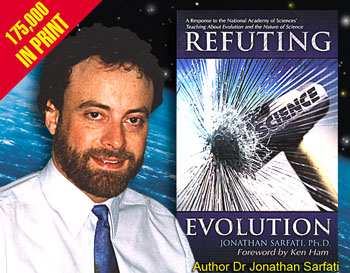
The recent 6–4 vote by the Kansas Board of Education to de-emphasize the teaching of particles-to-people evolution in schools has brought the creation/evolution controversy to the forefront of public debate in a way not seen for some years. Most newspaper headlines and expressions of outrage from scientific circles gave the impression that Kansas had banned the teaching of evolution. Not so—the new Kansas science teaching standards clearly state that for ‘grades 9–12, all students should develop an understanding of … biological evolution.’ All the Kansas ruling effectively did was ensure that students will not be tested on evolution at the state level. (As Kansas is a strong local-control state, the decision whether to test students on evolution is left to the local districts.)
The momentum of the ensuing public controversy has been maintained by talk-back radio ‘debates’, derisive newspaper columns, and public comment from scientific, church, and community leaders, not just in the USA, but worldwide. Time magazine referred to the Kansas decision in a cover story on ‘How man evolved’, with an additional full-page contemptuous commentary by atheistic evolutionist Stephen Jay Gould.
The book by CMI scientist Dr Jonathan Sarfati was given to each Kansas Board member prior to the decision—a key factor in the deciding vote?
- The Advertiser (Adelaide), p. 28, 13 August 1999.
- Time, pp. 44–53, 23 August 1999.
‘Missing links’ still missing
Ever since Darwin, evolutionists have clung to the hope that the gaps in the fossil record—the ‘transitional forms’—would eventually be filled in. But in the new book Sudden Origins, biologist Jeffrey Schwartz (who does not believe in God) asserts that the ‘missing links’ will never be discovered, because they never existed!
Schwartz recommends that biologists should therefore now dump Darwin’s idea of slow evolution through accumulation of tiny mutations over countless generations, and instead look for a new explanation of how life developed.
However Schwartz’s new substitute theory of ‘evolution by big jumps’ (mutations in crucial genes controlling development, e.g. the ‘homeobox genes’) has already been dismissed by other biologists as implausible.
Review of: Schwartz, J., Sudden Origins: Fossils, Genes, and the Emergence of Species,
We agree with the gradualists that evolution in such big leaps is statistically bizarre, and with Schwartz that the evidence doesn’t show the anticipated evolutionary ‘stages’.
- Scientific American, p. 90, September 1999.
Animal rights lawyers
Researchers have successfully taught chimpanzees some basic communication using a specially designed keyboard with 400 image-labelled keys linked to a voice synthesizer.
Though it is doubtful that they were using language in the human way, the chimps delighted their trainers with ‘sentences’ such as ‘I write give grape’, and ‘Please buy me a hamburger.’
As evolutionary thinking has led to the blurring of the distinction between people and animals, animal-rights activists, perhaps thinking that chimps will now be able to testify in court, are looking to use litigation to knock down the legal wall between humans and apes.
Though apes are not persons, and therefore do not have the right to sue, a Harvard Law School professor is confident that lawyers should be able to use slavery-era statutes which authorised legal non-persons (slaves) to file lawsuits. A dozen USA law schools now feature courses on animal law. One lecturer was quoted as saying that apes ‘should be declared to be persons under the constitution’.

- The Newcastle Herald (Australia), p. 20, 31 July 1999.
- U.S. News and World Report, p. 19, 20 September 1999.
Plant energy miracle
Although it has long been known that plants use sunlight energy to convert water and carbon dioxide into carbohydrates for growth, releasing oxygen to the atmosphere, scientists have not yet been able to mimic this process of photosynthesis.
Indeed, they remain baffled as to how plants break the water molecule apart, because theoretically the blast of energy required would be more than enough to vapourize the plant itself.
Recently a team of biochemists excitedly announced that they had managed to duplicate part of this process in the laboratory—but they used chemical energy (not sunlight) and, being unable to regenerate itself, their system quickly collapsed.
The staggering complexity of systems like photosynthesis still far outstrips anything mankind can produce. Yet our culture insists on seeing all this as undesigned, and not the product of intelligence.
- New Scientist, pp. 26–30, 14 August 1999.
Children: born to sin
Psychologists who conducted a study of 511 toddlers under 18 months old have concluded that children are born with a destructive and aggressive streak.
The research revealed that 70% of these youngsters snatch and grab things from others, 46% push and shove, 27% bite, 24% kick, 23% fight, 21% physically attack, and 15% hit out.
The fact that we inherit our sin nature from Adam is unpopular in our culture.
Thus the finding that these children demonstrated this behaviour long before it could have been learned shocked many psychologists, who had expected them to still be at an ‘age of innocence’.
The findings showed that the modern child-rearing challenge is not helping kids express themselves, but rather teaching them to ‘suppress’ themselves.
- Alberta Report, albertareport.com, 16 August 1999.
Eugenics in Vermont
A soon-to-be released book, Vermont Eugenics Survey, documents the plans of Vermont authorities in the 1920s and ’30s to eliminate ‘degenerate’ bloodlines and ‘genetically inferior’ people from the population. (Eugenics is the term coined by Charles Darwin’s cousin, Francis Galton, to denote the ‘science’ of improving the genetic condition of the human race.) Illiterates, thieves, the insane, Abernaki Indians, paupers, alcoholics, epileptics, and anyone who seemed inferior due to their economic or physical conditions were targeted for forced sterilization to prevent ‘undesirables’ breeding.
These tragic practices were being instituted elsewhere in the USA as well (The lies of Lynchburg, Creation 19(4):22–23, 1997), with Vermont in 1931 becoming the 31st state to enact a sterilization law (not repealed until 1973) for the handicapped or ‘feeble-minded’.
- The Washington Post, p. A21, 8 August 1999.
Now it’s volcanoes killing the dinosaurs

Since 1980, scientists who believe that a catastrophe wiped out the dinosaurs have mostly held to the ‘asteroid impact’ theory. However, some geologists are now emphasizing evidence of much volcanic activity they say was associated with the mass extinctions in the fossil record. By injecting masses of dust and aerosols into the upper atmosphere, this could have disrupted climate and food availability worldwide to a far greater extent than a large meteorite.
There is however enormous resistance to abandoning the asteroid theory. In the words of one paleontologist, ‘So many people have jumped on the bandwagon and so many reputations are at stake, they have lost the ability to be objective.’ With dissenting scientists being denied career advancement, and movies such as Deep Impact and Armageddon reinforcing the asteroid theory in popular culture, the impact theory may hold sway for some time yet.
In long-age frameworks, an ‘age of dinosaurs’ followed by an age without them sustains the demand for a ‘catch-all’ explanation for their extinction. But within a biblical framework, progressive dying out, over centuries, of the reduced populations struggling to re-establish themselves after the Flood needs no ‘unique’ explanatory efforts.
- New Scientist, p. 48, 28 August 1999.
- Science, pp. 604–605, 616–618, 23 April 1999.
- The Sciences, pp. 39–43, July/August 1999.
Young dinos grew fast
Researchers have found that the bones of sauropod dinosaurs look more like the fast-growing bones of mammals than reptiles.
Paleontologists had previously estimated that it would take these giants, weighing tens of tonnes, over a century to reach adult size.
However, detailed analysis of the annual bone layers of Apatosaurus fossils shows they were fully grown in just eight to eleven years.
Young dinosaurs taken on board the Ark could have reached reproductive maturity very soon after the Flood—see How did dinosaurs grow so big?
- Science, pp. 603–604, 23 October 1998.
Readers’ comments
Comments are automatically closed 14 days after publication.