

Journal of Creation 15(2):59–61, August 2001
Browse our latest digital issue Subscribe
Fossil axe-head?
An object claimed to be a fossilised axe-head, discovered in a paddock near Warwick, Queensland, Australia, was carefully examined. Radiography failed to reveal a shaft hole expected for a modern axe-head. Basic mineralogical analysis matched limonite, a mineral aggregate. X-ray diffraction identified the mineral composition as goethite, a common weathering product of iron-bearing minerals. Thus the suggestion that this object is man-made and stems from some advanced pre-Flood culture is highly unlikely.

For some time now, a ‘fossil axe-head’ has been reported from a private collection. It was found in a paddock near Warwick, Queensland, Australia. Items such as this are sometimes claimed to be ‘pre-Flood artefacts’ and hailed by enthusiastic creationists and various anti-establishment types to be evidence for an advanced ancient culture. It was therefore important to do a careful study of this object to clarify whether it was indeed a fossilized axe-head or simply a peculiarly shaped rock, since it is commonly known that weathered rocks can take some amazing shapes.
Results and discussion
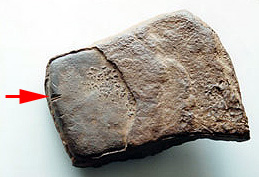
The exact geological setting of this object was not known, only that it had been found lying exposed on the ground in a paddock in the Warwick area of Queensland. Upon examination, the shape was remarkably like that of a man-made axe-head, seemingly encased in a thin layer of hard mineral over about 80% of its surface (Figures 1 and 2). It was brown/ochre and reminiscent of rusted iron. This object is apparently a focus of attention at rock-swap meetings.
If the object were indeed an ‘axe-head’, its shape reflected a ‘modern’ design like those of today’s axes, and we would expect the composition to be either steel or iron. The first obvious test to differentiate between these metals and a natural geological formation2 coincidentally shaped like an axe-head, was to test its magnetism with a handheld magnet. The object exhibited no ferro-magnetic properties.
Some may propose that this an ancient axe-head that has lost its magnetic property because the original metal has rusted and/or leached away. This is an unsatisfactory explanation, however, because of the object’s smooth surface and the lack of any cracks—when iron oxidises and/or hydrates, it loses its shape and cracks.
Since it was still plausible that the object could be made of some sophisticated, resilient man-made alloy, it was brought to Brisbane for further testing.
Radiography
A modern axe-head would be of no use without a shaft tunnel through it for the handle. This is in contrast to axes from cultures with low technical expertise, where the handle is tied to the outside of the axe-head.
In order to see if there was any difference in density in one portion that would suggest a shaft tunnel for a handle, or anything else that could be used to attach to a handle, the ‘axe head’ was X-rayed from two angles:
i) From one end at 100 mA, 74 kV; and 100 mA, 86 kV (Figure 3b), and
ii) From the side at 100 mA, 62 kV; and 100 mA, 72 kV (Figure 3a).
The X-rays revealed a homogeneous consistency, and the lack of any cracks expected in a rusted metal object that had been polished by weathering. None of the X-rays showed any evidence of a shaft hole. These results are thus inconsistent with a modern man-made axe-head.
Preliminary mineral identification
Some basic tests were initially performed to determine the mineral composition of the specimen.
- A streak test of the ‘axe’ part of the specimen yielded a yellow ochre powder.
- Filings were obtained using a steel file, showing that its Mohs hardness must be less than ~5.5 for iron. Thus the softness of the mineral is inconsistent with a man-made axe.3
- Archimedean Density measurement revealed a density of about 2.7 g/cm3. The density of the specimen is therefore only about 1/3 of that expected for an iron or steel axe (the density of iron is 7.9).
- Visual examination showed that the specimen was ‘earthy’ or ‘massive’ in terms of texture.
All the above characteristics matched limonite, a mineral aggregate that contains iron (limonite’s density is 2.7–4.3, hardness 4–5.5). This is not surprising, since limonite is often found in weathered outcrops, and the sample was found exposed in a paddock. Limonite is a field term—the hydrated iron oxides it contains are called goethite and lepidocrocite, and the latter is the pigment in brown ochre, which also fits.
X-ray diffraction

To conclusively identify the mineral, shavings from the ‘filed’ area of the ‘axe-head’ were analysed by X-ray diffraction for mineral content. Approximately 200 mg of this dark brown finely-divided powder was tested by the Debye–Scherrer Powder Camera Method using a Philips X-ray Diffraction Goniometer with copper tube. Ground crystal aggregate (single-phase) material was cemented in a vulcanized rubber ball and mounted on a hair in a Debye–Scherrer Camera.
The ‘d’ spacings from a Powder Camera photograph were measured (using a scalar for a 114.6 mm diameter cylindrical camera). These were recorded along with a visually judged decreasing order of relative line intensity. A search was conducted in the Powder Diffraction File using a Hanawalt Search Manual to find a match in the Mineral Powder Diffraction File Databook (sets 1–42). The pattern match was made with card 29-713 for goethite,4 identifying unequivocally the sample as 100% goethite—α-FeO.OH.
‘Goethite commonly occurs as a weathering product of iron-bearing minerals such as siderite, magnetite, pyrite, etc. It is normally formed under oxidizing conditions, and includes much material previously classed as limonite. It accumulates as a direct precipitate from both marine and meteoric waters and occurs in bogs and springs.’5
Goethite gives a yellow streak, and has a hardness of 5–5.5 and a density of about 4.3 g/cm3 .6
Conclusion
Under the right geochemical conditions, it is feasible that an iron or steel object could have weathered into goethite. However, the fact that no shaft tunnel was found for an axe handle, and because of the smoothness of its surface and lack of any cracks, it is highly likely that this is simply a naturally formed object that resembles a man-made axe-head. While rock can take many shapes, there is no doubt that this is a rare specimen, since this shape is improbable.
The evidence shown here strongly indicates that this axe-head shaped object is the result of either the weathering of iron bearing minerals or it was precipitated in a bog. To identify the source of the specimen, better knowledge of its geological setting would be needed.
Naturally occurring objects with familiar shapes, such as this ‘axe-head’, are found occasionally. Creationists need to refrain from jumping to speculative, unsubstantiated conclusions of what an object appears to be, since what one ‘sees’ is often not what it truly is. Instead we need to examine these finds carefully. It is most unwise to use spurious evidence to try to substantiate the Bible’s account of history. And there is no need to do this anyway because there is plenty of solid evidence available.
Acknowledgments
Don Batten, Tas Walker, Carl Wieland and Jonathan Sarfati were involved with various aspects of this investigation.
References
- Sparking interest in rapid rocks, Creation 21(4):6, 1999; Fascinating fossil fencing wire, Creation 20(3):6, 2000; Fossil pliers, Creation 14(1): 20, 1991. Return to Text.
- One exception is the mineral magnetite, which, as the name suggests, has magnetic properties. Return to Text.
- Deer, W.A., Howie, R.A. and Zussman, J., An introduction to the Rock-Forming Minerals, Longman Scientific and Technical, Essex, UK, p. 582, 1992. Return to Text.
- Goethite: Card 29-713. Mineral Powder Diffraction File Databook—Sets 1–42 ICDD (International Centre for Diffraction Data). Return to Text.
- Deer et al., Ref. 3, p. 579. Return to Text.
- Deer et al., Ref. 3, p. 578. Return to Text.
Readers’ comments
Comments are automatically closed 14 days after publication.