

Freedom from the New Age
From pagan to ‘New Age’ missionary

Today, Paul James-Griffiths works with London City Mission as a missionary to the New Age Movement, and as a chaplain to the West End Theatre staff. He has a B.A. in Ancient History and Classical Studies and has lectured in Ancient History. He has also written several books on the subject of the New Age. His fascinating testimony has lessons for us all.
What follows is the remarkable story of one man’s spiritual journey from outright paganism to a thoroughly biblical Christian faith and how he struggled with the evolutionary ideas that he encountered in his quest for truth. Paul says:
‘My conversion to Jesus Christ happened in 1982 during a survival trip in the rainforests of Australia. I had been a spiritualist and had practised witchcraft. My intention had been to promote an interfaith movement for world peace.’
With this background, it is not surprising that Paul had all sorts of erroneous beliefs that only served to bring confusion to his mind as a young Christian. This was particularly the case when he began to read the first pages of the Bible.
‘As a new believer I struggled with Genesis. I mixed pagan ideas with my Christian faith. As a pagan, I had believed in an eternal universe that continually underwent a cycle of rebirth and death. Evolution and the vast age of the cosmos were all part of my belief system and we always spoke of the human race evolving in consciousness as the New Age was upon us. Morality was defined by the spirit of the age. I knew from the Bible that God had created the universe, so I rejected pantheism,1 but I became a theistic evolutionist with stricter morals.’

Of course, this serves to highlight that our views of what is good or bad are ultimately determined by whether or not we have a basis for moral absolutes. If the Bible really is God’s revealed Word to humankind, we are accountable to the Creator for how we live (Isaiah 33:22).
If, on the other hand, we are part of an evolving world, there is no reason why our ‘moral sense’ should not shift with the times, as people’s opinions change—and this is exactly what we see in many Western nations as moral standards are increasingly relaxed and biblically-based laws are overturned. Like so many today, by retaining his prior religious beliefs concerning evolution and ‘millions of years’, Paul had to resort to a ‘God used evolution’ compromise.
Sadly, as is commonly the case, he was in danger at university of being aided and abetted in his error. Yet, in a wonderful way, God used Paul’s history studies to open his eyes to the ancient origins of this evolutionary worldview:
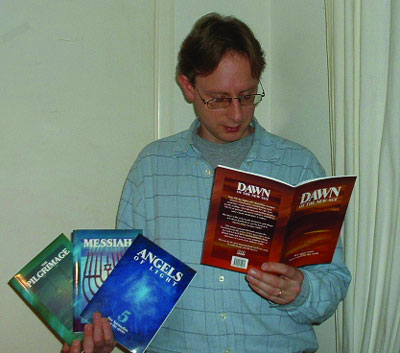
‘My professors trained me in the art of “hermeneutical phenomenology”?,2 which meant they taught me how to deconstruct a Judaeo-Christian worldview and replace it with a pluralistic one. God used my study of ancient history at university to shake me from an evolutionary position. To my amazement I discovered that evolution, the big bang theory and the vast ages of the universe had existed as pagan theories thousands of years before Darwin and Lyell. I learned that Epicurus (341–271 BC ) promoted a materialistic theory that had no place for God, and Pliny the Elder wrote, “… Chance herself takes the place of God … .”?3
Anaximander reckoned that “humans originally resembled another type of animal, namely fish.”?4 Aristotle developed the theory of spontaneous generation in the fourth century BC, and Democritus (c. 460–370 BC ), who proposed an atomic theory, also held to a sort of evolutionary view of human anthropology.5 The Babylonians gave dates for humankind upwards of 730,000 years,6 and Buddha (c. 500 BC ) estimated that man had existed for at least 3 x 1027 years!7 Meanwhile the Hindus, among other pagans, held to a cosmic egg expansion of the universe, as part of an evolutionary cycle every few billions of years.’8,9
Paul had discovered that modern evolutionary ideas, far from being a direct consequence of advances in operational science in the nineteenth century, had roots that went much deeper in human history. Indeed, his biblical namesake, the Apostle Paul, encountered disciples of the Greek evolutionary philosopher Epicurus when he spoke to the people of Athens (Acts 17:18). Rather than simply preaching about Christ’s Resurrection and the need for repentance, he tackled their wrong evolutionary ideas head-on by teaching them the real history of the world from Genesis.

As Paul James-Griffiths studied further, he was in for a surprise:
‘When I looked into the roots of Darwinian evolution I received a big shock. Wallace, widely recognised alongside Darwin as the co-founder of evolution, wrote books defending spiritualism. Furthermore, he came to the same conclusion as Darwin while studying spiritualism among the mediums in Malaysia!10
‘As a former spiritualist, my suspicions were aroused. I began a long and intensive investigation of scientific evolution in physics, chemistry, biology, geology and archaeology, only to find it was not scientific but mere pagan philosophy decked out in fancy language! I therefore rejected macroevolution as science.’
It is well known that Alfred Russel Wallace was a devotee of spiritualism (also called spiritism), and it is certainly intriguing that the relatively modern resurgence of New Age philosophies (including pantheism, paganism and occult ideas and practices) coincided with the arrival and rapid acceptance of Charles Darwin’s evolutionary ideas.11
Paul had come a long way in his pursuit of truth but there was one last hurdle. Though he had rejected molecules-to-man evolution, his earlier millions-of-years beliefs remained.
‘Next was my investigation of the long ages of evolution. This was much harder. It has taken me nearly 20 years to come to the conclusion, from the evidence, that the earth is less than 10,000 years old. I recall going to a creation science talk at Leicester University in 1984 and joining forces with liberal “churchians”? and atheists against the speaker, Professor Verna Wright.12 I hammered him about the Global Flood because my professors of archaeology had taught me that the Bible referred to a localised event in Sumeria. I left feeling puffed up with pride. Today I repent. Verna Wright was right; I was wrong.’
So many Christians—who have, like Paul, seen the light when it comes to the falsity of the evolutionary big picture—still tenaciously hang on to their belief in ‘millions-of-years’. Yet, as numerous articles in Creation magazine have shown, not only does old-earth belief ignore much scientific evidence for a young earth, such a compromise undermines the foundations of true biblical Christianity and effectively destroys the basis of the Gospel message.
Paul now realizes this and chooses to let the Bible speak, rather than reinterpret it to conform with people’s ultimately fallible opinions. Now, when he encounters people and shares his own faith, he is able to draw on the experiences of his spiritual journey, his historical research and, most importantly, God’s Word.
‘I work with London City Mission as a missionary to people involved in the New Age Movement and as a chaplain to the West End Theatres. We go into “mind, body, spirit”? events and have a stand where we share the Gospel with thousands of New Agers. In talking to pagans, whether actors, film directors or anything else, I show them evidence from the Bible and science to point them to a Creator God and then, eventually, to the only Saviour, our Lord Jesus Christ.’
References and notes
- This is the false belief that God is equal to the universe (from Greek pan = all, theos = God). Return to text.
- A hermeneutic is a method of interpreting the Bible. Paul James-Griffiths was being trained to take ideas outside of the Bible and read them into Scripture (eisegesis). Sound biblical hermeneutics requires the Christian to start with God’s infallible Word and read out from the text (exegesis). See: Ham, K., Eisegesis: A Genesis virus, Creation 24(3):16–19, 2002. Return to text.
- Pliny the Elder, Natural History, Healy, J.F. (translator), Penguin Classics, London, England, p. 13, 1991. Return to text.
- Barnes, J., Early Greek Philosophy, Penguin Classics, London, England; Hippolytus, Refutation of all heresies, p. 72, 1987. Return to text.
- Cartledge, P., Democritus, Phoenix, London, England, p. 21, 1998. Return to text.
- Ref. 3, p. 105. Return to text.
- Buddhist Scriptures, selected and translated by Conze, E., Penguin Classics, London, England; Outline of a Bodhisattva’s progress, p. 31, 1959. Return to text.
- Mundaka Unpanishad 1, translations and explanations by Swami Nikhilananda, Ramakrishna–Vivekananda Center, New York, from Understanding Hinduism, Creation, pp. 6–9, hinduism.org.za, 9 June 2003. Return to text.
- Wiseman, P.J., Clues to Creation in Genesis, Wiseman, D.J. (Ed.), Marshall’s Paperbacks, England, p. 226, 1977. Return to text.
- Morris, H., Who Started the Evolutionary World View? Sword and Trowel 1:2–7, 1996. Return to text.
- For a helpful discussion of spiritism, pantheism and the New Age, see chapters 3 and 4 of: Morris, H., The Long War Against God: The history and impact of the creation/evolution conflict, Master Books, Arkansas, USA, pp. 93–195, 2000. Chapter 4 is entitled ‘The dark nursery of Darwinism’. Return to text.
- Verna Wright (1928–1998), an eminent rheumatologist, was a committed Christian and keen biblical creationist. He was a key figure in such British organisations as United Beach Missions, Young Life, Lord’s Day Observance Society, Christian Medical Fellowship and Creation Science Movement. Return to text.


Readers’ comments
Comments are automatically closed 14 days after publication.