

Journal of Creation 21(1):26–28, April 2007
Browse our latest digital issue Subscribe
From Plato to pragmatism
A review of Total Truth: Liberating Christianity from its Cultural Captivity by Nancy Pearcey
Crossway Books, Wheaton, Illinois, 2005
The book is long (over 500 pages) and is divided into four sections which segue well into each other. The first deals with worldviews and epistemological concerns, then Darwinism, followed by the history of American evangelicalism and its present problems (provocatively titled ‘How We Lost Our Minds’), and finally, her solution. I’ll only be discussing the first two. In addition, the book contains four appendices, a study guide and generous endnotes.

A schizophrenic worldview
Nancy Pearcey has set herself a monumental task, nothing less than ‘to liberate Christianity from its cultural captivity, unleashing its power to transform the world’ (p. 18). Both the cause of the problem and its solution lie in an attitude to the world and to knowledge. She points out that non-Christians have promoted an epistemology which has fractured knowledge into a two-tiered system: a ‘lower’, ‘more accessible’ stratum, given over entirely to the public sphere, containing science, facts, rationality, materialism, the objective and empirical; the other, a ‘higher’, in some cases, transcendent, private realm, characterised by such structures as religion, morality, the non-rational, the subjective and relative (figure 1). Such an attitude has a history which stretches back deep into the past and yet continues to be ‘the most pervasive thought pattern of our times’ (p. 121). If Christians are to successfully engage with the world they must, she argues, ‘find ways to overcome the dichotomy between sacred and secular, public and private, fact and value—demonstrating to the world that a Christian worldview alone offers a whole and integral truth.’ (p. 121)
All well and good, but, unfortunately, Christians, beginning very early on in the young Church, picked up and ran with this flawed epistemological outlook, and enthusiastically continue to do so today. Even more sadly, Pearcey doesn’t recognise that she, although endlessly dissuading us from the danger, has herself fallen under the spell of this schizophrenic epistemology. But I’ll save this major flaw in the book until later.
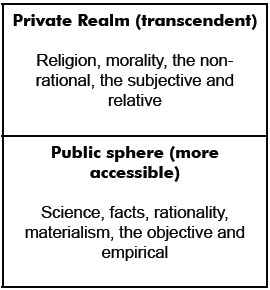 Figure 1. According to Pearcey, the two-tiered epistemology promoted by non- Christians has fractured knowledge into a ‘higher’, in some cases, transcendent, private realm and a ‘lower’, ‘more accessible’ stratum. To successfully demonstrate that only a Christian worldview offers a whole and integral truth, Christians need to find ways to overcome this dichotomy, something Pearcey fails to accomplish by viewing the age of the earth as a theological matter rather than a fact of history.
Pearcey is an unapologetic admirer of Francis Schaeffer, having stayed at L’Abri in Switzerland while he was still alive. And this brings me to my first criticism of the book. Her whole approach to the epistemological divide was more than adequately explained by Schaeffer, and having read his major works several times, I can see little value in her returning to this old ground to the degree she does. Schaeffer covered all the same watershed moments in Western civilization more succinctly, with greater eloquence and with significantly fewer digressions. Plato, Aristotle, Augustine, the Medievalists, the Enlightenment, Kant and Hume, Rousseau and the Romantics that followed him, the uniquely American-inspired pragmatic movement, were all given his learned attention. Schaeffer’s genius was his ability to analyse complex and disparate philosophical events and characters, reduce them to simple, perspicacious statements, and then thread them together to revisit the journey that led us to this present period, a time in which even Christians have fallen prey to the sacred-secular dichotomy.
Notwithstanding this criticism, what may be unique is her nuts-and-bolts education program to renew the Christian mindset, one she hopes will reawaken its present enervated epistemology. She lays out a valuable three-area grid for sifting any issue or systematic thought through, each grid accompanied by a number of relevant questions. ‘After all,’ she writes, ‘every philosophy and ideology has to answer the same fundamental questions:
- Creation: How did it all begin? Where did we come from?
- Fall: What went wrong? What is the source of evil and suffering?
- Redemption: What can we do about it? How can the world be set right again?’ (p. 25).
As the reader works their way through her book this ‘toolbox contain[ing] biblically based conceptual tools’ (p. 44) is applied against Marxism, Rousseau, Margaret Sanger (the pro-abortion and eugenicist founder of Planned Parenthood), Buddhism and New Age Pantheism. This was a particularly useful section of the book and gives the reader something that can be immediately put into practice anywhere, at anytime.
On evolution
Perhaps her most voluminous attack is reserved for Darwin, evolution and, to a lesser degree, theistic evolutionists. In keeping with her focus upon the secular-sacred divide, she discusses how evolution has taken over all the lower tier, and in the process edged out God and metaphysics, pushing them into the upper—and easily ignored—realm.

Nothing she says here about evolution, however, is new, though quite possibly some may find this section a reasonable summary and critique of evolution’s claim to ultimate explanation status. She discusses, inter alia, evolution’s inability to ground ethics on any meaningful and stable platform that empowers a person to generate logically consistent moral judgments, the religious nature of the evolutionary worldview, Darwin’s finches, Haeckel, fruit flies (figure 2), peppered moths, information theory, and mutations’ and natural selection’s lack of process to bring about change on the scale that evolution necessarily demands. Along the way she draws upon the work of Behe, Johnson and, to a disturbingly limited degree, the young-earth creationist Wilder-Smith, whom she treats with respect, while also garnering support for her thesis from a swag of true-believer evolutionists like Daniel Dennett, Michael Ruse, Richard Dawkins, Peter Singer and Ernst Mayr.
By far the most interesting statements in this section were the two testimonies from former born-again Christians that lent support to the common enough argument that evolution is insidiously dangerous for faith. Apparently, both Michael Shermer, director of the Skeptics Society, and E.O. Wilson, founder of sociobiology, were professing conservative Christians until they encountered Darwinian theory at university.
She commits one minor error in this section. Mislabelling Christian morality ‘teleological’ she incorrectly defines this category as ‘being based on the concept of human progress toward the purpose or ideal (τέλος, telos) for which we were designed’ (p. 222). This is not what teleological means in normative ethical philosophy. Teleological ethics are systems in which actions are judged right or wrong based upon their outcomes. The most well-known representative of this class would be John Stuart Mill’s utilitarianism that argues an action is right if it generally possesses utility, measured by the degree of pleasure and happiness it brings and/or reduction of pain and unhappiness. Contrasted with this are deontological (from δείν, dein, to be obliged, ought) practices, like Christianity, in which an action is intrinsically right or wrong irrespective of the consequences it entails.
This small slip aside, lying exposed within her epistemological and theological pursuits is an egregious and disturbing contradiction. Despite her disavowal of evolution and her commitment to a Creator God, one has to question if she manages to live consistently by her own criterion of complaint.
Her blind spot
As Pearcey reiterates throughout her book, the problem for Christians is that we have, in mirroring pagan thought systems, divided knowledge into a separate fact realm and another reserved for religious matters. She believes that, with regard to the origins’ issue, Christians are losing the battle because they ‘get caught up in fighting each other’. What are they fighting over? ‘Endless arguments over theological questions [my italics] like the length of the creation “days”’ (p. 173).1
Here is clear demonstration that Pearcey has undermined her own project by promoting the epistemological divide that she so vociferously fulminates against. She relocates a question of fact, the young-earth history, into the upper realm of the private realm, and thus transforms it into a religious issue. The age of the earth is not a ‘theological’ issue but one of historical truth or falsehood. She maintains that this issue is divisive. Has she not heard that the Creator himself warned us that truth, by its very epistemological concern, is divisive? The pursuit of truth is hardly a project not worth pursuing.
Furthermore, by precluding debate of the age of the earth from the public realm, she destroys the only sound and logical support for the Fall, the second element in her grid. In fact, let her own past self eloquently show up her current blind spot:
‘Where did evil come from? … The Bible clearly tells us that evil, suffering, and death are real, so we are not escapist. However, evil is not intrinsic to the world. God created a good world. Evil entered by the free choice of individual human beings when Adam and Eve first sinned. So it is not contradictory to say that some day God will wipe out evil and sorrow.
‘This teaching is both our hope for the future and our basis for fighting evil today. The theistic evolutionist loses all this. By denying the Fall, he loses the Biblical answer to the question, where did evil and suffering come from?
‘Theistic evolution assumes that evil and death are intrinsic to God’s creation and have been there since the beginning. In other words, that God created them. God Himself is then the source of evil. But then God must be an evil God. To avoid this conclusion theistic evolutionists usually trivialize evil.’2
But she seems blind to the fact that all old-earth views have death and suffering before man,3 so it is hardly a trivial issue. So her own advocated ID fails her own test of failing to provide for a Fall. And she hasn’t bothered to refute her own argument above!
Then she goes on to point out how theistic evolution fails her own third test:
‘Redeemed from what? … If there was no Fall, why do we need redemption? If the problem is not our sin but our animal nature, then we only need to wait for evolution to raise us to the next stage.’
But once again, she is blind to the fact that ID likewise fails.
She also overlooks the other, fundamental and non-optional aspect for detecting intelligence: rapidity of specified action, something which Design Theorists to the person ignore. Someone’s performing a complicated and specified task perfectly and quickly is an indication of high intelligence. Conversely, any completed action unaccompanied by one or both of these intelligent signatures can be construed as arising from luck, incompetence, insouciance or mediocrity.
To recommend or not to recommend?
Would I recommend the book? I am ambivalent.
For her address of the history of philosophy and how particular epistemological approaches affected Christianity and many key areas of its belief structure, I would. She has managed to tie together an enormously diverse amount of material and made it interesting. Throughout the book Pearcey takes time to explain difficult and unfamiliar concepts and introduces her material with relevant anecdotes. The other welcome aspect is her periodic recapitulation of important points to assist the reader’s progression through often quite complex philosophical moments in history.
With regard to the book’s presentation, there is one in-your-face, grating aspect. Both its dustjacket and first four pages have been plastered with sycophantic testimonies from a veritable ‘who’s who’ in the popular theological world. Key words boldly capitalised—‘astute’, ‘profound’, ‘compelling’, ‘superbly crafted’, ‘firing on all pistons’—I am unable to understand why her publisher didn’t recognise these seemingly endless hyperbolic seals of approval as cheap overkill. Given that the foreword is written by Phillip Johnson, one would think this an adequate recommendation.
However, Pearcey is inconsistent in the application of her epistemic and does not understand the theological and philosophical importance of the question of the earth’s age—not even bothering to address her own cogent arguments of yesteryear. Thus I hesitate to recommend the book, despite there being so much to like about it.
References
- In some respects she follows Schaeffer here, though with far more resolve that her position is correct than he communicated. Schaeffer, who was not a Hebrew scholar, erroneously proposed that the meaning of yôm (day) in Genesis 1 should be held with some openness, but never dogmatically claimed that the issue was divisive. See his Genesis in Space and Time, IVP, Downers Grove, p. 57, 1972. Return to text.
- Pearcey, N., God and evolution: do they mix? Creation 17(1):24–25, 1994. Return to text.
- Sarfati, J., The Fall: a cosmic catastrophe: Hugh Ross’s blunders on plant death in the Bible, Journal of Creation 19(3):60–64, 2005. Return to text.
Readers’ comments
Comments are automatically closed 14 days after publication.