

Horse non-sense
[Ed. note: see the more up-to-date The
non-evolution of the horse.]
One of the most commonly presented ‘proofs’ of evolution is the horse series. It is claimed that the evolution of the horse can be traced from the tiny, four-toed Hyracotherium—sometimes called Eohippus, which supposedly lived about 50 million years ago—to Equus, the single-toed horse of today. But this is a gross over-simplification and ignores some facts.
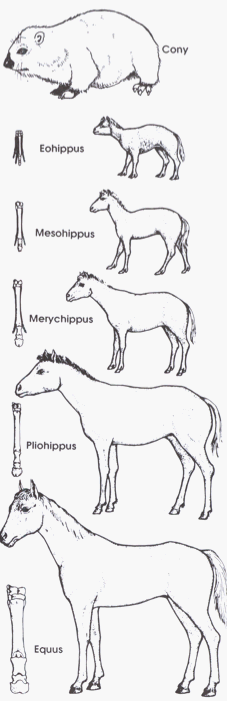
Eohippus (Hyracotherium) was most likely not related to horses at all, but to modern conies (creatures like rabbits). Indeed, the first specimen was named Hyracotherium by its discoverer, Robert Owen, because of its resemblance to the genus Hyrax (cony). Later specimens, found in North America, were named Eohippus (‘dawn horse’), but there is no sound reason for linking it with horses. So the horse family tree has a false origin.
The horse series was constructed from fossils found in many different parts of the world, and nowhere does this succession occur in one location. The series is formulated on the assumption of evolutionary progression, and then used to ‘prove’ evolution!
The number of ribs varies within the series, up and down, between 15, 19, and 18. The number of lumbar vertebrae also changes from six to eight and then back to six.
There is no consensus on horse ancestry among palaeontologists, and more than a dozen different family trees have been proposed, indicating that the whole thing is only guesswork.
Fossils of the three-toed and one-toed species are preserved in the same rock formation in Nebraska USA1, proving that both lived at the same time, strongly suggesting that one did not evolve into the other.
Modern horses come in a wide variety of sizes. There is a great difference between the Fallabella horse of Argentina—fully grown at 43 centimetres (17 inches) high—and the massive Clydesdale. Both are horses, and the larger has not evolved from the smaller, nor the smaller from the larger.
In view of the above facts, it is amazing that evolutionists continue to present the horse series as one of their ‘best proofs of evolution’.
Readers’ comments
Comments are automatically closed 14 days after publication.