

How does a ‘box’ swim?
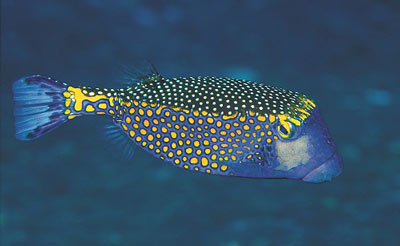
With their ‘boxy’ shape and rigid bony carapace that covers most of their body, boxfish look somewhat awkward compared to most other fish. As Science journal commented recently, ‘One look at the aptly named boxfish, and you might expect it to swim as well as a barn would fly.’1
In reality, boxfish are able to swim extremely smoothly.2 This is even more remarkable considering where they live—reefs washed by highly turbulent and unpredictable waters. But even when continually buffeted by swirling currents, boxfish make only the slightest of deviations from their straight swimming paths, as they correct for unseen eddies and turbulence.
So what makes these ungainly-looking fish so stable and manoeuvrable? How do they so efficiently keep to their swimming trajectory in swirling, surging waters?
According to recent research, the boxy shape is a major reason for their ‘hydrodynamic stability’.3 Using a model of the boxfish, Lactophrys triqueter (also known commonly as the ‘smooth trunkfish’), in a water tunnel, the researchers found that, as the model was tilted, its boxy shape changed the water flow, setting up counter-rotating currents (vortices). These effectively act as self-correcting forces so that the fish is automatically stabilized. Basically, if currents slant the boxfish upwards, a vortex on top helps straighten it out.1 These findings excited the researchers, who recognized that this same phenomenon is a hallmark of delta-wing aircraft such as the Concorde and the space shuttle.4

The researchers found that the effect of varying pitch (tilting up/down) or yaw (side-to-side movement) was the same—i.e. the self-correcting vortices that develop around the boxfish’s body are the secret of its ‘unflappability’. Apparently, this self-correction characteristic not only saves boxfish a lot of energy, but it is also faster for them than using their fins to correct their position. Navy engineers are showing interest in this, too, with a view to building more efficient undersea robots.1
Who could have ever known that such an apparently simple ‘boxy’ shape would be ideal for a fish that spends its life buffeted by the turbulent waters swirling about the coral, hollows and overhangs of a reef? Who else but the Master Designer—Creator of the heavens and the Earth and the sea and all that is in them (Exodus 20:11).
References and notes
- Boxy swimmers, Science 299(5608):817, 2003. Return to text.
- Tilley, S., Smoothly does it, The Journal of Experimental Biology 206(4):637, 2003. Return to text.
- Bartol, I.K., Gharib, M., Weihs, D., Webb, P.W., Hove, J.R. and Gordon, M.S., Hydrodynamic stability of swimming in ostraciid fishes: role of the carapace in the smooth trunkfish Lactophrys triqueter (Teleostei: Ostraciidae), The Journal of Experimental Biology 206(4):725–724, 2003. Return to text.
- In fact, ‘Lift coefficients of boxfish models were similar to lift coefficients of delta wings, devices that also generate lift through vortex generation.’ Ref. 3. Return to text.
Readers’ comments
Comments are automatically closed 14 days after publication.