

Climbing Mt Improbable “evo devo” style

Evolutionary champion Richard Dawkins provides an intriguing analogy for how the evolutionary process works—he likens it to climbing a mountain, Mount Improbable.1 Many structures in living things are so complex, he concedes, that the likelihood they could arise by chance is absurd (like scaling a mountain in a single leap).2 But, according to Dawkins, if we climb the mountain in incremental steps (of gene mutation filtered by natural selection) we can reach the summit without any need to invoke a creator. This evolutionary mechanism is known as neo-Darwinism. And even though it has been enthusiastically taught for many years, numerous evolutionary biologists now concede that neo-Darwinism is not sufficient to climb Mount Improbable. This doesn’t mean they are accepting defeat. As we shall see, evolutionary biology is itself evolving.
A new paradigm in evolutionary biology: “evo devo”
About three decades ago I was only a single cell (a fertilized egg), but now I’m a “galaxy” of cells (over 100 trillion) typing this article. As I developed in utero, different cells took on different tasks. Some started forming eyes, other cells became cardiac muscle, and so on. But how did the different cells “know” how to carry out this highly orchestrated task? This mystery of embryonic development has puzzled scientists for centuries. But it wasn’t until biologists discovered a set of developmental genes (known as Hox genes) in 1983, that the black box of embryonic development finally began to be opened.
Hox genes are developmental genes that guide overall body architecture. A single mutation in a Hox gene can dramatically change an organism. For instance, consider the mutant fruit fly that has legs in the place of its antennae! Although this condition obviously disadvantages the fly, these types of changes have excited many evolutionists, because they think they might provide clues as to how radical new body designs could evolve.
As more developmental genes have been discovered, a whole new field of inquiry has “sprouted” that attempts to merge developmental and evolutionary biology. The result is Evolutionary Developmental Biology (“Evo Devo”). The basic principle driving Evo Devo is that if embryonic development is “re-programmed”, “improbable” structures like limbs, wings and new body designs might arise.
Diverse organisms, similar genes

Hox genes are part of a broader group of developmental genes that have many varied roles. Some of them mark out the geography of the embryo’s body. Others play key roles in the development of structures like limbs, eyes and hearts. But the most astonishing thing about Hox and other developmental genes is that they are shared across the animal kingdom. Organisms as diverse as leeches and lawyers are “built” using the same developmental genes! This discovery has come as such a shock that one of the world’s most eminent biologists, Sean Carroll3, confessed: “no biologist had even the foggiest notion that such similarities could exist between genes of such different animals.”4
But why are evolutionists so surprised? Well, it’s simply because creatures that supposedly diverged millions of years ago shouldn’t share the startling similarity in developmental genes that they do. For example, evolutionists allege that humans once shared a common ancestor with fruit flies. However, since we diverged so long ago, any similar genes we shared should’ve been scrambled beyond recognition by almost countless generations of mutations. This is why Ernst Mayr, a man once described as “the world’s greatest living evolutionary biologist” stated, “the search for homologous [similar] genes is quite futile except in very close relatives”.5 But this is wrong. Not only do we share similar developmental genes with fruit flies, but also with almost every other creature on the planet!
So how has this changed the way scientists view evolution? Well, since very different animals are made using similar genes, Evo Devo proponents contend that the driving force of evolution is not changes in (protein coding) genes, but changes in regulatory DNA (genetic switches) that control the genes.6 In other words, “ … the evolution of form is not so much about what genes you have, but about how you use them.”7 Yet this contradicts what neo-Darwinists have long told us—“According to the modern theory (called neo-Darwinism), changes occur in organisms by mutations of genes”8 [emphasis mine].
Building a “baby”
Many of the shared developmental genes are part of genetic switches that regulate other genes.9 During embryonic development these genetic switches initiate the cascade of gene expression that builds various structures. For example, the Pax-6 developmental gene is part of a genetic switch that induces eye development. When Pax-6 from a mouse was inserted into a fruit fly’s genome, fruit fly eye structures were formed. The mouse gene was so similar to its fly equivalent (even though these creatures supposedly diverged over 500 million years ago) that it induced the fly program for eye development! Likewise, the Distal-less gene forms part of a master switch for limb development and the Tinman gene (named after Tin Man in The Wizard of Oz) is part of a master switch for heart development. So embryonic development involves a vast array of master genetic switches that turn on the right program in the right place.
Evolution of genetic switches?
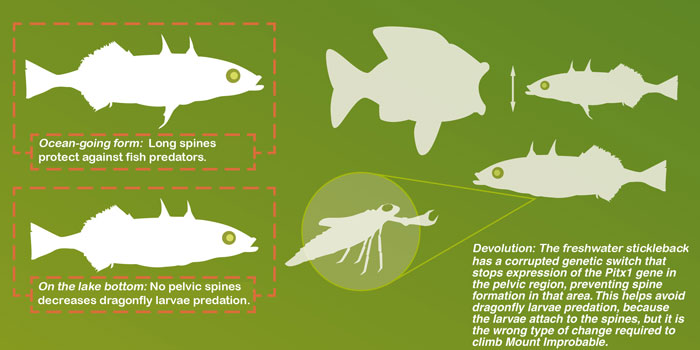
Since changes in genetic switches are now being hailed as the key to evolution, Evo Devo proponents have been keen to highlight adaptations caused by such changes. Probably the most cited example involves stickleback fish. Normally, these fish have long spines projecting from their body. On the lake bottom, these are a disadvantage because dragonfly larvae latch onto them. However, some varieties have adapted to their environment. Due to a mutated genetic switch, they don’t develop pelvic spines, so they are much better at evading the grasp of predators.10 However, these sorts of changes are really devolution, not evolution, because a genetic switch has been corrupted, preventing the expression of a key spine-building gene (Pitx1) in the pelvic region. This showcase example of “evolution via genetic switches” hasn’t inspired prominent evolutionists like Jerry Coyne (University of Chicago), either: “these examples represent the loss of traits, rather than the origin of evolutionary novelties”.11,12
Furthermore, Jerry Coyne remains unconvinced that changes in genetic switches are the key to evolution: “the evidence for this critical hypothesis, however, rests more on inference than on observation or experiment”.11 But despite his Evo Devo skepticism, Dr Coyne’s belief in evolution shows no sign of wavering.
“Urbilateria”—your long lost relative?
Since common developmental genes are shared across the animal kingdom, evolutionists think they must have originated before the different animal groups embarked on their separate evolutionary pathways. So the last common ancestor of people and snails must have possessed them. This hypothetical creature, which evolutionists tell us lived over half a billion years ago, has been dubbed “Urbilateria” (i.e. the ancestor of all animals with two-fold symmetry).13
Urbilateria was certainly “ahead of its time”. It supposedly possessed many key developmental genes for complex “improbable” structures like limbs, eyes and hearts—but it allegedly lived long before evolution had “invented” limbs, eyes or hearts! No wonder Sean Carroll muses, “it is intriguing to ponder just what so many genes were doing in Urbilateria”.14 Remarkably, these evolutionists now insist that much of the genetic program for building complex animals existed long before the animals did! “The genetic potential was in place for at least 50 million years, and probably a fair bit longer, before large, complex forms emerged”.15 Statements like this inadvertently give the impression that evolution has foresight! But Dawkins himself insists that “nature, unlike humans with brains, has no foresight”.16 And if genomes are supposedly “shaped” by the demands of their environment over time, why should “nature” write a complex genetic program 50 million years before it is needed?
Thus, the discovery that the animal kingdom is built using the same developmental genes does not support the notion that all life has descended from a common ancestor (although this is how it is commonly reported).17 Ironically, though, the data fits nicely with the proposal that a single Creator used a common “blueprint” to “build” the animal kingdom, rather than there being many creators. Indeed, in most cultures, a designer using the same underlying design in a variety of applications would bring him great honour, showing his mastery over his designs.18
A recent New Scientist article cautioned its readers: “If you want to know how all living things are related, don’t bother looking in any textbook that’s more than a few years old. Chances are that the tree of life you find there will be wrong”.19 As we have seen, it doesn’t seem to matter what sort of problems the data raises for evolutionists (or how much it offends past predictions) the idea that all living things have descended from a common ancestor is not negotiable. Even questioning this idea is regarded as scientific heresy.20
References and notes
- Dawkins, R., Climbing Mount Improbable, W.W. Norton & Company, New York, 1996. See review by Sarfati, J., Journal of Creation 12(1):29–34, 1998; <creation.com/dawkins>. Return to text.
- Dawkins gets frustrated when people say evolutionists believe things evolve by chance. While he concedes that mutation can largely be thought of as a random/chance process, he insists that cumulative (natural) selection is definitely not random. So, according to Dawkins, it is incorrect to call evolution a “chance” process. But since natural selection can’t occur before there are self-reproducing entities, the origin of first life must be due to chance alone. Return to text.
- According to evolutionary philosopher of science Michael Ruse, “Of all the scientists in the world today, there is no one with whom Charles Darwin would rather spend an evening than Sean Carroll.” Return to text.
- Carroll, S.B., Endless Forms Most Beautiful: The New Science of Evo Devo, W.W. Norton & Company, New York, p. 64, 2005. See review by Williams, A., Journal of Creation 19(3):40–44, 2005; <creation.com/carroll>. Return to text.
- Ref. 4, pp. 71–72. Return to text.
- Evo Devo proponents regard changes in regulatory DNA (i.e. genetic switches) as the key to the evolution of anatomy but still concede that the evolution of physiological processes relies heavily on genes evolving (see Carroll, S.B., Evolution at two levels: on genes and form, PLoS Biology 3(7):1159–1166, 2005). Return to text.
- Ref. 4, p. 153. Return to text.
- Heffernan, D. and Miller, R., The Australian Biology Dictionary (2nd ed.), Longman, Melbourne, Australia, p. 86, 1997. Return to text.
- A large portion of the genes in the tool kit code for transcription factors. These bind to regulatory DNA sequences (often called enhancers) to “switch on” other genes. That’s how genetic switches work. (See Carroll, S.B., Prud’homme, B., Gompel, N., Regulating evolution, Scientific American 296(5):38–45, 2008.) Return to text.
- Similar examples of such natural selection abound—creationists since even before Darwin have readily acknowledged natural selection as an observable fact. Note though that natural selection is not evolution because no new information is generated; natural selection merely culls already existing information. See Wieland, C., The evolution train’s a-comin (Sorry, a-goin in the wrong direction), Creation 24(2): 16–19, 2002; <creation.com/train>. Return to text.
- Coyne, J.A., Switching on evolution—how does evo-devo explain the huge diversity of life on Earth? Nature 435(7045):1029–1030, 2005. Return to text.
- Evo Devo proponents also contend that new switches evolve. However, much of the evidence for new switches comes from “comparative genomics”, whereby you compare the genomes of organisms considered to be evolutionary relatives and (on the basis of that assumption) conclude that the switches in one and not in the other must have evolved. Return to text.
- From German ur = ancestral; and Latin bi–, bis = two, twice and laterālis = pertaining to the side. See also Lamb, A., Corals and sponges and ur-complexity, Contradictions and imaginative scenarios pepper evolutionary dogma, <creation.com/ur>, 27 October 2007. Return to text.
- Ref. 4, p. 144. Return to text.
- Ref. 4, p. 139. Return to text.
- Ref. 1, pp. 318–319. Return to text.
- Evolutionists think the “genetic tool kit” has expanded and changed over time. For instance, fruit flies have 8 Hox genes whereas mammals have 39 spread over four clusters. Nevertheless, they still concede Urbilateria’s tool kit was remarkably complex (7–9 Hox genes along with a few hundred more body-building genes). See Garcia-Fernandez, J., The Genesis and evolution of homeobox gene clusters, Nature Reviews/Genetics 6:881–892, December 2005 and ref. 4, p.143. Return to text.
- Holding, J.P., Not to be used again : homologous structures and the presumption of originality as a critical value, Journal of Creation 21(1):13–14, 2007; <creation.com/homologous>. Return to text.
- Spinney, L., Back to their roots, New Scientist 194(2608):48–51, 2007. Return to text.
- As documented in Ben Stein’s movie Expelled. Return to text.

Readers’ comments
Comments are automatically closed 14 days after publication.