
Feedback archive → Feedback 2008

Karl Kruszelnicki: still missing the missing links
This week we feature a recent article1 by popular Australian science personality Dr Karl Kruszelnicki, a physicist and Skeptic, in which he chides creationists over the issue of ‘missing links’. Andrew Lamb responds.
Missing link’s Gospel truth
When it comes to matters of evolution, Dr Karl is no old fossil. He’s always thrilled to hear about any newly unearthed find.
There is a misconception here. We discover new organisms and unearth new fossils, but examples of evolution are not ‘unearthed’, found or discovered. They are invented (like the urmetazoa), constructed (like the legged sea cow) or just blithely assumed and boldly asserted. The bones we dig up don’t come with labels saying ‘I evolved from such-and-such’. In fact, even if evolution were true, it is not possible that an instance of evolution could be discovered, in the sense that a fossil or plant can be discovered. Evolution, if it really did occur, would need to be observed. But as atheistic evolutionist Richard Dawkins disingenuously admitted, ‘Evolution has been observed. It’s just that it hasn’t been observed while it’s happening.’2 Indeed, outside of cartoons and movies, no creature has ever been observed to transform into a different kind of creature.
Even in these supposedly enlightened times, the word ‘evolution’ still raises some hackles, and in some pious circles is considered the equivalent of a four-letter word.
I don’t know about hackles, but chuckles are certainly raised around here when the latest evolutionary claims are aired (cf. Psalm 2:4). However, yes, we do often equate evolution with a four letter word, that word being ‘hoax’—consider Archaeoraptor liaoningensis, Eoanthropus dawsoni, and Homo pongoides. The five letter epithet ‘fraud’ features even more frequently in the annals of evolution. Examples that spring readily to mind include the Biston betularia story (the moth is real—just the story and concocted evidence are fraudulent), Haeckel’s infamous embryo diagrams (still used in textbooks!) and Pithecanthropus erectus and kin. There are numerous others.
It was only as recently as February 2008, that the Florida State Board of Education finally allowed (by a close 4–3 vote)
Indeed the vote was close. One would think that with their multi-billion dollar budgets, the Western world’s education systems and media could manage a better showing. Yet polls consistently show that a huge proportion of Western-educated people reject evolution. Why do evolutionists have such difficulty convincing people that they evolved from slime? And why do they so consistently resort to outlawing dissent, as they did in Florida?
the use of this dreaded word,
Creationists do not fear evolution—we want people to know much more about evolution, to know it so well as to know that it does not explain the origin of life or its diversity. But many evolutionists seem to dread the prospect of people hearing about the evidence against evolution and for creation. They are apparently so terrified that they try to suppress the contrary evidence—see Expelled: new movie exposes persecution of anti-Darwinists, and Censoring intelligent design: One man’s personal experience of state school anti-Christian intolerance in the USA.
However, it is prudent to fear the consequences of belief in evolution. Mass murderers like Harris and Klebold, Pekka-Eric Auvinen, and Jeffrey Dahmer expressed strong evolutionary ideas in relation to their killings. Consider too that the greatest mass-murderers of all time, the atheist leaders Stalin and Mao, as well as the pagan Adolf Hitler, used evolution as ‘scientific’ justification for their crimes.
rather than previous euphemisms such as ‘change over time’.
‘Change over time’ is indeed a euphemism, and one which the evolutionists use to great effect to conflate the meaning of two entirely different phenomena, namely 1) the observable scientific phenomenon of natural selection, which involves limited change within a population, and 2) the mythical pseudoscientific3 phenomenon of evolution of one kind of organism into a different kind, which would require the coming into existence of encyclopedic quantities of new genetic information coding for new types of organs, new kinds of physiologies, etc. To conflate these two separate concepts is to commit the fallacy of equivocation or bait-and-switch.
Mind you, the vote was very close, even though the teachers are specifically forbidden to use the terrifying word ‘evolution’ by itself—instead ‘evolution’ always has to be preceded by the mollifying phrase ‘theory of’, as in ‘theory of evolution’.
This is neither here nor there; we have advised in our Don’t Use page against saying ‘Evolution is just a theory’.
Evolution is the process of change, from one generation to the next, of inherited characteristics. The microbiologists see it happening all the time, as bacteria evolve to beat the antibiotics that we have so painstakingly developed.
No, what Karl describes here is not evolution but adaptation. Even after hundreds of thousands of generations, the bacteria are still the same kind of bacteria, despite Lenski’s recent hype about allegedly new abilities. The type of change involved is in the opposite direction to that required for microbes-to-man evolution. See Superbugs not so super after all and Anthrax and antibiotics: Is evolution relevant?
A part of this process of evolution is the ‘Missing Link’ (or to give it the proper technical name, Transitional Fossil). A missing link would have characteristics of both its ancestors, and its descendants.
That’s interesting, because a recent alleged transitional form, Materpiscis attenboroughi (‘Mother fish of Attenborough’), had a mode of reproduction (live birth) that neither its supposed ancestors nor supposed descendants possessed. See ‘The oldest pregnant mum’—not!
Animals that combine features typical of different classes of organism are referred to as mosaics. The platypus and Archaeopteryx are two classic examples of mosaic creatures, as are creatures like Tiktaalik and Pakicetus. And common features can be evidence of a common Designer rather than common ancestry—see Are look-alikes related? Commonalities also bring great honour to the Designer, showing His mastery over what He has designed—see Not to be used again: homologous structures and the presumption of originality as a critical value.
In the USA, the anti-evolution creationists are dead-set against acknowledging the very concept of the missing link. They claim that no missing link has ever been found, anywhere in the world.
Leading creationists do not claim this. And re ‘found’, as pointed out earlier it is organisms and fossils that are found, not evolution. The evolution exists only in the stories told about those bones and organisms by the evolutionists.
There are always a currently popular handful of disputed transitional forms. Inevitably, as more facts come to light, and as sober evaluation replaces the initial gush of evolutionary enthusiasm and hype, each alleged transitional form is shown to be completely bird, completely fish, etc., perhaps, at best, having some mosaic features. However for the time being, such fossils are regarded by the evolutionary establishment as genuine transitional forms.
Many people are naturally skeptical (this includes Christians—see Antidote to superstition and Scepticism), and when challenged by a new idea will automatically try to think of a counter-example to disprove it. If creationists use emphatic language like ‘not a single transitional form’ or ‘none, ever, anywhere’ it can act like a goad, provoking skeptics to strive to try to find a loophole—to think of a mere single counter-example needed to disprove the claim. If someone is aware of even just one of the many obsolete or the few current transitional fossil claims, they can then use this as an excuse to reject as untrustworthy the whole creationist argument against transitional fossils. This, in part, is why our ministry advises against making categorical claims like ‘there are no transitional forms’. Instead, it is better, and accurate, to say ‘if evolution were true, there should be thousands of transitional forms, but all we have are a handful of disputed examples’. See here and here for example.
Would you believe it, but their claim is actually a wicked fib.
Ahem! Dr Kruszelnicki you seem to be assuming that fibbing is bad, and that there exist such things as ‘wicked’ and ‘good’. But if evolution is true, then human consciousness is just an epiphenomenon of electrical activity in the brain, arising from millions of years of mutations, and so you have no basis for assuming that there exist such things as objective/absolute/universal good and bad. And even assuming good and bad do exist, evolution gives no basis for assuming that statements that accurately reflect reality (truths) are somehow better than statements that do not (fibs). Stop plagiarizing creationist assumptions to argue against creation.
What is a wicked fib, and one recognised by the formal legal term slander, is to make unfounded public accusations like the above.
Charles Darwin wrote his Origin of Species in 1859. He very honestly pointed out that the lack of any missing link found up to that date was ‘the most obvious and gravest objection’ that could be mounted against his theory.
Indeed he did, and indeed it is. And as leading palaeontologist Colin Patterson of the British Museum of Natural History said 120 years later, ‘there is not one such fossil [i.e. transitional fossil] for which one could make a watertight argument. The reason is that statements about ancestry and descent are not applicable in the fossil record. … It is easy enough to make up stories of how one form gave rise to another… But such stories are not part of science…’4 See That quote!—about the missing transitional fossils.
But in 1861, only two years later, the very first missing link was found. Archaeopteryx was the missing link that ‘joined’ the birds and the dinosaurs, because it had characteristics of both.
Archaeopteryx is a true bird, as acknowledged by leading (including evolutionist) experts such as Dr Alan Feduccia, who famously wrote ‘Paleontologists have tried to turn Archaeopteryx into an earth-bound, feathered dinosaur. But it’s not. It is a bird, a perching bird. And no amount of “paleobabble” is going to change that.’5
On the bird side, it had feathers, wings and a wishbone. On the dinosaur side, it had jaws with sharp teeth, a long bony tail and three fingers with claws.
Sharp teeth, long bony tails, and fingers with claws are hardly unique to dinosaurs. There exist reptiles, mammals and yes, even birds, that exhibit these features. Several species of living birds have wing claws and several species of extinct birds had teeth—see Living dinosaurs or just birds? There was much greater variety in birds in the past. Loss of features such as claws, bony tails and teeth is a degenerative process, but evolution would require generative processes, producing nascent new kinds of organs, etc.
And for the horse, by the late 1800s, a quite clear set of transitional fossils had been found. They covered some 50 million years, documenting the evolutionary changes that led to the modern horse.
Fossil horses do not show a consistent progression in features, no matter which of the various different sequences one consults (several have been proposed). Formerly ubiquitous in textbooks, the horse series is now discredited as just speculative arrangement. And evolutionary mythology doesn’t just handicap understanding of fossil horses:
‘One enduring myth holds that Arabian horses [hailed as the evolutionary ‘fountain head’ of the world’s breeds, Ed.] have one fewer lumbar vertebrae than horses of other breeds. While it may be true that some Arabians have only five, the same can be true of all breeds. “In necropsy studies I did with Thoroughbreds, maybe 20 to 30 percent had only five lumbar vertebrae,” says Kevin Haussler, DVM, DC, PhD. of Colorado State University.’ 6
And over the 20th century, many more such transitional fossils have been found, making the sequence of changes leading to the modern horse more complete.
Actually, further finds have only complicated the story, not made it clearer. And as we have explained in ‘horse series is now discredited’ (above), nearly all the fossils look like mere variations in the horse kind; there is no directional change towards some fitter horse.
As explained, in regard to supposed transitional fossils in general, what is actually found is usually fragmentary fossil bones, shells, teeth and other hard parts. The ‘transitional’ is all in the explanation given by evolutionists to fit the bones into their framework of understanding.
As another example, we have a very detailed set of missing link fossils that take us from the fish to the amphibian—the famous ‘fishibian’ sequence.
‘Very detailed’ is misleading. What they have is many fragmentary fossils, and these fragments are studied and expatiated upon in great detail. But it is this very fragmentary nature itself that makes them suitable as candidate transitional forms, because the evolutionists are then free to speculate on the missing parts. On several occasions scraps of fish skull have been announced with fanfare as the remains of legged fish, despite the absence of leg bones. This is the same sort of zealous over-enthusiasm that resulted in a whole spate of single teeth being declared to be new species of hominid (see ‘Southwest Colorado Man’ and the year of the one-tooth wonders).
Organisms in the alleged fish-to-amphibian sequence include:
- Livoniana, based on a scrap of jaw—no limb bones.
- Acanthostega, regarded by experts as a mosaic.
- Tiktaalik, another mosaic fish.
- Ventastega, without a leg to stand on.
- Materpiscis attenboroughi, the reproductive mode of which was NOT transitional.

And more recently, fossils found in Pakistan have filled in the gaps in the sequence that takes us from amphibians to reptiles onto primitive mammals and then to whales-with-legs and finally to whales-without-legs.
Again, the fossils are just petrified bones—the ‘gap filling’ takes place entirely in the stories told about these bones by evolutionists. See Whale evolution? and Walking whales, nested hierarchies, and chimeras: do they exist?
And just in May 2008, another missing link was found—it had characteristics of both frogs and salamanders.
As we reported in a subsequent article, Creative frogamandering, the fossil concerned, Gerobatrachus hottoni, is actually missing its legs and the front of its pectoral girdle! Many who wrote enthusiastic evolutionary media reports about this creature may not have realized no legs were found, due to the jargon used in the scientific paper—this reported that the fossil lacked ‘stylopods’ and ‘zeugopods’, terms that the journalists may not have realized referred to the upper and lower limb bones respectively. Without these bones, it is rash to claim anything about how this creature walked (hopped?).
It has always been these gaps (that would be filled by missing links) that the creationists have seized upon.
Since evolution predicts almost countless transitional forms, it is perfectly reasonable for creationists to point out that evolutionists can only produce a handful of debatable examples. But it is a bit uncharitable of Dr K to imply that we always seize upon these gaps. There are numerous egregious weaknesses in evolution in addition to the gaps-in-the-fossils problem, and we try hard to bag all these weaknesses equally vigorously . See for example our articles on the Origin of Life problem (i.e. refuting theories of chemical evolution), the increase in information problem, the thermodynamics problem, the probability problems …
But it’s perfectly reasonable to have gaps in the fossil record.
But this is not so. The fossil record is remarkably complete—97.7 percent of living orders of land vertebrates are represented as fossils and 79.1 percent of living families of land vertebrates—87.8 percent if birds are excluded, as they are less likely to become fossilized.7 The only reason to call it ‘gappy’ is the scarcity of the transitional forms that evolution expects. But it’s circular reasoning to use the expectation of many transitional forms and their subsequent failure to materialize as an argument for gappiness. See The links are missing.
In short, virtually all the kinds of creature found living today are also found as fossils.
There are certainly patterns of fossils and physical gaps (i.e. fossil-free zones) in the sedimentary strata. With a global Flood, these are easily explained in terms of ecological zoning (sea-floor organisms buried first, highland organisms last, etc.), differential mobility, hydrodynamic sorting (low-buoyancy organisms first, etc.), and Flood dynamics. As a skeptical journalist remarked on a geology excursion to the revered (by evolutionists) Walcott Quarry fossil site, part of the Burgess Shale formation in Canada’s Yoho National Park: ‘Everybody else here sees the origin of life embedded in these rocks, but I just see nice, albeit significant, patterns.’8
Life has been around for a long time (about 3.8 billion years),
This is a statement of dogmatic belief, not a scientific fact—Age cannot be measured.
but we have been hunting for fossils for less than two centuries.
Dr K is playing a bit of journalistic trickery on the reader here—as if the supposed long time it took to form the fossils meant that it would take a long time to find them! There is absolutely no relationship between the two. It would be like saying because the Great Wall of China had an active history of some 1,000 years that it would take a thousand years to discover it. This statement by Dr K is nothing but a smokescreen to try to deflect the issue of the myriad missing transitional forms.
Like facts, fossils do not always ‘speak for themselves’. Suppose one encounters a fossil. By itself it is just a lump of rock in the shape of an animal or plant. For centuries people did not know what fossils were:
‘Neoplatonism held that the funny fossil shapes were controlled by mysterious astral influences, and Aristotelianism attributed marine-looking fossils to the transport of “seeds” of ocean-dwelling organisms that got carried inland and grew in place after lodging in the cracks.’9

And some reportedly still don’t. Tibetans are said to believe that ammonite fossils are miraculous reproductions of the Buddhist wheel of life.10
The first to realise that fossils were actually the petrified remains of dead creatures was Nicolas Steno (1638–1686). See Geological pioneer was a biblical creationist.
Only two continents have been moderately well-explored for fossils (North America and Europe) and there, more often accidentally via the digging of mines and quarries, and the carving of roads into hills.
Excuses, excuses. And also a bit misleading. Many thousands of fossils have been collected from Australia and Africa. Africa is renowned for its supposed ape-man fossils, such as Australopithecus afarensis (Lucy) and Ardipithecus ramidus kadabba, and Australia is renowned for its megafauna and marsupial fossils, e.g. Propleopus oscillans and Bullockornis. For a visual representation of the phenomenal numbers of fossils recovered from the various continents, try out the ‘Visualize’ feature on The Paleobiology Database website. Just make a selection from the ‘Group of animals’ list and then click ‘Draw map’. For more databases of fossils, see the list here.
Further, you need a very specific and uncommon set of circumstances to make fossils, such as sediment, or lack of oxygen to stop decay.
Excellent! Now we are making progress. The global Flood constituted just such uncommon conditions, providing the circumstances that produced the bulk of the world’s fossils.
Also, not all animals fossilise well, and small, fragile, forest-dwelling animals with many soft parts are the worst.
More progress. A mere two decades ago, evolutionists scoffed and scorned at those with the temerity to suggest that jellyfish-shaped impressions they found in Ediacarian rocks were actually fossil jellyfish. Evolutionists are discarding their former no-soft-fossils dogma, but it is not easy for them—see Hundreds of jellyfish fossils!
And finally, most reports on transitional fossils are written in detailed and dense language in relatively obscure scientific journals.
Not really. It’s just that every one of the thousands of fossils discovered is placed somewhere within the evolutionary framework. Few are claimed as transitions between one kind of organism and another. Those that are pronounced transitional are normally acclaimed in the media with great fanfare, and then quietly dropped as more information or better (critical) analysis negates their candidate transitional status. But the public remembers the ‘transitional fossil’ hoo-ha, and rarely gets to hear the later muted retractions.
So you can see that it’s easy for the creationists to be creative and selective with the truth.
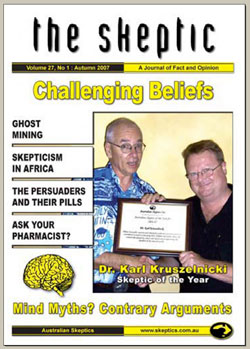
As followers of Christ, we put great value on truth and integrity. And in accordance with Scripture we ‘test all things, holding fast to what is good’ (1 Thessalonians 5:21). I challenge Dr K to demonstrate (as opposed to merely asserting) a single erroneous fact (as opposed to merely interpretations he finds disagreeable) on Creation.com. We are open about our presuppositions (bias) while evolutionists tend to deny that they start with their answer (There is no Creator …) and work backwards to get evolution (… and yet we exist, therefore we must have evolved).
Most Skeptics delight in equating belief in creation to belief in a flat earth, implicitly perpetuating the urban myth that Europeans in the Middle Ages were less intelligent and believed the earth was flat (see Topics: Flat earth). To his credit, Dr K does not use this particular slur against creationists, and in fact has boldly denounced the flat earth urban myth.11
It is disappointing that people who pride themselves on their skepticism should be so unwilling to apply their skepticism to evolution. Skeptics fancy themselves immune to gullibility, and yet refuse to question the assumptions and dogmas of evolution.
Which is why it was such a delight to read the Sydney Morning Herald of 21 February 2008. Scientists had found that an insignificant ‘little round ball of algae’ was actually a living missing link between Apicomplexan parasites (which cause human diseases, most notably malaria) and dinoflagellates (water-borne creatures, some of which can cause ‘red tides’ that leave us with poisonous shellfish).
Dr K is referring to Chromera velia. We are planning to publish soon a critique of the ‘missing link’ claims made about this microorganism (keep watching our website). It sounds like it could be a case of a benign organism degenerating into a pathogenic specialized organism. Cases of this sort of change include:
- Loss of the ability to correctly assemble flagella, resulting in the toxin-injecting bubonic plague germ Yersinia pestis.
- Loss of half the genome in some mycobacteria, resulting in Mycobacterium leprae, the germ that causes leprosy.
- Loss of chemotaxis causing virulence in Vibrio cholerae.
- Genome decay making Mycoplasma an obligate parasite.
And where did they find this missing link? Sydney Harbour!
This is one of the few bottom-of-the-harbour schemes that has brought us closer to the truth, and it benefits the Public Good.
Regardless of what the creationists like to think or say, missing links are all around us, and they’re making a Gospel Truth of evolution.
No, distinctive kinds of creature are all around us, and they’re making offspring after their kind, just as the Bible says. We observe variation and degeneration within each kind, including adaptive changes in daughter populations enabling them to survive better in particular niche environments. But organisms are never observed to change into different kinds of organisms. Such transitions exist only in the stories told about them by evolutionists, as they try to shoehorn the recalcitrant facts of nature into their evolutionary framework of understanding.
Andrew Lamb
References
- Karl Kruszelnicki, Missing link’s Gospel truth, Great Moments in Science, Australian Broadcasting Corporation, 5 June 2008, www.abc.net.au/science/articles/2008/06/05/2265784.htm? site=science/greatmomentsinscience. Return to text.
- Battle over evolution: Bill Moyers interviews Richard Dawkins, Now, 3 December 2004, PBS network, www.pbs.org/now/transcript/transcript349_full.html. Return to text.
- See Mark Johansen, Is evolution pseudoscience? Creation 29(4):25–27, September 2007. Return to text.
- Colin Patterson, personal communication to Luther D. Sunderland, 10 April 1979, published in Darwin’s Enigma, Master Books, 1998, page 102. Return to text.
- Alan Feduccia; cited in: Virginia Morell, Archaeopteryx: early bird catches a can of worms, Science 259(5096):764–65, 5 February 1993; page 764. Return to text.
- Patrick Conlin Gallagher PhD and Laurie Bonner, Your horse’s back, Equus 341:44–53, March 2006; page 50. Return to text.
- Michael Denton, Evolution: A Theory in Crisis, Adler & Adler, 1986; page 190. Return to text.
- Andrew Bain, Fossil fever in the Rockies, Sunday Mail Escape, 13 May 2007, page 9. Return to text.
- William A. Hoesch, Fossil political correctness in the sixteenth century, Back to Genesis 217:c, January 2007, www.icr.org/article/3138. Return to text.
- Michel Peissel, Tibet: The Secret Continent, page 21, Cassell Illustrated, 2002. Return to text.
- Karl Kruszelnicki, Mythconceptions: What goes around …, Weekender theweekender.com.au. [This article appeared in the print version of Weekender magazine several years ago. We have a photocopy on file. A.L.] Return to text.
Readers’ comments
Comments are automatically closed 14 days after publication.