
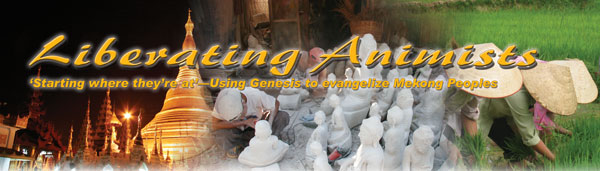
The author has been working as an OMF missionary1 among the people who live in the mountains of southern China and northern areas of Vietnam, Laos, Thailand, and Myanmar (Burma)—a place known as the Mekong River region.2
People in the Mekong River region, spanning 70 ethnic groups, all have one thing in common. Even though they speak different languages and some call themselves Buddhists and many have lived under Communist governments for many decades, they all share a belief that the world in which they live is controlled by spirits. From what I have seen, Communism and Buddhism are often just veneers that overlay animistic worldviews for several hundred million people in the Mekong Region.
The spirit world is real

They believe that everything in nature is controlled or inhabited by evil spirits or demons. This includes vegetables and trees, animals, and objects like rocks, rivers and mountains. They treat these things with great respect and make offerings to bring themselves ‘good luck’ or favour, so the spirits—including the spirits of their dead ancestors—won’t be offended and cause them harm.
Everything they do is controlled by their belief that the spirit world is real. They highly respect their witchdoctors or shamans because they believe they are in touch with the spirit world. Before they do many things, people go to the witchdoctor and ask him whether they should. He tells them yes or no.
In nearly all houses there is a shelf for a demon god or an ancestral altar. This is the case for both Animists and Buddhists, both city people and village people. There is no distinction. It’s very common to walk through a predominantly Buddhist town and see people offering bottles of Coke or candy or other food on the public spirit shrines to appease the spirits and to make sure they are happy.
Belief about life after death
One group believes that when they die they go to a spirit world where they are still able to eat. Their families have to make offerings of food at the temple, so that their relatives will have food in the after-life. The priests constantly use loudspeakers to remind the people that their ancestors will die of starvation if they do not conform.
We have found that if a person is very interested in the Gospel, then at night he may have very vivid dreams, seeing his parents or ancestors starving, and so when he wakes up next morning he goes to the temple to make an offering. Some give up inquiring about becoming a Christian because it’s so real to them to see their parents starving in their after-life.
Introducing them to God
- There are striking similarities between this account and certain ‘alien encounters’—see pp. 225–268 in Gary Bates’ book Alien Intrusion—UFOs and the Evolution Connection.
Our aim is to tell these peoples the Gospel message about Jesus Christ and then see the churches that develop multiply themselves. We tell them who God is, how He loves them, and why God sent His Son to die for them. We long for them to come into the freedom of knowing the true God who can deliver them from their fears and give them peace and joy.
To do this, we missionaries live among them, learn their stories, their customs and their legends, and from these we try and understand their worldview. We look for opportunities from their own stories to start the process of introducing the people to God. That is, we start where they are at.
Stories similar to the Bible
Each people group has its own story about how the world began and where people came from. Most of these have similarities to the Creation account in the Bible. Most groups believe in a creator god who sent two people into the world. Sometimes there are several people because there are several gods who have done this. When we begin with the Genesis account of Creation, they generally know what we are talking about.
The Tai Dam have a story about a great flood. In this story rain fell incessantly for three months and water completely covered the mountains. Four gourds as big as a house were placed on the waters and they floated around. Inside were the 550 clans of Tai, 330 clans of hill people and every kind of bird, animal and serpent. Once again, when we tell them the true account of the Flood in Genesis, they know what we are talking about.
Because these people are so conversant with the evil spirits, we tell them how in the beginning one of the angels in Heaven, called Lucifer, rebelled against God and led a third of the other angels in a rebellion against God. God banished them from Heaven and sent them to Earth. We explain that it is these fallen angels who now roam the earth and that these are the evil spirits or demons that the people now fear and worship. The people know the names of some of these spirits. For example, they name a spirit and tell us, ‘So-and-so is the spirit who lives in those trees over there.’ Thus they immediately recognize the truth of what we are saying.
Deception and deliverance
These spirits deceive the people into thinking that they are there for their protection, but they are being duped. On a trip into south-west China one of our workers challenged the people in a village when they complained of being poor. A demon had deceived them into thinking he was the spirit of prosperity, and the people called him ‘Da Chia Meng’. They said that they had been worshipping this spirit for 20 generations, making many sacrifices every new year to it. The people asked, ‘Do you have a better way?’ My colleague went on to teach the people that God is the true spirit (John 4:24) who loves them (John 3:16; 10:16) and who can help them.
Twenty generations would be about 400 years. Genealogies are very important to Mekong peoples. They measure time in the past in terms of the number of ancestors involved, and they can recite their ancestors’ names for many, many generations. This is why they are very, very impressed by the genealogies of Jesus that go back to Abraham in Matthew 1:1–16, and to the first man, Adam, in Luke 3:23–37.
Preparing the way
Introducing Jesus and the Gospel can take several weeks (or as little as 20 minutes). We usually spend a lot of time in the Old Testament preparing the people for Jesus, just as God prepared the Jews in the O.T. We tell them this in story form, starting with who God is (John 4:24), how God created the world (Genesis 1), and who Satan is (2 Corinthians 4:4; Ephesians 2:2). We point out man’s rebellion (Genesis 3), then God’s promise despite this rebellion (Genesis 3:15), and then go through the sacrificial system (Leviticus 4ff.). The animistic people like that part. They really do understand that there needs to be a sacrifice (cf. Hebrews 9:22).
We get to Isaiah where it talks about the suffering servant (ch. 53). They identify this person as the only sacrifice that needs to be made; they want to know who this person is. At times we can go straight from there to Jesus (Acts 4:12), because He was the suffering servant (Isaiah 42:1–4, cf. Matthew 12:16–21). Sometimes they are not yet ready for this, and so we continue through the Bible, talking about the prophets and how they spoke of the coming Messiah.3 Then we introduce Jesus, whom we have talked about right through the Old Testament4 without actually mentioning His name. The people immediately understand who this person is, and what He came to do. They are then usually ready to receive Him or reject Him.
This chronological Bible teaching has been very successful among the animistic peoples who think chronologically.5 People hear the Bible stories and we encourage them to then go and tell their friends. Because many are oral societies, they love to hear stories and tell their friends about the new stories they have heard. This is great for fulfilling our aim of planting churches that will multiply churches that will multiply churches.
References and notes
- OMF is OMF International, formerly Overseas Missionary Fellowship, and before 1964 the China Inland Mission, founded by James Hudson Taylor in 1865. Return to text.
- The Mekong River is the 10th largest in the world. It begins in Tibet and flows for over 4,200 km (2,600 miles) through all the countries mentioned to the South China Sea. There are about 600 minority groups in this area. OMF currently works among 19 of them. Return to text.
- For example, born of a virgin (Isaiah 7:14), at Bethlehem (Micah 5:2), anointed by the Spirit (Isaiah 61:1ff.), pierced in his hands and his feet but not have a bone broken (Psalm 22:16; 34:20), buried with the rich (Isaiah 53:9), rise from the dead (Psalm 16:10), etc. Return to text.
- See Dr Jonathan Sarfati’s DVD presentation Jesus in Genesis—The Messianic Prophecies. Return to text.
- It should be noted that with some Mekong groups where Buddhism is much more the predominant belief system, this method does not have quite the same results. Return to text.
Readers’ comments
Comments are automatically closed 14 days after publication.