

Journal of Creation 21(2):16–19, April 2007
Browse our latest digital issue Subscribe
Loess problems
Loess, generally considered to be wind-blown silt, has caused a number of problems for uniformitarism. The major problems are the missing periglacial loess from past ice ages, a lack of a source for the immense volume of loess (covering about 10% of Earth’s land surface) and the lack of eroded loess from past ice ages. How loess is produced has also caused a quandary for uniformitarians, with only fluvial tumbling in mixed-sized sediment producing a large volume of silt. However, the Flood and post-Flood Ice Age provide a more plausible framework in which to explain the volume and distribution of loess. Extreme turbulence in the Flood would have provided the right context for producing the necessary silt, which may have been reworked during the dry, deglacial phase of the Ice Age.

Loess is difficult to define, but it is generally considered to be wind-blown (eolian) silt.1 It is composed mostly of quartz grains, with minor portions of clay and sand often mixed with the silt. Loess is commonly intermixed vertically with ‘paleosols’, which are supposedly fossil soils that have been preserved in the geologic record or buried deeply enough that it is no longer subject to soil forming processes.2 Scientists previously believed the silt particles in loess were derived from ice abrasion, but they now believe that loess has both a glacial and non-glacial origin.3–6
Loess covers much of the mid and high latitude continents, forming a thickening belt in Europe from the Atlantic coast east into Russia and the Ukraine in areas generally south of the Scandinavian Ice Sheet. It also covers a large portion of the Midwest of the United States, the lowlands of Alaska, southeast Washington and eastern Idaho7 and some 440,000 km2 of central China, where it is up to 300m thick.8 Millions of woolly mammoths and other Ice Age animals are mostly entombed in loess in non-glaciated areas of Siberia, Alaska and the Yukon Territory of Canada.9 Wind blown material is common within the Ice Age portion of the Greenland ice cores.10
Despite the large number of studies, there are many problems associated with loess from a uniformitarian view: ‘Few problems in Quaternary geology have raised so much controversy as loess’.11
Missing loess
The most difficult uniformitarian problem is the ‘missing loess’. Practically all periglacial loess is derived from the ‘last’ glaciation within the uniformitarian multiple glaciation system, and specialists have tended to avoid discussing the implications:
‘The periglacial loesses from China and elsewhere predominantly date from the last Pleistocene glaciation: relatively few comparable occurrences are known from earlier Quaternary glaciations … . A loess problem that is rarely touched upon is the almost complete lack of loesses from ice ages before the last one’.12
The periglacial loess in China is different from the thick, extensive loess in central China, which is considered non-glacial.13 Quaternary geologists once believed there were only four ice ages, but now they claim there have been over thirty during the past 2.5 million years of geological time, based on deep-sea cores.14 Where is the loess from all these previous supposed ice ages? The most straightforward deduction is that there were no previous ice ages; there was only one Ice Age, which was one of eleven reasons I listed in support of just one.15
Uniformitarian scientists have attempted to explain this missing loess in various ways. The simplest explanation is that the loess was eroded by water and wind during interglacial periods. The problem with this explanation is that the earth is currently in an interglacial (the Holocene) and supposedly about ready to plunge into the next ice age, according to the Milankovitch mechanism for multiple ice ages. If it was eroded, the loess from the ‘last’ ice age has hardly been eroded during the current interglacial, despite accelerated erosion caused by deforestation and agriculture.16
As a result of this contradiction to the uniformitarian idea of multiple ice ages, some scientists have simply suggested that the current interglacial is ‘different’ from all the previous interglacials. But such a special condition for the current interglacial is difficult to imagine for some geologists,17 probably because such a suggestion defies the very uniformitarian principle upon which current geological interpretation is based.
A recent hypothesis suggests that the loess from each ice age is simply ‘recycled’.18 According to this idea, each ice age produces a little more loess than is lost during interglacials. So, the amount of loess builds with time from the first glaciation to the thick loesses of today.
It seems inconceivable that the entire amount of loess is reworked during each glaciation so as to destroy evidence of loess from previous glaciations. Besides, the idea is untestable and ad hoc. Since some of this loess is trapped in river valleys, such as the Mississippi Valley, how would loess be scoured out of these valleys and redeposited? There is also the problem that each time the loess is recycled, why is it always recycled at the same location and not spread all over the continents? Do strong ice age winds that would rework loess only blow in the loess belt?
Lack of a source for loess
A second conundrum is the missing sources for loess. The amount of loess on the continents is immense, greater than the volume of glacial till. It covers 10% of the earth’s land surface.19 Where and how did all this silt originate? The source and erosion of loess is difficult to explain:
‘This leaves one well known question (where do the loesses come from?) and one rarely (if ever) asked question: where did the eroded loesses go to?’17
One of the main problems for the origin of loess is that quartz in igneous and metamorphic rocks has a mean grain size of approximately 700 μm, while the main size of detrital quartz in 60 μm.20 The cutoff between sand and silt is 63 μm and most loess is in the range of 20 to 50 μm. So, the size of the quartz has to be reduced 90% from its source to account for the formation of loess. How does this happen?
Four sources of loess have been proposed: (1) hot deserts, (2) cold deserts, (3) drowned sources covered by late-glacial sea level rise and (4) glacial grinding.21 All these sources raise questions. Hot and cold deserts do not produce significant quantities of loess. There are problems associated with the origin of loess from continental shelves, now underwater, since many loess belts are far inland from the sea.22
It had been assumed that the formation of loess was only by subglacial grinding.3 However, loess has been discovered in areas far from present or past glaciers or ice sheets, such as in northern Tunisia, northern Nigeria, Israel and Saudi Arabia.23 Minor amounts of loess have even been found in the Sahara Desert. Furthermore, experiments have shown that glacial grinding does not produce much silt.3,5 This deduction is reinforced by the observation that hardly any loess is produced by or deposited in front of present-day glaciers.21 So, there does not appear to be a viable source for the immense volume of loess.
Where is the eroded loess?
A third problem is the lack of eroded loess. In the last quote above, an ignored problem is the location of all the eroded loess over the several millions of years allotted to multiple ice ages by uniformitarian scientists. Loess does not erode easily, but when it starts, vertical erosion proceeds relatively fast.16 So, there should be a huge volume of eroded loess deposited somewhere if all these glaciations were real. However, there is little of this reworked loess found on the continents. Just like the missing loess, the supposedly eroded loess is also missing. Furthermore, little of the loess, such as the Chinese loess, has been eroded.
The lack of erosion of current loess deposits and the failure to find several millions of years of eroded loess strongly suggest that those millions of years are imaginary. Loess is very young and fits in well with the young-earth timeframe and one Ice Age.
How is loess produced?
Fourth, how is loess produced? There are now several other mechanisms besides glacial grinding suggested for the formation of loess. These mechanisms include wind abrasion, weathering, frost weathering, salt weathering and fluvial abrasion. However, experiments in the formation of silt particles have demonstrated that these other mechanisms are either ineffective or too slow, except for fluvial abrasion of mixed-size sediment:
‘The tumbling of sand alone in water resulted in very little comminution or silt production … However, the addition of gravel-sized ceramic spheres to simulate a mixed-size sediment load in a turbulent, high-energy fluvial environment, produced rapid comminution and particle size reduction.’24
Based on a table of the amount of silt and the time needed to produce it, fluvial tumbling with mixed-sized sediment rapidly produced a large volume of silt, while wind abrasion was a distant second.25
Flood-Ice Age solution
How would the Flood, followed by a post-Flood Ice Age, explain the observations of loess? There does not seem to be enough time in the Ice Age to generate so much loess by glacial grinding or any other post-Flood mechanism. For instance, the monstrous volume of non-glacial silt in the Chinese ‘loess’ cannot be accounted for even within 2.6 million years of uniformitarian time:
‘The supply of immense quantities of quartz-dominated silt over the past 2.6 Ma for the Chinese loess plateau is indeed a very intriguing problem.’26
It is inconceivable that the sediments for the Chinese ‘loess’ can be formed after the Flood.
A much better possibility for explaining the thick sources of ‘loess’ is extreme turbulence in the Flood, which would provide an ideal environment during rock erosion for producing large volumes of silt. The Flood would act like a global water abrasion mechanism, similar to the tumbler experiment of mixed-grain sizes described above.
The Flood might also explain the origin of the particles that make up thick siltstone and shale, which contains ~75% silt, observed in the rock record. The formation of all this silt and its concentration in the rock record is a difficult uniformitarian problem.27 One siltstone formation in Africa averages 300 m thick.28
As the Floodwater drained, mud with much silt would have been deposited in ‘slackwater’ areas, which are areas with low current velocity late in the Flood. This mud could be left on the surface after the Flood in various areas. For the Palouse silt, such a slackwater area could have been created by the uplift of the Cascade Mountains of western Washington and Oregon. Strong Ice Age winds would then rework the top of the mud layers into true wind-blown deposits and spread real loess downstream from sources.
The origin of most of the ‘loess’ from Flood abrasion is a rather radical idea but seems to be the only possibility within the young-earth timeframe. There is further evidence suggesting the original Flood generation of surficial silt deposits. One of the reasons is that water seems to be involved in the transport process of the silt at some stage:
‘Indeed, many loess-like deposits seem to have undergone some transport by water and many such deposits accumulated in previous depressions even seem to have formed by settling from suspension in shallow pools or lakes.’16
The action of water at some stage is reinforced by Wright:
‘Finally, a recent geochemical and isotopic study of loess deposits by Gallet et al. (1998) revealed that all loess particles must have experienced at least one cycle of aquatic transport.’27
The above quotes seem to suggest more than transport by glacial meltwater within the uniformitarian paradigm. Gallet et al. further state that the geochemical characteristics of loess are indistinguishable from shales, which favours a Flood generation of ‘loess’.29
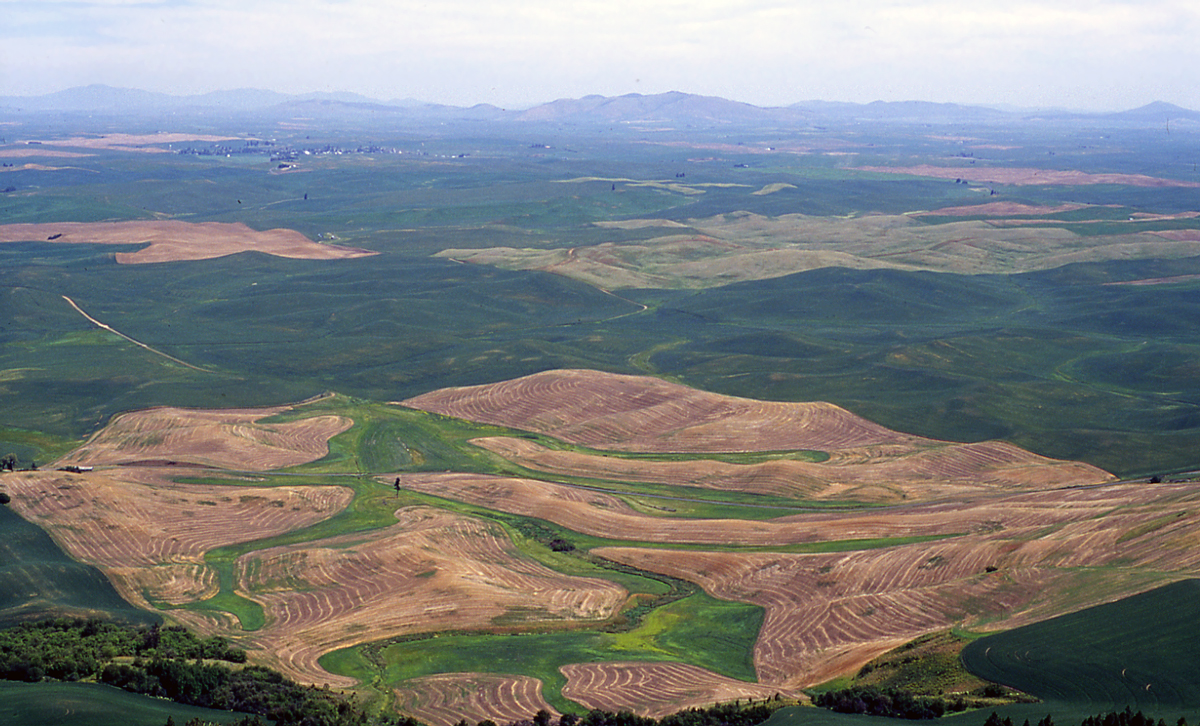
In studying the Lake Missoula flood,30 I noticed that since the peak of the Ice Age, only about a metre of wind-blown silt was deposited on top of flood rhythmites in Burlingame Canyon of southeast Washington (figure 1). This canyon is within the area of the deposition of the thick Palouse ‘loess’ that ranges in thickness from 2 to 75 m and covers an area greater than 50,000 km2.31 Figure 2 shows a picture of the rolling Palouse silt. The rolling character is actually derived from the underlying Columbia River Basalts.32 The early Ice Age should have been wet with the formation of little loess, while deglaciation should have been much drier with great amounts of wind blown silt. If all the Palouse ‘loess’ was formed by dry winds during deglaciation, much more than a meter of silt should have been deposited on these rhythmites.
Furthermore, sponge spicules have been found in the ‘loess’.33 Harold Coffin collected sponge spicules, likely marine, at all nineteen locations sampled within the Palouse ‘loess’ of southeast Washington.34 The lower layers of the Palouse silt are layered, and rounded gravel is also found at some locations within the silt.33
This evidence suggests that the lower portions of many silt and sand deposits on the surface of the earth likely were laid down in the very last moments of the Flood. This material was subsequently reworked during the dry, deglacial phase of the Ice Age. This reworking can explain the fact that loess contains some Ice Age mammals.
A further implication is that the Flood/post-Flood boundary is in the late Cenozoic in the loess source areas, in particular in the early to mid Pleistocene, such as in the Palouse ‘loess’ and probably in the Chinese loess. Such a boundary was advocated by the late Roy Holt.35
References
- Wright, J.S., ‘Desert’ loess versus ‘glacial’ loess: Quartz silt formation, source areas and sediment pathways in the formation of loess deposits, Geomorphology 36:231, 2001. Return to text.
- Klevberg, P., Oard, M.J. and Bandy, R., Are paleosols really ancient soils? Creation Research Society Quarterly 40(3):134–149, 2003. Return to text.
- Wright, ref. 1, pp. 231–256. Return to text.
- Muhs, D.R. and Bettis III, E.A., Geochemical variations in Peoria loess of western Iowa indicate paleowinds of Midcontinental North America during last glaciation, Quaternary Research 53:49–61, 2000. Return to text.
- Wright, J., Smith, B. and Whalley, B., Mechanisms of loess-sized quartz silt production and their relative effectiveness: laboratory simulations, Geomorphology 23:15–34, 1998. Return to text.
- Smith, B. J., Wright, J. S. and Whalley, W. B., Sources of non-glacial, loess-size quartz silt and the origins of ‘desert loess’, Earth-Science Reviews 59:1–26, 2002. Return to text.
- Busacca, A.J., Begét, J.E., Markewich, H.W., Muhs, D.R., Lancaster, N. and Sweeney, M.R., Eolian sediments; in: Gillespie, A.R., Porter, S.C. and Atwater, B.F., (Eds.), The Quaternary Period in the United States, volume 1, Elsevier, New York, pp. 275–309, 2004. Return to text.
- Kohfeld, K.E. and Harrison, S.P., Glacial-interglacial changes in dust deposition on the Chinese Loess Plateau, Quaternary Science Reviews 22:1,859, 2003. Return to text.
- Oard, M.J., Frozen in Time: The Woolly Mammoth, the Ice Age, and the Bible, Master Books, Green Forest, AR, 2004. Return to text.
- Oard, M.J., The Frozen Record: Examining the Ice Core History of the Greenland and Antarctic Ice Sheets, Institute for Creation Research, El Cajon, CA, 2005. Return to text.
- Van Loon, A.J., Lost loesses, Earth-Science Reviews 74:309, 2006. Return to text.
- Van Loon, ref. 11, pp. 309, 310. Return to text.
- Sun, J., Provenance of loess material and formation of loess deposits on the Chinese Loess Plateau, Earth and Planetary Science Letters 203:845–859, 2002. Return to text.
- Kennett, J., Marine Geology, Prentice-Hall, Englewood Cliffs, NJ, p. 747, 1982. Return to text.
- Oard, M.J., An Ice Age Caused by the Genesis Flood, Institute for Creation Research, El Cajon, CA, p. 149, 1990. Return to text.
- Van Loon, ref. 11, p. 313. Return to text.
- Van Loon, ref. 11, p. 310. Return to text.
- Van Loon, ref. 11, pp. 314–315. Return to text.
- Wright et al., ref. 5, p. 16. Return to text.
- Wright, ref. 1, p. 232. Return to text.
- Van Loon, ref. 11, pp. 309–316. Return to text.
- Van Loon, ref. 11, p. 312. Return to text.
- Wright, ref. 1, p. 233. Return to text.
- Wright et al., ref. 5, p. 25. Return to text.
- Wright et al., ref. 5, p. 30. Return to text.
- Gallet, S., Bor-ming, J., Lanoë, B.V.V., Dia, A. and Rossello, E., Loess geochemistry and its implications for particle origin and composition of the upper continental crust, Earth and Planetary Science Letters 156:158, 1998. Return to text.
- Wright, ref. 1, p. 234. Return to text.
- Nahon, D. and Trompette, R., Origin of siltstones: glacial grinding versus weathering, Sedimentology 29:32, 1982. Return to text.
- Gallet et al., ref. 26, p. 169. Return to text.
- Oard, M.J., The Missoula Flood Controversy and the Genesis Flood, Creation Research Society Monograph Number 13, Creation Research Society, Chino Valley, AZ, 2004. Return to text.
- Busacca et al., ref. 7, p. 294. Return to text.
- Ringe, D., Sub-loess basalt topography in the Palouse Hills, southeastern Washington, GSA Bulletin 81:3049–3060, 1970. Return to text.
- Lowry, W.D. and Baldwin, E.M., Late Cenozoic geology of the Lower Columbia River Valley, Oregon and Washington, GSA Bulletin 63:12, 1962. Return to text.
- Coffin, H.G., The Miocene/Pleistocene contact in the Columbia Basin: time implications, Origins 53:39–52, 2002. Return to text.
- Holt, R.D., Evidence for a late Cainozoic Flood/post-Flood boundary, Journal of Creation 10(1):128–167, 1996. Return to text.

Readers’ comments
Comments are automatically closed 14 days after publication.