

‘Lost world’ animals—found!
Cave drawings brought to life by exciting new discoveries
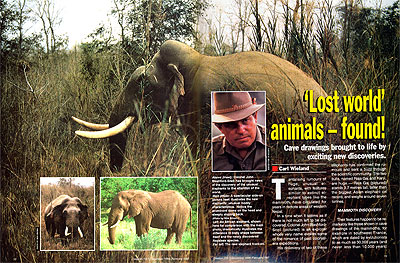
Tantalising rumours of huge, unusual elephants, with features similar to extinct elephant types like the mammoth, have circulated for years in remote areas of western Nepal.
In a time when it seems as if there is not much left to be discovered, Colonel John Blashford-Snell is an explorer whose very name evokes some of the romance of past colonial–era expeditions.
His discovery of two of these elephants has confirmed the rumours and sent a buzz through the scientific community. The two bulls, named Raja Gaj and Kanji, are huge—Raja Gaj stands 3.7 metres (12 feet) tall, taller than the biggest Asian elephant on record, and weighs around seven tonnes.
Mammoth discovery
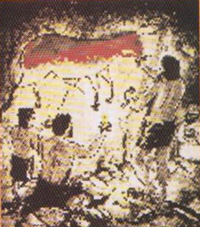
Their features happen to be remarkably like those shown in cave drawings of the mammoths, for example in southwest France, which are dated by evolutionists to as much as 30,000 years (and never less than 10,000 years) ago.1 These distinctive characteristics include unusually sloping backs, ‘reptilian’ appearance of the tail, a swept-up forehead interrupted by a deep depression and a large dome-shaped hump on the top of their heads.
Media speculation about the Nepalese giants has canvassed not only mammoths, but also species believed to be extinct for millions of years, such as the Stegodon, and Elephas hysudricus. Fossil bones of the latter, as well as of mammoths, have been found in Nepal.1,2
Obtaining DNA samples to compare with the DNA of mammoths (of which there are some samples) involves some difficulty. Also, neither mammoth nor modern elephants’ DNA has been properly sequenced yet. Nevertheless, using dung believed to be from these creatures, preliminary DNA testing is said to show that they are more similar to the Asian elephant than to the mammoth. Some speculate that these unique giants might represent some sort of ‘throwback’ due to unusual inbreeding.
Those who blithely accept evolutionary dating have a problem: what are features found in mammoths which supposedly vanished more than 10,000 years ago doing in animals today?3 These features are presumably caused by the same genes which produced them in the ‘extinct’ mammoths. It is most unlikely that even the most ardent evolutionist would think that the same distinctive features evolved twice in creatures that happened to be similar in many other ways as well.
A horse, of course
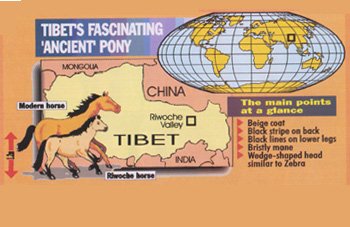
Not long after the elephant discovery, another team of explorers found a previously unknown breed of horse, grazing in a remote valley in Tibet, which looks exactly like those in ‘Stone Age’ cave paintings. Known as the Riwoche (pronounced Ree–woe–chay) horse, it has the same wedge-shaped head (zebras have this too), the same black stripe on its back, and black lines on its lower legs.
Discoveries like this, of animals (or features) which are supposed to be ‘extinct’ long ago, in spite of the discomfort they may cause to evolutionary thinking, seem to always generate headlines laced with evolutionary assumptions. Statements such as ‘prehistoric survivors’ or ‘creatures from millions of years ago that time forgot’ are routine, and serve to further indoctrinate the public into an evolutionary, antibiblical worldview, when the evidence contradicts this view.
When we look at these same facts through a different set of glasses, as it were, we can see that they fit much more neatly into what the Bible teaches is the true history of the world.
A biblical understanding
Most creationists would suggest that there was probably only one ‘elephant kind’ on the Ark, which would have been the ancestor of all living elephants, such as the Asian and the Indian, as well as those which have died out since that time, such as the mammoth, the mastodon, and the stegodon.4 Similarly, one ‘kind’ was likely ancestral to the various types of horses, zebras and asses.
The cave paintings which show features just like the living Nepalese elephants and the Riwoche horse would have been made in the early centuries after the Flood, following the dispersion at Babel, when many rapidly migrating groups would have needed to shelter in caves and use stone tools. This is so, not only because of the fact that small groups leaving a culture do not necessarily carry all its technological ‘know-how’, but also because of the harsh climatic conditions of that inevitable consequence of the biblical Flood, the Ice Age.5
Since the time when these paintings were made is obviously much, much more recent than evolutionists claim, the fact that the same animals are still alive is nowhere near as surprising for the Bible-believer as it is for the evolutionist, who has to believe that they survived unchanged for tens of thousands of years, with no other record of their existence in the intervening period.
It is not surprising to find that the Riwoche horse has a zebra-like head, being descended from the same gene pool. For the same reason, it is not surprising to find that genes giving rise to characteristics similar to those in vanished types are still in some elephant populations today.
The Riwoche horse was described in news reports as ‘primitive’ or as looking ‘archaic’.6 It is obvious that there is nothing ‘primitive’ about this real, modern horse living normally in the same world as the rest of us. Such terms merely demonstrate a belief system being forced onto the facts. It is easier for believers in evolution to label these present–day elephants and horses as ‘archaic’, than to face the uncomfortable alternative proposition; namely, that finding them in the modern world means that the culture which drew the same creatures was far less ‘archaic’, and far closer to modern times, than evolutionary belief requires.
Once Christians learn, and train their children, how to read news of such discoveries discerningly, it will be seen that even stories full of evolutionary terms usually turn out to reinforce biblical creation, the true history of the world.
The Riwoche horse–all the same features as the horses common in ‘stone age’ cave drawings
Creationists agree with evolutionists that forests once covered Tibet, only creationists believe it was much more recent than evolutionists do.
Not surprisingly, the discoverers of this horse also found what look like living remnants of these forests of conifer, willow, birch and other vegetation.
The frequent discoveries of such ‘prehistoric’ survivors and so-called ‘living fossils’ make it ever more difficult to believe the alleged long timespans between ‘prehistory’ and the present.
Re-posted on homepage: 20 April 2022
References and notes
- ‘Elephants take mammoth step out of an ancient past’, The Sunday Mail (Brisbane), December 17, 1995, p. 57. Return to text.
- ‘The elephant that time forgot’, The Mail on Sunday (Adelaide), May 23, 1993. Return to text.
- See ‘Are mammoths still alive?’ Creation 15(4):23 referencing Nature and The Age (Melbourne). This dealt with C14 dating of mammoth remains at 4,000 years (supposedly extinct 6,000 years earlier), and well-preserved mammoth skins kept by the Siberian Evenk tribe, who said they still hunted mammoths, at the turn of the century. Return to text.
- This is not evolution, which would require new genetic information to be added through time. It is instead a ‘downhill’ process which actually involves a thinning out of genetic information into more depleted, but more specialised sub-groups. In modern times, a genetically rich ‘mongrel’ dog population was ‘sorted out’ into more specialised (hence gene-depleted) sub-groups—the various breeds of modern dog—by artificial selection. The enormous natural selection pressures after the Flood, with many empty ecological niches, would constitute a plausible mechanism to see many different elephant types arise from one stock, without any new genetic information. (For more information, see Creation: The Facts of Life by biologist Dr Gary Parker). It is also possible that chromosomal translocations may have, again without adding any new information, contributed to the development of genetic barriers between such daughter groups/species. Also, different mate recognition systems in varieties can cause them to be classified as separate species, although interbreeding is possible in artificial conditions. Return to text.
- See Life in the Great Ice Age, by meteorologist Michael Oard and Beverly Oard. Return to text.
- ‘Stone Age horse found in a lost world of Tibet’, Sydney Morning Herald, November 15, 1995, p. 16. Return to text.


Readers’ comments
Comments are automatically closed 14 days after publication.