

Meeting the ancestors
A fascinating observation about the patriarchal lists of early Genesis

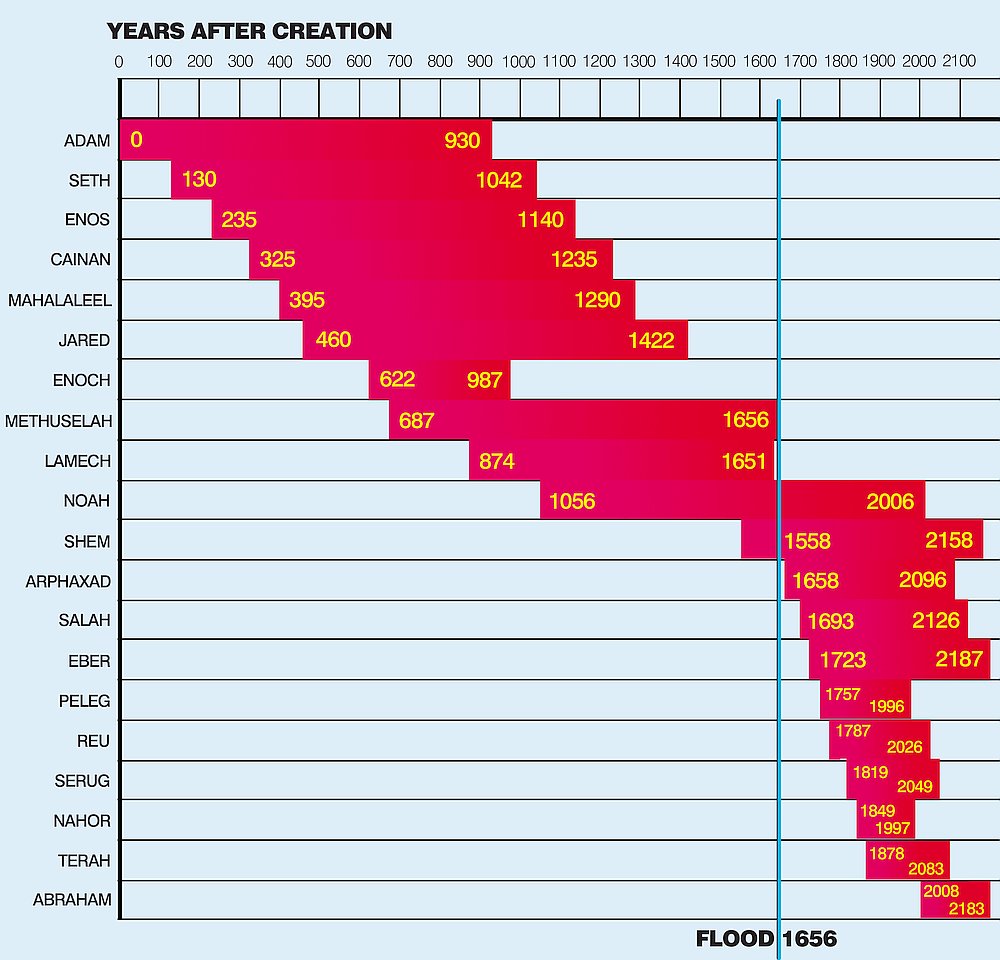
Can you imagine Lamech, the father of Noah,1 talking to Adam and saying, ‘Tell me again what it was like to talk with God in the Garden of Eden, before you ate the forbidden fruit’? A fictitious conversation? Yes, but it could have taken place, because, according to the genealogies recorded in Genesis, Adam did not die until Lamech was 56 years old.2 See table.
What about Abraham saying to Shem, ‘Tell me again how you and your brothers, Ham and Japheth, and your father, Noah, built the Ark, and what it was like to live on it for a year during the Flood, with all the animals God sent you.’ A fictitious conversation, yes, but another which could have taken place, because, according to the genealogies recorded in Genesis, Shem was alive in Abraham’s day!3,4
The Bible is meticulous in recording the ages of the patriarchs from Adam to Abraham. It states how old each was when his first child, or the child in the Messianic/covenant line, was born, how long each lived after that, and/or how old each was when he died.5,6 Hence, by simple arithmetic, the Year of the World (in Latin Anno Mundi, so usually abbreviated to ‘AM’) that each patriarch was born, lived and died can be easily and accurately reckoned, and any possibility of a ‘gap’ is thereby eliminated from these Genesis lists.
Thus Adam, who was created on the sixth day of the first year, and died AM 930, could have talked with his descendants all the way down to Noah’s father, Lamech, who was born AM 874. And Noah’s son, Shem, born AM 1558 and died AM 2158, could have talked with his descendants all the way down to and including Abraham (born AM 2008).3
Similarly, the date of the Flood after Creation can also be accurately stated. Genesis 7:6 says: ‘And Noah was six hundred years old when the flood of water was upon the earth.’ From the table we see that Noah was born AM 1056, and so the Flood occurred 600 years later, i.e. AM 1656, which was 352 years before Abraham was born.
Notice that Shem (died AM 2158) and Eber (died AM 2187) both outlived all their descendants down to Abraham. In the patriarchal society that then was, it is no wonder that the Israelites were also known as ‘Semites’ (after Shem) or ‘Hebrews’ (after Eber).
Are there any gaps?
Some well-meaning Christians have said that there are gaps in these genealogies. The reason they say this is to try and stretch the Biblical timeframe to partly accommodate secular geology and archaeology. However, as shown above, there are no gaps in the Genesis genealogies—they were written to be water-tight!
Are the records accurate?
There are 11 verses in Genesis which read, ‘These are the generations [Hebrew toledoth = ‘origins,’ ‘history,’ or ‘family history’] of … ’.7 These statements all come after the events they describe, and the events recorded in each division all took place before rather than after the death of the individuals named, so they may very well be subscripts or closing signatures, i.e. colophons, rather than superscripts or headings. If this is so, the most likely explanation of them is that Adam, Noah, Shem, and the others each wrote down on clay tablets an account of the events which occurred during their lifetime,8 and handed them down from father to son via the line of Adam, Seth …, Noah, Shem …, Abraham, Isaac, Jacob, etc. Moses, under the guidance of the Holy Spirit, selected, compiled and edited these, along with his own comments, into the book we now know as Genesis.9
Such written records would have helped keep accurate any oral accounts of the happenings, as would the fact of the huge ancestral overlap. Thus, between Adam and Abraham there needed to have been only two intermediaries, e.g. Methuselah (or perhaps Lamech), and then Shem.
The genealogical details of the early patriarchs are given three times in the Bible—in Genesis chapters 5 and 11, 1 Chronicles 1, and Luke 3—a fact which shows the importance that God places on these details.10,11,12 Jude 14 specifically refers to Enoch as being ‘the seventh from Adam,’ thereby reinforcing the fact that these genealogies are a tight record of history and that we are meant to take them literally, as did the New Testament writers.13
Those long lifespans
Many have suggested that the long lifespans of the patriarchs in early Genesis were not historical. However:
1) There is nothing in the text to suggest that they were not intended to be historical.
2) Their order of magnitude is supported by Sumerian records.1
3) The Hebrew way of writing numbers (in words) would make it very difficult to introduce copying errors.
4) The suggestion has been put that each ‘year’ was actually meant to be a month. Thus Methuselah, for example, would be 80 years at death. But in addition to being an ad hoc assumption with no textual support, it makes no sense, as some of the patriarchs would be fathers in their early childhood.
5) There are several internal consistencies. From the ages given at death, it can be calculated that Methuselah died exactly in the year of the Flood.2 Whereas if one used the (fallible) Septuagint, his death would be 14 years after the Flood, yet he was not on board the Ark—an internal contradiction. Dramatic lifespan decline (only) kicks in just after the Flood, consistent with its catastrophic effect on the world and on populations.
6) There is no biological barrier to long lifespans, and there are convincing genetic explanations (in addition to any environmental factors) for the subsequent decline.3
References and notes
- The ages of their pre-Flood kings seem astronomical. However, when one realizes that the Sumerians used a number base of sixty (not ten), presumably when transcribing from historical pre-Flood records, the ages come into good alignment with the patriarchal lifespans of Genesis. See López, R., The antediluvian patriarchs and the Sumerian King List, J. Creation 12(3):347–357, 1998.
- Some commentators argue that the name Methuselah comes from the roots muth (= death) and shalach (= bring or send forth), thus his name means ‘his death shall bring’—a prophetic reference to the Flood judgment. If so, then it is fitting that he was the longest-lived person in the Bible, a symbol of God’s immense patience and longsuffering.
- Wieland, C., Living for 900 years, Creation 20(4):10–13, 1998 and Decreased lifespans: have we been looking in the right place?, J. Creation 8(2):138–141, 1994.
References and notes
- Not to be confused with another Lamech, son of Methusael and descendant of Cain (Genesis 4:17–18). Return to text.
- Adapted from McIntosh, A.C., Genesis for Today—Showing the relevance of the creation/evolution debate to today’s society, 2nd edition, Day One Publications, Epsom, UK, pp. 44–47, 2001. Note that Genesis for Today discusses other options for the dates of Abraham. Return to text.
- Abram, mentioned first in Genesis 11:26, was the most important of the three sons born to Terah; he might or might not have been the first born, cf. Shem, Note 6. Abram left Haran at the age of 75 (Genesis 12:4), after the death of Terah (Acts 7:4) who died at age 205 (Genesis 11:32). This would mean that Abram was born when Terah was 130, i.e. in AM 2008. Return to text.
- Abram’s name, which means ‘exalted father,’ was changed by God to Abraham, meaning ‘father of many,’ when Abram was 99 years old (Genesis 17:1,5). Return to text.
- E.g. Genesis 5:3–6: ‘And Adam lived a hundred and thirty years, and begat a son in his own likeness, after his image; and called his name Seth: And the days of Adam after he had begotten Seth were eight hundred years: and he begat sons and daughters: And all the days that Adam lived were nine hundred and thirty years: and he died. And Seth lived a hundred and five years and begat Enos … ’. Return to text.
- Of Noah’s three sons, born after Noah turned 500 (Genesis 5:32), although Shem (the son in the covenant line) is mentioned first, Japheth is described as the elder (Genesis 10:21), so presumably Japheth was born when Noah was 500; Ham is called the younger (Genesis 9:24). Genesis 11:10 says, ‘Shem was one hundred years old, and begat Arphaxad two years after the flood’; i.e. Shem was 100 in AM 1658, and so would have been born AM 1558, when Noah was 502. Return to text.
- Genesis 2:4; 5:1; 6:9; 10:1; 11:10; 11:27; 25:12; 25:19; 36:1; 36:9; 37:2. Return to text.
- Most of the events of Creation Week in Genesis 1 occurred before Adam was created, so must have been revealed by God, probably to Adam. Return to text.
- The Lord Jesus Himself and the Gospel writers said that the Law was given by Moses (Mark 10:3; Luke 24:27; John 1:17), and the uniform tradition of the Jewish scribes and early Christian fathers, and the conclusion of conservative scholars to the present day, is that Moses wrote Genesis. See Grigg, R., Did Moses really write Genesis? Creation 20(4):43–46, 1998. Return to text.
- Cf. the importance of repetition of incident in Genesis 41:32 and Acts 10:9–16; 11:10. Return to text.
- For a discussion of the mention of Cainan in Luke 3:36, see Cainan: How do you explain the difference between Luke 3:36 and Gen. 11:12? Return to text.
- For a discussion on how many people there were pre- and post-Flood, see Batten, D., Where are all the people? Creation 23(3):52–55, 2001. Return to text.
- The key to understanding any portion of the Bible is to ascertain the purpose of the writer of that part. A straightforward reading of these three records indicates that the writers intended to give a complete genealogical record from Adam to Abram/Abraham (and on to the kings of Judah in 1 Chronicles, and on to the Lord Jesus Christ in Luke 3). See Biblical chronogenealogies. Return to text.


Readers’ comments
Comments are automatically closed 14 days after publication.