

Mining mountains in West Virginia

Like so many people today, miners in West Virginia often commute to work, but that’s where the comparison ends. Their travel is deep inside the earth below the mountains of ‘the mountain State’, famous for its coal.
It’s not unusual for coal miners to descend 350m (1,200ft) down slope before travelling for 20–30 minutes out into the mine.
When you work inside a mine, you discover that it’s dark and damp. A new miner needs to get used to moving around with just a light on his head. Rookie miners, or ‘red hats’ as the old hands call them, soon realize that coal mining can be dangerous. It’s an unwritten rule to stay on your toes and look out for your workmates.
Many start underground because of their family history, with fathers and grandfathers being coal miners before them.
Not everyone who darkens a coal mine is thinking about Noah’s Flood, but there is much underground to remind us about that event—fossils for example.
At first, ‘red hats’ are fascinated to find the remains of trees, leaves, shells and sometimes fish so far underground. It’s fascinating to see delicate, fern-like leaves and leaf-scarred trunks with a scaly appearance.
The vegetation looks like it grew in a tropical climate, but there are no tropical plants growing in West Virginia today. Going underground is like travelling into a long lost world, a different environment when the coal was laid down.
Miners often uncover roots and branches, and in places the trees and brush are heaped up, just like they were dumped beside a flooding river. It is not uncommon to find large tree trunks, some as long as 25m (80ft). The tree trunks lying on their sides give the impression they have been washed into place.
Frequently fossil leaves show exquisite detail of veins and stalks. This reinforces the impression that the vegetation was buried quickly, before it had time to decay.

Usually the layers of coal, or seams, are sandwiched between layers of sandstone, which were laid down by flowing water. Naturally mining companies prefer to work seams that are reasonably flat and level, although in places seams will run up quite steeply in areas where the earth has moved, near a fault, for example.
The machinery can work seams that vary from as thick as 3m (10ft) in places to just 1m (3ft) in others.
Miners need to be alert for methane, a gas that builds up underground. It is flammable, explosive and poisonous. Methane escapes when the coal is cut, so the mine must be well ventilated to keep the area safe.
When the machinery stops, you can hear the methane hissing from the coal face. Sometimes you can see it bubbling in water pooled on the ground. Mining companies are exploring ways to extract the methane before the coal is extracted.
The methane suggests that the coal is not millions of years old as generally believed. In such a long time you would expect that gas under such pressure would long ago have leaked out of the coal.
Working deep below the earth and seeing the evidence of the fossils, the coal, the sandstone and the methane could make the Bible come to life. Coal is evidence of the catastrophe of Noah’s Flood, and many miners agree with that.
Kettle bottoms—deadly tree roots
Sometimes, after the miners have dug out the coal seam, they can see tree roots in the sandstone roof. The wood is well preserved and they can even see where the roots have spurred off around its base. It’s like they are standing underneath the tree looking up at it.
Coal miners call the stumps ‘kettle bottoms’ or ‘kettle boms’. The wood is petrified and heavy.
Kettle boms are deadly dangerous because they can fall out without warning—a constant peril to coal mining families in West Virginia.
You could think that these trees grew in place, but how could such tall trees remain upright on a soft, spongy peat bog?
Surprisingly, during a watery catastrophe, broken tree trunks will often tip vertically with their heavy end, the roots, downward, into the water. They look like they grew in place but didn’t. This happened to many of the pine trees destroyed in the catastrophic eruption of Mt St. Helens in 1980.1
- And to the trees destroyed at Yellowstone; see Sarfati, J., The Yellowstone petrified forests: evidence of catastrophe, Creation 21(2):18–21, 1999; <creation.com/yellowstone>.
Some plants from West Virginian coal
Calamites grew up to 10 m (30 ft) high and looked a little like bamboo. They are also known as ‘articulates’ because of their jointed stems.
Lepidodendron, also called the ‘scale tree’, is an ancient lycopod. They grew more than 40 m (130 ft) high with trunks 2 m (6 ft) in diameter.
Did the coal form in a swamp?
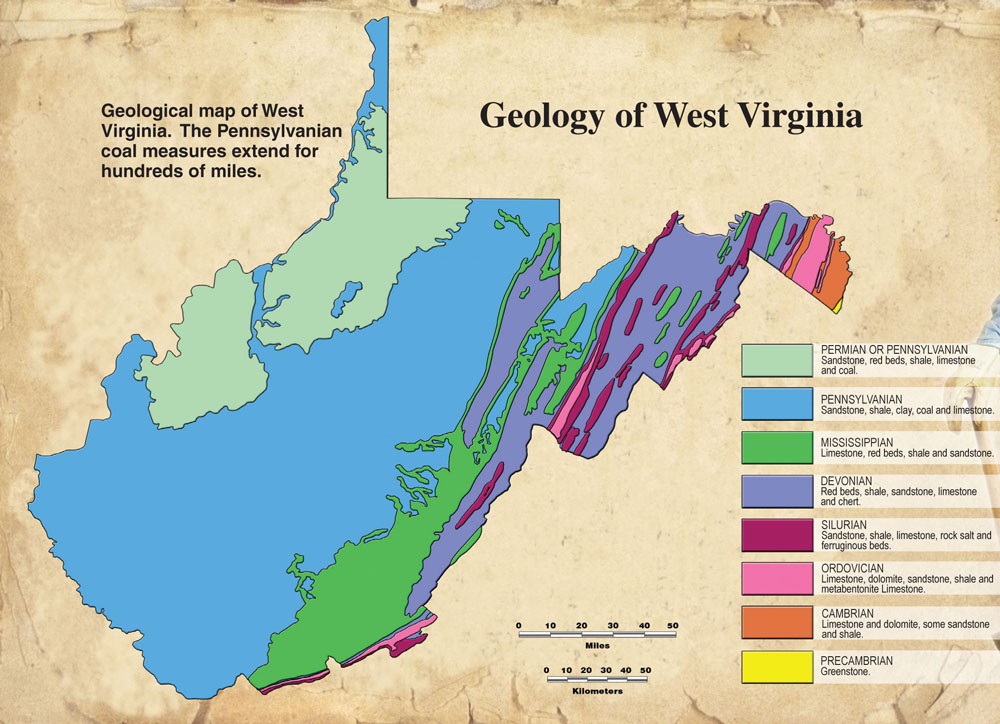
Most geologists say coal formed in a swamp. In West Virginia, supposedly 300 million years ago, the area was said to have been a vast, featureless coastal swamp extending for hundreds of miles and barely rising above sea level.1
Why a swamp? Because a swamp is the only way that geologists can imagine lots of vegetation could accumulate in one place. Normally, vegetation disintegrates, even in a rainforest. The idea is that a swamp could prevent the vegetation from decaying.
Geologists are reluctant to say that the vegetation washed into place because a flood of biblical proportions would be needed, and most geologists don’t like to believe in Noah’s Flood. So, without the Flood, they are only left with a swamp.
But, for the idea to work, the swamp has to be just above sea level—too low and it would drown; too high and it would dry out. It has to cover the whole area, hundreds of miles across. It has to sink gradually, over hundreds of thousands of years, at exactly the same rate that the vegetation accumulated. And it has to stay level all that time—no tilting or folding.
It is a tall order.
Coal doesn’t take millions of years to form
It does not take millions of years for vegetation to transform into coal. You can do it in 1–9 months using simple ingredients. Put some wood in a strong sealed container with water and a catalyst (such as clay). Heat it to 150°C (300°F) to get brown coal.1 Turn up the temperature for black coal.
It just takes heat and pressure. Time is not that important.
- Hayatsu, R., et al., Artificial coalification study: preparation and characterization of synthetic macerals, Organic Geochemistry 6:463–471, 1984; see also Walker, T., Coal: memorial to the Flood, Creation 23(2):22–27, 2001; <creation.com/coal>.
Other problems with the swamp idea include:
- Sandstone layers, or strata, sometimes with faint diagonal markings called cross-beds, frequently sit above or below the seams, indicating it was deposited from flowing water.
- Thin layers of clay only centimetres thick, called clay bands or partings, run through the coal, often extending for kilometres.
- The fossils immediately above and below the coal are very well preserved, indicating rapid burial.
- There are sharp contacts between the coal and the sand/silt/clay below and above.
- Fossils of broken tree trunks are sometimes in standing positions above, below, and occasionally through the coal, pointing to very rapid burial of the layers.2
- Logs immediately above the coal seams are often very large, pointing to watery transport, whereas trees growing on thick peat today are stunted due to lack of nutrients.
Coal points to the vegetation being dumped by a huge watery catastrophe—strong evidence to the reality of the global Flood just 4,500 years ago.
References
- Monte Hieb, West Virginia 300 million years ago, <www.clearlight.com/~mhieb/WVFossils/Article1.html>, 19 September, 2006.
- Pennysylvanian period, <www.clearlight.com/~mhieb/WVFossils/PennsylvPeriod.html>, 28 September 2006.


Readers’ comments
Comments are automatically closed 14 days after publication.