

Real tricks with hypothetical animals
Zoology was a fascinating subject that I studied at university as a mature-aged student. Each week we attended two lectures and a laboratory where we examined all sorts of animals.
One day, the lecturer introduced multi-celled animals such as corals, jellyfish and worms. She explained to the packed auditorium how multi-celled animals first evolved from uni-cellular animals such as the amoeba. You and I are multi-celled animals, as are dogs and shrimps.

A single-celled animal is not just a simple blob of protoplasm. It is a highly complex organism that is able to do everything that it needs to do to live and reproduce—all as one single independent living cell.1 It can move around, find its food, eat its food, digest its food and dispose of the waste. It can reproduce itself into the next generation. It is beyond amazement that this single cell can accomplish all this.
Likewise, a multi-celled animal is able to survive and reproduce. But a multi-celled animal, as the term aptly describes, is composed of different kinds of cells, each kind being specialized to perform the different functions necessary for the success of the organism.
For example, in a multi-celled animal, some cells might be specialized as skin cells, others as nerve cells, others to absorb food, others as blood cells to transport nutrients and oxygen to the other cells, and so on. Unlike single-celled animals, the individual cells in a multi-celled animal cannot survive on their own. If one is separated from the organism, then it will disintegrate.
All the different kinds of cells have to be present, all arranged in the proper way, and all working co-operatively if the organism is to survive. If some of the cells stop working (the blood cells, for example) the whole organism will die.
So, the big question is: if all living things evolved by natural processes by a series of small random steps, how did the first functioning multi-celled animal originate? Remember that, according to evolution, before the first multi-celled animal existed, only singled-celled animals were present on the earth.
That is what my zoology lecturer explained to the packed lecture theatre. There must have been 300 students in the class, all busy copying down the information as if their lives depended on it. And in some ways they did, because their results depended on how well they reproduced the information in the exam, and their job prospects depended on that.
So, to obtain a multi-celled animal from single-celled animals, the single cells would need to group together. Perhaps different kinds of single-celled animals existed by this time and it became advantageous for the cells to associate for some mutual benefit.
But just grouping together is not enough. The cells would have to become specialized, that is, give up some of their functions, such as digesting food, to concentrate on other functions. That means they would have to give up their ability to survive on their own and rely on the other cells to provide the functions they had given up.
If these changes were to be successful, the other cells would have to become specialized in complementary functions, and the changes would have to happen at the same time. And all the cells would have to connect together into a structure so the organism would survive as a whole, even though none of its component cells could then survive alone.
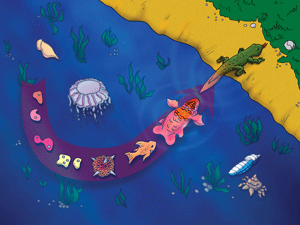
When you think about the steps needed, and the intricate timing required, it beggars belief. How could it possibly happen by unguided chance? No-one has been able to explain this. There is no plausible detailed account for how the first multi-celled animal could possibly have arisen. But once we by (blind) faith accept that evolution is true, then the transition from single-cell to multi-cell definitely did happen.
I have discovered that, with different aspects of evolution, the lecturers and the text books would describe these sorts of problems in great detail. I think it had a disarming effect on the students. It gave them the impression that the scientists had solved the problem since they described it in detail.
So students would not even imagine that there could be any doubt about evolution. But neither the lecturers nor the textbooks would actually provide answers to these problems.
And that is what happened that morning. The lecturer, after explaining the steps that would have to have taken place, and mentioning some of the problems, displayed a slide listing what the first multi-celled animal might have looked like. It was 1. small, 2. marine, 3. a hollow ball. The students busily copied the information into their notes. The multi-celled animal was 4. mono-flagellate,2 5. no mouth, 6. no gut. Write, write.
It was at about this point that I put up my hand and called out ‘Excuse me … ’
Students did not usually ask questions in such a large and intimidating gathering.
‘Yes’, the lecturer looked my way.
‘Excuse me, but I was just wondering what evidence there is for this particular animal that you are describing? Have any examples of these been found in the oceans, or have they found any fossils of them?’
She hesitated and removed the slide from the screen.
‘Well, no’, she said. ‘We don’t have any fossils. This is a hypothetical example. It is an animal that must have existed.’
Then she put the next slide up on the screen, looked at it and said, ‘Er, this is a hypothetical too.’
She had displayed the classic diagram of the so-called evolutionary tree that begins with a single cell and diverges into all the different kinds of living things that are alive today.
As she pulled that slide off the screen she said, ‘Look, just because these are hypothetical does not mean that evolution is not true. We see evolution happening all the time. Evolution is just descent with modification … .’
With those statements she opened up more issues. She mixed her definitions of evolution—bait and switch it’s called.3 Most students would not know the difference, and I had already disrupted the class once. So the lecture went on.
I often wonder what would have happened if I had not asked that question. Those students would have copied the details down but not known the animal did not exist—that it was a hypothetical construct based on no evidence whatsoever.
‘For since the creation of the world God’s invisible qualities—his eternal power and divine nature—have been clearly seen, being understood from what has been made, so that men are without excuse’ (Romans 1:20).
Notes
- Reproduction alone is amazing. Photocopiers copy only documents, not themselves. Return to text.
- I.e. one flagellum, a whip-like rotary motor used to move the organism around. See, DeVowe, S., The amazing motorized germ, Creation 27(1):24–25, 2004, <creation.com/flagellum> cf. Sarfati, J., Design in living organisms (motors), <creation.com/motor>. Return to text.
- Walker, T., Don’t fall for the bait and switch, Creation 29(4):38–39, 2007. Return to text.
Readers’ comments
Comments are automatically closed 14 days after publication.