
Our World (Creation for Kids)
‘Look. Miss Wright! Look what Rachel’s got!’ An excited class trooped in one Monday morning. ‘Well, sit quietly first,’said Miss Wright. ‘Now, Rachel, what is it?’
Rachel put a polished box on the teacher’s desk and took out a beautiful microscope.‘Mv Uncle lent it to us for a week.’ she explained. ‘We’ve looked at pond water: there’s all sorts of funny things.’
‘Can we see?’
‘Not unless we are all very careful with it. Only one can look at a time, so the others must get on with their work.’ We will.‘ they promised. ‘Lets see what we can find in our water butt,’ said Miss Wright. ‘Get some in this jar, Bob.’
The water was green. Rachel put a drop on a slide and showed how to let a coverslip down on it. She focussed it on low power.
‘There’s heaps of things swimming about most of them are green.’ she reported.
Miss Wright looked back and said, ‘I’m glad you will be able to see there is a whole world of life in one drop of water. We’ll get the pond-life books out and see what we can find.’‘These green things swimming—are they plants or animals?’ asked Babs. ‘They are plants whose whole body is one cell,’ answered Miss Wright. ‘That one is Euglena.’
‘But plants don’t swim,’ objected Jim. ‘Roses don’t, but these do. This one even has a red eye spot. It swims with a whip at the front.’ ‘How funny!’
‘Oh. there’s a sort of tulip just popped up—and some more. Now they’ve gone down again. They make a current round their tops.’
‘They discovered that these were Voticella, but, though they were on stalks, they were animals. ‘There is something here with two little wheels going round at the top!’ called Hob. ‘Like this?’ asked Rachel. She held up her arms and twiddled her fingers.
‘Yes, it seems to be sucking specks in.’
‘That’s a Rotifer.’ said Miss Wright. ‘The name is Latin for wheel-bearer.’
When Ralph had his turn, he burst out laughing.
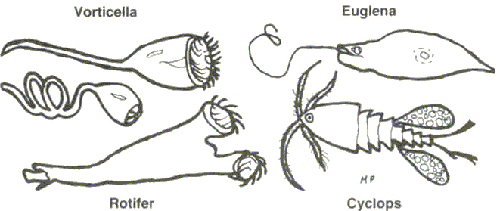
‘There is a jolly little thing coming along with bunches of balls each side of it.’ ‘Eggs,’ said Miss Wright. ‘It is called Cyclops because it has one eye.’ ‘Oh yes. I can see it!’ exclaimed Ralph. ‘This is much better than science fiction.’

Jenny was the lucky one. ‘How beautiful!’ she gasped. ‘A big green ball is rolling along, and there are little balls inside it. It’s so lovely—do look!’ Most of the others saw the Volvox and were thrilled.
‘All these lovely things and nobody sees them. What a shame!’ said Babs.
‘God does,’ said Tom. ‘He must have enjoyed making them. I suppose they are some of the "creeping things" that the Bible says God made in the beginning.’ ‘But that doesn’t make them sound beautiful. What are they for?’ asked Rachel.
‘All green things make oxygen and use up carbon dioxide,’ said Miss Wright, ‘even all over the sea. Without them, and land plants, our air would soon be useless to us.’ ‘So we mess up our air and these tiny things help to put it right.’
‘I know God knows each sparrow, but do you think He knows each of these microscopic things?’ asked Jenny.
Miss Wright hesitated, but Tom plunged in. ‘I’m sure He does, because He made them.’ ‘And I wondered if He could know all the people in China,’ said Babs. ‘I won’t worry now I’ve seen this. I know He cares about everyone!’
Tom and Jenny will be back in our next issue.
Weird and wonderful: the cicada
Many people use alarm clocks to wake them in the morning, but did you know that there is an insect which has its own ‘alarm clock’ to tell it when to turn from a grub into an adult insect? This wonderful insect is the Cicada.
The adult Cicadas lay their eggs, and the grubs hatch out and burrow into the ground, where they spend nearly all their lives. For some Cicadas this is a long time: one kind stays underground for 13 years and the other for 17 years! It is at the end of this time underground that some amazing things happen, for the Cicada grubs have some kind of clock which tells them just when they should come out. They do this at exactly 13 and 17 years, and all within a few hours, all those years after the eggs were laid!

In American forests, thousands of Cicada grubs all come out together and climb up tree trunks. There they leave their old skins, just as butterflies leave the chrysalis, and turn into insects with beautiful wings, leaving the forest floor covered with thousands of empty skins. As they spread their wings they begin to ‘sing’—making a loud clicking noise which fills the forest. The Cicadas live only a few weeks after this, during which they lay their eggs and so begin the cycle all over again.
Why does the Cicada have such a strange life-cycle? No one really knows, but it certainly helps it to survive, for no other creature could possibly depend upon Cicadas for food, having to wait all those years for a meal!
Evolutionists believe that the Cicada ‘evolved’ this life-cycle, including that wonderful clock which tells thousands of the grubs when it is time to come out of the ground. But surely, the Cicada needed a Designer just like the alarm clocks which wake us in the morning: they were not made by accident! The Bible tells us that God created the ‘creeping things’ and this must have included the Cicada.
Readers’ comments
Comments are automatically closed 14 days after publication.