
Primates spearing primates
It’s no big deal
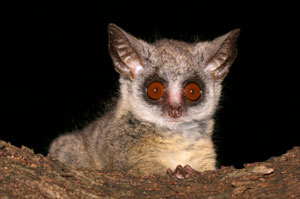
A small population of Savannah chimps (Pan troglodytes verus) living in the Fongoli area of Senegal has been observed using sticks as spears to hunt bushbabies (Galago senegalensis—a small, cute, wide-eyed, animal with prominent ears).1 Chimps have long been known to fashion simple twigs for ant dipping and termite fishing, but these chimps sharpened sticks with their teeth to better spear the smaller primates. Using a ‘power grip’, the chimps attempted to stab the bushbabies inside hollow trunks and branches.
This observed behavior has created an evolutionary frenzy. A New Scientist article states, ‘In a revelation that destroys yet another cherished notion of human uniqueness, wild chimpanzees have been seen hunting bushbabies with spears.’1 Jill Pruetz, a primatologist at Iowa State University, said ‘Back to the drawing board again in terms of trying to define how humans are special.’ However, a closer look at the evidence reveals a story that is far less sensational.
Tool use in the animal world
Chimps are intelligent and resourceful animals. The Fongoli chimps, in particular, display an impressive resourcefulness and sense of planning by utilizing sharpened sticks as spear-like objects to hunt bushbabies. However, several other animals are capable of using tools as well. For example, New Caledonian crows design and manufacture different types of sticks to probe for insects.2 Like the Fongoli chimps, woodpecker finches break off sharp pieces of cacti to spear insects.3 Egyptian vultures are famous for launching stones in order to break open ostrich eggs.3 Dolphins affix sponges to their snouts and stir up the sea floor to hunt fish.4 Elephants trim twigs and branches to create the perfect design for swatting flies and scratching themselves.5 In short, a number of animals are capable of making and using crude tools. God has endowed many animals with the intellectual capacity to solve problems, fashion crude tools, and plan for the future.
Statistics, natural selection, and intellect
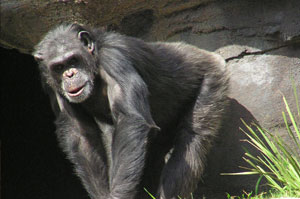
In addition, in the evolutionary model, chimpanzees have supposedly existed for about six million years. Apparently, they have survived quite well by expending large amounts of energy in chasing down monkeys at times. Also, if in six million years chimpanzees have only now figured out how to use a stick as a makeshift spear, it does not speak very well of their intellectual ability. Human beings possess the intellectual capacity to rapidly develop new forms of technology in vastly shorter periods of time. There is really no comparison between human and chimpanzee mental abilities.
Conclusions
The evolutionary community sees two major implications in this story about the Fongoli chimps. First, human beings are not unique in the animal world. This is strictly a philosophical worldview. Second, human tool use evolved step-by-step from a common ancestor shared with chimpanzees. This is pure speculation seen through the lens of Darwinian evolution. Observational evidence reveals that chimps, like many other animals, can be highly resourceful in using simple tools to hunt prey and perform basic tasks. It does not constitute any evidence that chimpanzees evolved from a creature that in the past was not a chimpanzee. Nor does it constitute any evidence that mankind developed its tool use capability from an animal ancestor in the distant past. It simply and only demonstrates what chimps can do.
The Bible makes it clear that chimpanzees and humans were created as distinct kinds. And human beings were specially created in the image of God with an intellectual, technological, moral, and spiritual capacity far more advanced than any chimpanzee.
References
- Hooper, R., Spear-wielding chimps snack on skewered bushbabies. 22 February 2007. Return to text.
- Pickrell, J., Crows better at tool building than chimps, study says. 23 April 2003. Return to text.
- Ehrlich, P.R., Dobkin, D.S. and Wheye, D., Tool using. 1988. Return to text.
- Hooper, R., Dolphins teach their children to use sponges. 06 June 2005. Return to text.
- Jaroncyk, R., Jumbo minds: Elephants are proving just as smart as chimps in many areas—if not smarter. 17 November 2006. Return to text.
- Choi, C.Q., Chimps make spears and hunt bushbabies. 22 February 2007.Return to text.
Readers’ comments
Comments are automatically closed 14 days after publication.