
Raymond Dart and the ‘missing link’
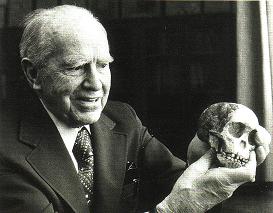

Anthropologist Raymond Dart (1893–1988) is best known for a skull found on the edge of the Kalahari Desert in 1924. He claimed it was part-human and part-ape, i.e. a ‘man-ape’1 and so the evolutionary ancestor of man.
Raymond was the fifth of nine children. He had made a somewhat hazardous entry into the world, upstairs in a house in the Brisbane suburb of Toowong, Australia, in 1893, during the Brisbane River flood season. The waters had risen so high that the attending midwife had to tie the newborn baby and his mother to a mattress and float them out of a second-storey window to neighbours waiting in a rowboat!2
The Dart family lived on a cattle farm, where all had their tasks. One brother recalled, ‘Ray wasn’t keen on ploughing—he’d rather dig with a shovel than harness a horse.’ One of Raymond’s chores was cleaning out the fowl houses. One day his brothers returned from the field to find this work neglected because he had spent his time dissecting a rooster.3 He later said, ‘I had no desire to emulate [my parents] in pioneering achievements. … Having little physical dexterity, I inherited the opportunity and passion for learning and books … .’4
Christian upbringing
One good thing he received from his parents was an upbringing in the Christian faith. His father, Samuel, a Baptist, was elected general visiting superintendent of the Methodist Sunday Schools circuit,5 and he brought up his family to study the Ten Commandments and all the Christian precepts of the New Testament. Raymond was baptized in the new local German Baptist Church and received into membership there in 1907.6 His biographers tell us: ‘Once grown up, Raymond always carried two Bibles around with him, one printed in English, the other in German. He could, if challenged, recite chapter and verse from Scripture in either language.’7
Concerning his youthful Christian beliefs, Dart wrote: ‘I was … raised in a devout Methodist and Baptist family environment, sharing gladly also the fundamentalist philosophy of Plymouth Brethren family friends.’8 His brother, Harold, tells us that Raymond ‘intended to become a medical missionary in China’,9 an ambition which he often expressed to fellow students during his school years.10
University student, medico and professor
In pursuit of this missionary goal, Raymond wanted to study medicine at the University of Sydney.10 However, because he had won a scholarship to attend the newly founded University of Queensland, his parents insisted that he study science there first. He gained an Honours degree in Biology (the first issued by that university), followed by a Master of Science, and also, having now achieved a robust physique, represented the university at rugby football.
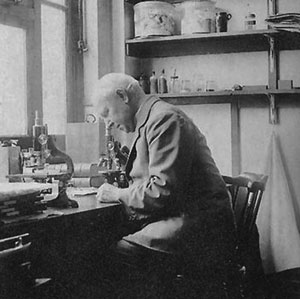
Professor Grafton Elliot Smith was considered the leading specialist of his day on the ‘evolution’ of the human brain. Smith appointed Dart to a position at University College in London and later suggested he apply for a position in South Africa.
Four busy years of medical studies at the University of Sydney followed. He became the Tutor of Biology at St Andrew’s College, Demonstrator of Anatomy at the Medical School (an unprecedented honour for an undergraduate), and in his final year served as Acting Vice-Principal of St Andrew’s College. A biographer comments, ‘[H]e was not yet 25! His prior qualification in science and an excellent record had opened doors to him.’11
In 1917, Dart enlisted in the Australian Army Medical Corps and served as a captain in England and France during WWI. Demobilised in 1919 in England, the bright and vivacious young Dart was appointed by neuro-anatomist Professor Grafton Elliot Smith of University College, London, as Senior Demonstrator in his Department of Anatomy.
The brash young medico now began writing scientific papers; his first, delivered at an Anatomical Society meeting, challenged a medical theory held by the chairman, Professor Arthur Keith! Not yet out of his twenties, ‘he was acquiring a reputation for spurning authority and for jumping to conclusions’.12
One day in 1922, Elliot Smith suggested to Dart that he apply for the position of Professor of Anatomy at the University of the Witwatersrand, Johannesburg, South Africa. Dart regarded this as banishment from the libraries and laboratories of Europe, for whose benefits he had deserted Australia,8 but he was finally persuaded to accept. He and his wife, Dora, whom he had met and married during a six-month lecturing trip to the USA in 1920, arrived in South Africa in January 1923, a few days before his 30th birthday.
The Taung skull controversy
In November 1924, there came into Dart’s hands a small fossilized skull from a limestone pit at Taungs (now called Taung, and, since 1977, located in the ‘independent homeland state of Bophuthatswana’).13 The teeth suggested that it would have been that of a five-or six-year-old if human, or two years younger if an ape.
Dart believed the find had human features (e.g. the teeth and jaw, the skull, and what he claimed was evidence of upright posture) and ape features (e.g. facial characteristics and brain size). He therefore said it represented a group of creatures ‘ … intermediate between living apes and primitive mankind’14—what he called a ‘man-ape’. He named it Australopithecus africanus, meaning ‘southern ape of Africa’ and announced it to the world, first in the Johannesburg Star of 3 February 1925, and then in Nature of 7 February 1925.1 Dart believed he had vindicated Charles Darwin’s claim that Africa would prove to be the cradle of mankind.1,15
The ape-like skull became so well known in Britain in the late 1920s that it became the subject of music-hall jokes like: ‘Who was that girl I saw you with last night—was she from Taungs?’16 The scientific establishment was also cynical and at first rejected Dart’s claims, asking why had he not sent his fossil to the British Museum for assessment by others before bursting into print with his own conclusions? However, the exposure in 1953 that the hitherto accepted Piltdown Man ‘missing link’ was a hoax, and the discovery of other (adult) australopithecine fossils elsewhere in Africa, swung the tide of evolutionary opinion temporarily back in Dart’s favour.
Claims refuted
Then in 1970 the famous British anatomist Sir Solly Zuckerman challenged almost every one of Dart’s conclusions, stating, ‘
In 1973, South African geologist T.C. Partridge presented evidence that the Taung skull could not be more than 750,000 years old. For Australopithecus africanus to evolve into humans in this short evolutionary time period was out of the question. Creationist Marvin Lubenow states, ‘The fact that sapiens-like fossils have appeared in the fossil record before australopithecines … reveals that the australopithecines had nothing to do with human origins.’18 Evolutionist Charles Oxnard came to a similar conclusion.19
In 1986, evolutionists Matt Cartmill, David Pilbeam and Glynn Isaac wrote: ‘The australopithecines are rapidly sinking back to the status of peculiarly specialized apes … .’20 And in 1994, evolutionist Fred Spoor did CAT scans of the inner ear region of Australopithecus africanus skulls, including Taung. These showed that their semi-circular canals, which determine balance and ability to walk upright, ‘resemble those of the extant [living] great apes’.21
From a creation perspective, the most significant difference between human beings and the various apes is not a matter of teeth shape, ability to walk on two legs, or brain size (all of which vary among the population and hugely from child to adult), but that humans were created in the image of God (Genesis 1:26–27). Humans have a spiritual dimension. We can worship God, experience His love, and be filled with His Spirit. We have moral consciousness, i.e. knowledge of right and wrong. We can talk.
The best explanation for the Taung child and all the australopithecines is that they were a type of ape, unlike either modern apes or humans, which were created by God on Day 6 of Creation Week, and which are now extinct.22,23
 |
 Dart was one among many who were presumably unaware that Haeckel’s drawings were fraudulent (left). |
Allegiance diverted
So what happened to Raymond’s youthful Christian beliefs and his strong intention to become a medical missionary in China? It seems that these succumbed to the theory of evolution. Dart wrote, ‘My first frank confrontation with evolutionary ideas was in 1911 as a biology student in the University of Queensland … .’ Then he says that in 1914 he fell under the spell of Grafton Elliot Smith, who gave a ‘brilliant public lecture on the evolution of the human brain’.8 He also absorbed the views of Professor J.T. Wilson at Sydney University who, he wrote, had ‘a deep respect for the Darwinian and Haeckelian process of utilizing vestigial comparative anatomical structures as clues to reveal our extremely ancient prehistory (i.e. phylogeny)’.8 Sadly Dart (and no doubt Prof. Wilson) presumably were unaware that the ‘evidence’ put forward by Haeckel was totally fraudulent.24,25 At the age of 29, Dart described himself (under ‘Religion’ in his application to the University of the Witwatersrand) as a ‘Freethinker’.26
Dart’s most famous successor as missing-link bone-hunter in Africa, Louis Leakey, also had youthful ambitions of becoming a missionary, until diverted by the theory of evolution.27 And Charles Darwin himself studied theology at Cambridge University for three years with a view to becoming an English country clergyman. That is, until his acceptance of the uniformitarian theory of Earth history with its untold millions of years28 resulted in his rejection of the Genesis creation account as the true history of mankind.
One might reasonably ask: Why this apostasy among these prominent evolutionists? Sadly, they all thought they saw, in Dart’s words, ‘discrepancies between Fundamentalism and the facts’,9 rather than seeing the data they uncovered as being supportive evidence for the Bible. All of them made the mistake of thinking that facts speak for themselves. But they looked at the data through the lens of naturalism, with which their teachers at University had indoctrinated them. Had they looked at their evidence through ‘biblical glasses’ they would have realized that the facts and Genesis were not in conflict. For example, Dart would have realized that his Taung skull was that of a now-extinct primate group and not that of an ape on its way to becoming human.
It is sad that Raymond Dart apparently died without acknowledging the truth of his origins—made ‘in the image of God’—or the salvation obtained for the sons of Adam by the work of the Lord Jesus Christ, the ‘last Adam’. How different it might have been if Raymond had been taught as a child how the Bible relates to biology, anthropology and geology, and not just about ‘faith and morals’ (see also What? A Christian mind?, Islam and worldview: the big picture from this issue).
Re-posted on homepage: 28 March 2012
References and notes
- Dart’s chosen term. Dart, R., Australopithecus africanus: the Man-Ape of South Africa, Nature 115 (2884):195–199, 7 February, 1925. In evolutionary thinking a ‘man-like ape’ would seem to be earlier than any ‘ape-like man’, making Dart’s ‘missing link’ appear to be the oldest. Return to Text.
- Wheelhouse, F., and Smithford, K.S., Dart: scientist and man of grit, Transpareon Press, Sydney, Australia, p. 3, 2001. Return to Text.
- Ref. 2, p. 9. Return to Text.
- Dart, R., Recollections of a reluctant anthropologist, Journal of Human Evolution, 2:417–27, 1973. Return to Text.
- Ref. 2, p. 4. Samuel joined the Methodists because there was no Baptist Church where he lived at that time. Return to Text.
- Ref. 2, p. 9. Return to Text.
- Ref. 2, p. 10. Return to Text.
- Dart, R., Associations with and impressions of Sir Grafton Elliot Smith, Mankind 8(3):171–75, June 1972. Return to Text.
- Dart, H., Happenings: historic, heroic and hereditary, Harold Dart, p. 110, 1981. Return to Text.
- Ref. 2, p. 11 Return to Text.
- Tobias, P., Dart,Taung and the ‘Missing Link’, Witwatersrand University Press, Johannesburg, p. 3, 1984. Return to Text.
- Ref. 11, p. 5. Return to Text.
- Ref. 11, pp. 18–20. Return to Text.
- Dart, R., Adventures with the Missing link, Harper and Brothers, New York, pp. 133–134, 1959. Return to Text.
- Darwin, C., The Descent of Man, John Murray, London, p. 155, 1887. Return to Text.
- Ref. 14, p. 38. Return to Text.
- Zuckerman, S., Beyond the Ivory Tower, Weidenfeld and Nicolson, London, pp. 75–94, 1970. Return to Text.
- Lubenow, M.L., Bones of Contention, Baker Books, Michigan, USA, p. 301, 2004. Return to Text.
- Oxnard, C., The place of the australopithecines in human evolution: grounds for doubt?, Nature 258:389–395, 4 December 1975. Oxnard was Professor of Anatomy at the University of Southern California Medical School, and is now at the University of Western Australia, Perth. Return to Text.
- Cartmill, M., Pilbeam, D., and Isaac, G., One hundred years of paleoanthropology, American Scientist 74:419, July–August 1986. Return to Text.
- Spoor, F. et al., Implications of early hominid labyrinthine morphology for evolution of human bipedal locomotion, Nature 369(6482):645–648, 23 June 1994. Spoor is Professor of Evolutionary Anatomy at University College, London, UK, and joint editor of the Journal of Human Evolution. Return to Text.
- Weston, P., The Taung Skull: ‘Missing link’? Creation 16(1):16–17, 1993. Return to Text.
- Sarfati, J., Refuting Evolution, ch. 6, Creation Ministries International, Brisbane, Australia, p. 80, 1999. Return to Text.
- Grigg, R., Ernst Haeckel: Evangelist for evolution and apostle for deceit, Creation 18(2):33–36, 1996. Return to Text.
- Grigg, R., Fraud rediscovered, Creation 20(2):49–51, 1998. Return to Text.
- Ref. 14, pp. 29–30. Return to Text.
- Grigg, R., Missing the mark, Creation 26(3):24–27, 2004. Return to Text.
- Promoted in Charles Lyell’s Principles of Geology, which Darwin read on his sea voyage to the Galápagos Islands. See Brentnall, J.M. and Grigg, R., Darwin’s slippery slide into unbelief, Creation 18(1):34–37, 1995. See also Philosophical naturalism and the age of the earth: are they related?. Return to Text.

Readers’ comments
Comments are automatically closed 14 days after publication.