
CMI’s response to PBS-TV series Evolution
Episode 2: Great Transformations
This episode tries to prove the ‘big picture’ of evolution, i.e. the ‘General Theory of Evolution’, i.e. particles to people. Of course, no experimental evidence can be offered, only inference. The experimental ‘evidence’ adduced in the series for ‘evolution’ is purely for change that doesn’t increase information content, and so actually has nothing to do with the ‘big picture’.
The program also made a revealing comment: ‘The evidence for evolution is all around us, if we choose to look for it.’ Revealing not because I think the evidence really supports evolution, but because of an important point inadvertently made. That is, creationists and evolutionists have the same evidence (‘facts’), but we interpret it differently because of our different axioms (starting assumptions). In reality, evolutionists have a materialistic bias, where a common designer is rejected a priori (see Lewontin’s admission), and this applies even to evolutionists who believe in ‘God’. Therefore any facts are interpreted as evidence for evolution. This would probably explain why a lot of the science in the series is not even directly stated as evidence for evolution, but is shown as if it is. It also explains why fragmentary remains are interpreted as an important transitional form. Conversely, creationists do not dispute the facts, since we have the same facts, although as shown we will frequently dispute assertions claimed to be facts when they are certainly not!
First, the narrator asserts that all living organisms come from a single source, and we can now trace branches and roots. They fail to explain how non-living chemicals could form a living cell by time and chance, despite the insuperable chemical hurdles (see Q&A: Origin of Life). Interestingly, the producer Richard Hutton, on this Washington Post online forum, answered the question ‘What are some of the larger questions which are still unanswered by evolutionary theory?’ as follows:
‘ There are open questions and controversies, and the fights can be fierce. Just a few of them:
The origin of life. There is no consensus at all here — lots of theories, little science. That’s one of the reasons we didn’t cover it in the series. The evidence wasn’t very good.’ …
No, it certainly isn’t, but of course he couldn’t have the viewers knowing that! I.e. the very roots of the alleged evolutionary tree are in very bad shape. So they gloss over the problems, assert that there really is a well-documented tree, and then move on to finding similarities between organisms and claiming that this proves a common ancestor.
Deep time
Neil Shubin, a paleontologist from the University of Chicago, is a key star of this show. He claimed that the Earth is 4.5 billion years old, and to show how insignificant humans are, he scaled this time to one hour. Then, he claimed, animals existed only in the last 10 minutes, while humans appeared only in the last 100th of a second.
Despite the series’ claim to be respectful of Christianity, this is one of many examples of the contradiction of evolution/billions of years with Christ’s teachings. Jesus says in Mark 10:6, ‘But from the beginning of the creation, God made them male and female.’ This is consistent with His belief in a literal interpretation of Genesis, where the Earth was created about 4000 years before He spoke those words, and Adam and Eve created on Day 6, which on the scale of 4000 years is almost indistinguishable from the beginning. But it’s diametrically opposed to Shubin’s illustration, which has man appearing almost at the end, not the beginning–and has about 4.5 billion years without humans at all. There are also many scientific problems with any assertions about dating the Earth. The conflicts between billions of years with both Christ and true science are well outlined in The earth: how old does it look?
Whale evolution?
This was a tricky problem for Darwin, but nevertheless he still had faith that whales evolved from land mammals. The paleontologist Phil Gingerich of the University of Michigan agrees that ‘it’s a real puzzle how whales originally evolved.’ But on this episode, he gives the impression that his fossil finds have gone a long way towards solving this puzzle.
Pakicetus

Right: Actual bones found (stippled).
Note: nothing below skull.
Gingerich discovered in Pakistan a few skull fragments of a wolf-like creature that allegedly had an inner ear like a whale’s. But this is far from conclusive. There wasn’t any post-cranial skeleton found, so we haven’t the faintest idea how it moved. However, this didn’t stop Gingerich from writing an article for schoolteachers with an illustration of an animal swimming and catching fish, and looking convincingly like an intermediate between land animals and whales. He also claimed, ‘In time and in its morphology, Pakicetus is perfectly intermediate, a missing link between earlier land mammals and later, full-fledged whales.’1 The diagram (left) shows the glaring contrast between reconstruction and reality.
New research since this series was produced has blown away this reconstruction. This demonstrates an oft-repeated phenomenon in evolutionary paleontology. Many of the alleged transitional forms are based on fragmentary remains, which are therefore open to several interpretations, based on one’s axioms. Evolutionary bias means that such remains are often likely to be interpreted as transitional, as with Gingerich, and is also prevalent in ape-man claims. But when more bones are discovered, then the fossils nearly always fit one type or another, and are no longer plausible as transitional. It’s also notable that alleged intermediate forms are often trumpeted in the media, while retractions are usually muted or unpublicized.
<http://www.neoucom.edu/Depts/Anat/Pakicetid.html>
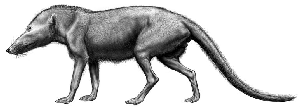
A prominent whale expert, Thewissen, and colleagues unearthed some more bones of Pakicetus, and published their work in the journal Nature.2 The commentary on this paper in the same issue3 says, ‘All the postcranial bones indicate that pakicetids were land mammals, and … indicate that the animals were runners, with only their feet touching the ground.’ (See illustration, left) This is very different from Gingerich’s picture of an aquatic animal! But the evolutionary bias is still clear, describing Pakicetus as a ‘terrestrial cetacean’ and saying, ‘The first whales were fully terrestrial, and were even efficient runners.’ But the term ‘whale’ becomes meaningless if it can describe land mammals, and it provides no insight into how true marine whales supposedly evolved.
Also, ‘solid anatomical data’ contradict previous theories of whale ancestry. The news article Fossil Finds Show Whales Related to Early Pigs says:
‘Until now paleontologists thought whales had evolved from mesonychians, an extinct group of land-dwelling carnivores, while molecular scientists studying DNA were convinced they descended from artiodactyls [even-toed ungulates].
‘“The paleontologists, and I am one of them, were wrong,” Gingerich said.’
Such candor is commendable, and it shows the fallacy of trusting alleged ‘proofs’ of evolution. Pity that Gingerich is still committed to materialistic evolutionism.
Ambulocetus
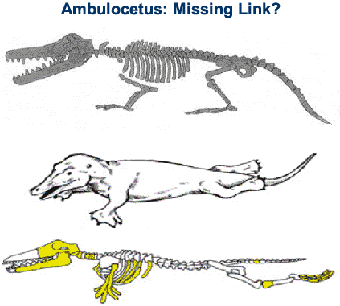
Middle: Ambulocetus reconstruction, as drawn in Miller‘s book
Bottom: Actual bones found (Yellow). Note missing pelvic girdle.
This was mentioned fairly briefly in this episode, but it features prominently in
the anti-creationist book Finding Darwin’s God, by Kenneth Miller
who starred in Episode 1 (see rebuttal).
On p. 265, Miller claimed, ‘the animal could move
easily both on land and in water’, and contained a drawing of a
complete skeleton and a reconstructed animal. But this is misleading, bordering
on deceitful, and indicative of Miller’s unreliability, because there was
no indication of the fact that far fewer bones were actually found than appear in
his diagram. Crucially, the all-important pelvic girdle was not found (see diagram,
right). Without this, it’s presumptuous for Miller to make that proclamation.
His fellow evolutionist Annalisa Berta pointed out:
‘… since the pelvic girdle is not preserved, there is no direct evidence in Ambulocetus for a connection between the hind limbs and the axial skeleton. This hinders interpretations of locomotion in this animal, since many of the muscles that support and move the hindlimb originate on the pelvis.’4
See also A Whale of a Tale?, including the
addendum addressing claims of subsequent Ambulocetus bones and
their (ir)relevance to evolution.
Basilosaurus
This serpentine and fully aquatic mammal has been known since the 19th century, but Gingerich discovered something new in some specimens in the Sahara Desert. The narrator pointed out that this area was under water once, and described a 100-mile stretch of layered sandstone called the ‘valley of the whales’, and allegedly 40 million years old. They theorize that it was a protected bay where whales came to give birth and to die. Gingerich discovered what he alleged were a pelvis, leg bones and a knee cap, so was evidence of ‘functioning legs’ and ‘dramatic proof that whales were once fully four-legged mammals.’
But this contradicts other evolutionists, including Gingerich himself! E.g. the National Academy of Science’s Teaching about Evolution and the Nature of Science claimed, ‘they were thought to be non-functional’ (p. 18), and Gingerich himself said elsewhere ‘it seems to me that they could only have been some kind of sexual and reproductive clasper’.5 So these bones can be explained as a design feature, while the interpretation as ‘legs’ reflects evolutionary wishful thinking. (The article The strange tale of the leg on the whale refutes another urban myth about whales being found with legs).

Whale evolutionary sequence?
The program claims that there is a series including Ambulocetus, Rhodocetus,
etc., where the nostrils supposedly migrate to the back of the head. Teaching about
Evolution and the Nature of Science contains a diagram (left) on p. 18.
But when the series is examined, the sequence is not as smooth as they imply. E.g.
this diagram failed to indicate that Basilosaurus is actually about 10
times longer than Ambulocetus, and the fragmentary nature of the remains
has been discussed already.
Another problem is that Basilosaurus has a number of features that mean
it could not possibly have been ancestral to modern whales, e.g. body shape, skull
structure and tooth shape.
There is certainly no support for the program’s claim, ‘front legs became fins, rear legs disappeared, bodies lost fur and took on their familiar streamlined shape’. Waving the magic wand of mutation/selection is hardly sufficient without an observable mechanism that would effect these changes.
Locomotion
The program also claims support for a transition from the way they move. Marine mammals move through the water with vertical undulating movements of the spine, just as many fast-running mammals do on land. Fish move with sideways undulations instead. But this could be another common design feature of mammals, like milk or hair. It’s also doubtful whether this is a unique prediction of evolution; if whales used side-to-side movements, evolutionists could presumably have ‘predicted’ this because the tails of land animals also swish sideways.
My book Refuting Evolution, written to rebut Teaching about Evolution and the Nature of Science, has a chapter on alleged whale evolution that covers all this section in more detail, with full documentation. It is available on the CD we produced in answer to the PBS series.Tetrapod evolution?
Tetrapods are animals with four limbs, i.e. amphibians, reptiles, birds and mammals. In 1995, Neil Shubin and Ted Daeschler found in Pennsylvanian cliffs a shoulder bone of a tetrapod allegedly 370 million years old.
Cambridge University paleontologist Jenny Clack found an early tetrapod hand in Greenland, called Acanthostega. Supposedly this creature had gills, a fish-like tail, paddle-shaped fins, and a hand with fingers.
She said this refuted the usual textbook theory that fish evolved limbs for a selective advantage because they were being stranded in drying pools. Rather, the limbs evolved before they crawled on the land, while they were still aquatic. The selective advantage was the ability to escape the weird and wonderful predatory fish that lived during this time (called the Devonian Period).
Shubin stressed that ‘evolution wasn’t trying to do this’, and later the program said, ‘we’re here through chance coincidences’. This should make it clear that evolution, as believed by evolutionists, is not ‘progressive’ and shows no sign of a divine guiding hand (see again Darwin’s real message: have you missed it?).
Shubin also highlighted the common limb pattern between tetrapods, illustrated by fish and humans having the sequence one bone/two bones/small bones/rods (digits). But this fails to explain the totally different developmental sequence, as explained in this diagram of my rebuttal to Episode 1.
Cambrian Explosion
Cambridge University paleontologist Simon Conway Morris explained that this was ‘one of the greatest breakthroughs in the history of life.’ Essentially all the different animal phyla (major groups) appeared abruptly, without any known transitional forms preceding them. According to evolutionary dating methods, this was about 500 million years ago. Morris acknowledged that Darwin recognized this as a problem for his theory, with animals appearing out of nowhere. Morris said, ‘to a certain extent that is still a mystery.’ Darwin predicted that animals diverged gradually from a common pattern, so there should be fossil examples of this divergence, while instead we see that the major differences arose abruptly at the beginning. Again, this is according to the evolutionary time frame; Biblical creationists see the fossil record not as a time sequence but a sequence of burial by Noah’s Flood and its aftereffects.
Then the program shifted to the Burgess Shale, with lots of bizarre creatures, e.g. one with five eyes, another worm-like creature with large spines, and still another with prongs around its mouth. But none of this showed what the Cambrian animals could have evolved from. Supposedly the evidence shows that evolution tinkered with a few basic body plans, but provides no evidence for their origins.
Gene switches: means of Evolution?
The 19th century biologist William Bateson found that embryos sometimes grew body parts in the wrong place. From this he theorized that there are underlying controls of certain body parts, and other controls governing where they go.
Ed Lewis investigated and won a Nobel Prize in 1995 for discovering a small set of genes that affect different body parts (Hox or Homeobox–see Hox (homeobox) Genes: Evolution’s Saviour?). They act like ‘architects of the body’. Mutations in these can cause ‘dramatic’ changes, as the program says. Many experiments have been performed on fruit flies (Drosophila), where poisons and radiation induced mutations.
The problem is that they are always harmful. One famous case is Antennapedia, where legs grow where antennae should be. The program showed an extra pair of wings on a fly, but failed to mention that they were a hindrance to flying because there are no accompanying muscles. Both these flies would be eliminated by natural selection.
Walter Gehring of the University of Basel (Switzerland) replaced a gene needed for eye development in a fruit fly with the corresponding gene from a mouse. The fly developed normal fly eyes, i.e. compound eyes rather than lens/camera. This gene is called Eyeless, because absence of this gene means no eyes will form.
However, there is obviously more to the differences between different animals. Eyeless is a switch–it turns on the genetic information needed for eyes. But evolution requires some way of generating the new information that’s to be switched on. The information needed to build a compound eye is vastly different from that needed to build a lens/camera type of eye. By analogy, a switch on a power socket can turn on a light or a laptop, but this hardly proves that a light evolved into a laptop!
All the same, the program says that Eyeless is one of a small number of common genes that cause a common body organisation in many animals. The program illustrated this with diagrams. Supposedly all evolution needed to do was reshuffle packets of information into different combinations.
But as shown, known mutations in these genes cause monstrosities, and different switches are very distinct from what is switched on or off. Also, the embryo develops into its basic body plan before these genes start switching–obviously they can’t be the cause of the plan before they are activated! But the common genes make perfect sense given the existence of a single Creator.
Human Evolution?
Donald Johanson, the discoverer of the alleged missing link ‘Lucy’, featured here. Supposedly humans are part of evolution, despite our unique abilities to design and create works of art. Allegedly about 7 million years ago, our ancestors swung down from the trees and became bipedal. Then they could gather and carry food, and this food could be higher in energy. This fed bigger brains, which in turn helped food to be gathered more efficiently, in a positive feedback. But Johanson said that there are still differences in the skeletons of chimps and humans, e.g. differently shaped pelvis, a different angle where the spine meets the skull, and the way we walk with our knees together while apes walk with their legs far apart.
This episode offered little actual evidence. The fossil record is full of holes, and ‘missing link’ claims become boring after a while because they are so often discredited (e.g. see Time’s alleged ‘ape-man’ trips up (again)). The nearest thing to ‘evidence’ was Liza Shapiro, University of Texas, showing how flexible the lemur’s spine was. The lemur can move on all fours, but leap upright. But this doesn’t show how a quadruped can make all the transformations needed to turn it into a proper biped.
References
- Gingerich, P., The Whales of Tethys, Natural History, p. 86, April 1994. Return to text.
- Thewissen, J.G.M., Williams, E.M, Roe, L.J. and Hussain, S.T., Skeletons of terrestrial cetaceans and the relationship of whales to artiodactyls, Nature 413:277–281, 20 September 2001 (see PDF file). Return to text.
- Muizon, C. de, Walking with whales, Nature 413:259–260, 20 September 2001 (see PDF file). Return to text.
- Berta, A., What is a Whale? Science 263(5144):180–181, 1994; perspective on Thewissen, J.G.M., Hussain, S.T. and Arif, M., Fossil evidence for the origin of aquatic locomotion in Archeocete whales, same issue, pp. 210—212. Return to text.
- The Press Enterprise, 1 July 1990, A-15. Return to text.
Readers’ comments
Comments are automatically closed 14 days after publication.