

Separating the sheep from the goats
When evolutionists are asked to give examples for molecules-to-man evolution, they often point to examples of changes in animal populations. Animals can adapt to new environments, and domestic animals can be selected for desired traits. Are these changes really evidence for molecules-to-man evolution? Are these types of changes expected only by those who believe in evolution? Do these types of changes explain how animals came into existence?
The Bible’s history
According to the biblical record, God created animals ‘after their kind’. These kinds were created with the ability to reproduce so they could fill the whole earth (Genesis 1:20–31). Initially, everything was ‘very good’ (Genesis 1:31). However, mankind soon rebelled against God and the earth was cursed. At this point death, thorns, and suffering became a part of the world (Genesis 3). Many years later, mankind became so wicked that his thoughts were continually evil. At that time, God sent judgment in the form of a global Flood. Just prior to the Flood, Noah had built an enormous Ark at God’s command. Some of every kind of land animal and bird were brought into the Ark and preserved along with Noah’s family (Genesis 6:5–8:19).
Given this history, it is reasonable to expect that mankind and animals would need to have the ability to adapt to new environments. Otherwise they would have been unable to utilize new, even hostile environments that arose following the Fall and the Flood. God intended for animals to reproduce and fill the earth, because he had created the earth to be inhabited.1 So the ability of animals to adapt to new surroundings is actually a prediction of the creationist viewpoint.
Changes to ruminate on
The Bible does not provide an exhaustive view of history, but it claims to be inspired and accurate in all it does present. It is interesting to note that in Hebrew, the language in which much of the Bible was originally written, there is a word2 that refers to sheep and/or goats. This word is used in Genesis to describe the animals that Abel, a son of Adam and Eve, raised and used as a sacrifice to God (Genesis 4:2, 4). The Bible commonly refers to sheep and goats collectively. The frequent use of a single word to refer to sheep and goats strongly suggests that these animals belong to the same created kind. However, there are also words that specifically refer to sheep3 and others that specifically refer to goats.4
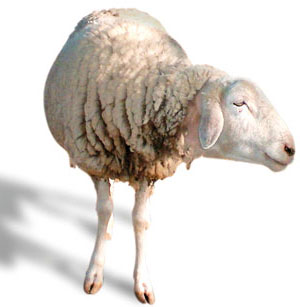
That sheep and goats belong to the same created kind is further supported by the fact that some matings between sheep and goats have resulted in live offspring.5 This created kind has undergone a change known as speciation, where some of its descendants differ enough from others that they are classified as separate species.6 Domestic sheep (Ovis aries) and goats (Capra hircus) have very similar anatomy and are classified in the same subfamily (Caprinae).


Variations in hair style
Like most mammals, sheep and goats have two types of hair; an outer, usually more obvious, layer of guard hairs and an underfur, which is called wool in these animals.7 These hairs vary in the length, diameter and colour.8 Variety like this in animals is important in helping them to adapt to different environments. It is also useful for breeders. For example, in cultures that valued wool for clothing, sheep were selected for fine (thin), white wool. There are several breeds, known as fine wool breeds (such as the Merino), which have very few guard hairs and abundant fine, white wool. However, when breeders selected for this trait, they lost some of the variety that had naturally existed in sheep. The breeders culled, or ‘weeded out’, animals with coarser wool or hair. If a breeder wanted to regain some of this lost information, the sheep would need to be crossed with sheep from other breeds which still retain those traits.
Sometimes variety is added to animals through mutations. For example, in sheep a white fleece is usually dominant. However, there is a mutation which causes black to be dominant. This mutation causes the biochemical machinery for the production of black pigment to be ‘switched on’ when it otherwise would not be.9 This is not a particularly desirable trait; white wool is usually preferred since it is easy to dye various colours. It is one example of how mutations change existing biochemical pathways through loss of function, although they can seemingly add something (in this case more black pigment).9 This may add variety, but it essentially damages the pathway. Often, this process results in disease;10 very rarely it may add a desirable trait.11 All these changes in animals (i.e. speciation, natural and artificial selection, and mutations) are recognized by creationists.
Who are they kidding?
At this point it may seem like creationists believe in evolution just as much as the evolutionists. Creationists do believe that animals can change over time, but there is an important difference. The ‘logic’ of evolutionists is in effect often as follows:
- Evolution is change over time.
- Animals have been observed to change over time.
- Therefore, all animals evolved from a common ancestor which arose spontaneously from inorganic chemicals.
Something should look very suspicious here. Change over time does not imply that all living things have a single common ancestor. Points one and three involve two different definitions of evolution. Evolutionists define evolution as mere change, then they ‘bait-and-switch’ to mean descent of all organisms from a common ancestor. Changing the definition of a word in the middle of an argument, is a logical fallacy known as equivocation. Evolutionists have been using this tactic for years to pull the wool over people’s eyes. While mutations may cause changes in existing biochemical pathways, they are insufficient to explain the origin of the many complex, interdependent pathways that characterize living things.12 The next time someone tries to defend belief in molecules-to-man evolution by giving an example of change, ask if there is a new organ, structure, or biochemical pathway that has formed. If evolution were true, there should be many published volumes filled with examples of changes that make animals more complex. However, none of the changes known to occur in animals adds functional information. What we do see are animals that are well designed and able to adapt to different environments.
Although harmful mutations remind us that the world has been marred by mankind’s sin, the creative genius of our Maker is still evident in what He has made.
Separating the sheep and goats
(Matthew 25:31–34, 41, 46)
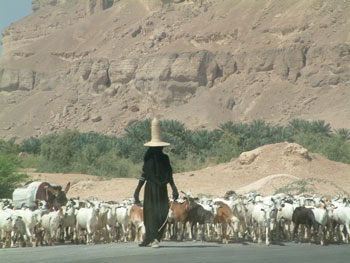
Jesus spoke of the final judgment as being like a shepherd separating sheep and goats (shepherds grazed them in mixed flocks). Separating sheep from goats in western countries is not difficult, as the sheep have been bred to accentuate their wool production so they look quite different. However, sheep and goats in Asia and Africa are often similar in appearance—consistent with them belonging to the same created kind, as Dr Lightner pointed out above.1
Non-shepherds find it difficult to distinguish such sheep and goats, but the shepherd knows the difference and easily separates them. For example, there are differences in behaviour: sheep tend to follow; goats go their own way. At the judgment, the Great Shepherd (Hebrews 13:20) will know the difference and will separate those who followed Him (Mat. 10:38) from those who went their own way.
- See also, Sheep-goat hybrid, Creation 23(2):5, 2001.
References and notes
- Genesis 8:17; 9:1, 7; Isaiah 45:18. Return to text.
- Tsō’n, צאן. This word is used 275 times in the Old Testament. Kohlenberger III, John R. and Swanson, James A., The Hebrew-English Concordance to the Old Testament, Zondervan, Michigan, USA, pp. 1349–1351, 1998. Return to text.
- For example, keseb, כשב, first used in Genesis 30:32 and used a total of 13 times. Ref. 2, p. 854. Return to text.
- For example, ‘ēz, עז, first used in Genesis 15:9 and used a total of 74 times. Ref. 2, pp. 1190–1191. The three Hebrew words all appear in Leviticus 1:10: ‘If the offering is … from the flock (tsō’n, צאן), from either the sheep (keseb, בשכ) or the goats (‘ēz, עז) … ’. Return to text.
- Although mating between sheep and goats is not uncommon when they are kept together, a live offspring is actually very rare. Stewart-Scott I.A., et al., A case of a sheep-goat hybrid in New Zealand, New Zealand Veterinary Journal 38(1):7–9, 1990; Letshwenyo, M. and Kedikilwe, K., Goat-sheep hybrid born under natural conditions in Botswana, Vet Rec. 146(25):732–734, 2000. Return to text.
- Much to the surprise of many evolutionists, creationists believe such changes can occur very rapidly when the right conditions are present. See Catchpoole, D. and Wieland, C., Speedy species surprise, Creation 23(2):13–15, 2001; Bell, P., Genetic engineers unwind species barrier, Creation 25(4):52–53, 2003; and Wieland, C., Brisk biters, Creation 21(2):41, 1999. Return to text.
- The underfur may also be composed of fur or velli depending on the animal and specific characteristics of the hair. The underfur is typically softer than guard hairs. Return to text.
- Myers, P., Hair, Animal Diversity Web, animaldiversity.ummz.umich.edu/site/topics/mammal_anatomy/hair.html, 23 June 2005. Return to text.
- The receptor for α-melanocyte stimulating hormone (MSH) is activated even in the absence of MSH, caused by a single amino acid substitution which alters the configuration of the receptor. A second mutation associated with this trait has also been described. Våge, D.I., et al., Molecular and pharmacological characterization of dominant black coat color in sheep, Mammalian Genome 10(1):39–43, 1999. Return to text.
- Basrur, P.K. and Yadav, B.R., Genetic diseases of sheep and goats, Vet Clin North Am Food Anim Pract. 6(3):779–802, www.ncbi.nlm.nih.gov/entrez/query.fcgi?cmd=Retrieve&db=PubMed&list_uids=2245374&dopt=Abstract, 4 September 2006. Return to text.
- For example, the polled trait in Dorset sheep resulted from a mutation that eliminated horns. Lightner, J., The riddle, Creation 27(4):30–32, 2005. Sheep farmers found this useful. Return to text.
- For example, hair colour in sheep is known to be controlled by at least three different genes; see Mongold, S., Color genetics in Icelandic sheep, www.icelandicsheep.com/genetics.html, 4 September 2006. Also, hair growth is controlled by complex biochemical interactions between several cell types; see Nakamura, M., et al., Control of pelage hair follicle development and cycling by complex interactions between follistatin and activin, www.fasebj.org/cgi/content/full/17/3/497, 23 June 2005. Return to text.


Readers’ comments
Comments are automatically closed 14 days after publication.