

Journal of Creation 19(2):3–4, August 2005
Browse our latest digital issue Subscribe
Startling plant discovery presents problems for evolution
A recent paper published in Nature should encourage and excite creationists. It describes a plant that can fix its own mutations, apparently without using DNA as a template.1 The plant, Arabidopsis thaliana, is able to revert from a homozygous recessive mutant form, known as Hothead, to a heterozygous normal form by altering the DNA base sequence on one of the homologous recessive genes. Such a mechanism allows a ‘revert to saved’ function not unlike that in Microsoft Office®. The plant is able to revert to a previous copy of the gene just as an author can revert to a previously saved copy of a document if undesirable changes have been made. Another parallel is the ‘Edit–undo’ function. Both of these significantly benefit computer users, however it is stunning to see such a phenomenon in living things.
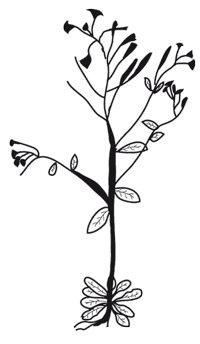
Normally, an organism directly inherits the genetic information from both of the parents. Inheriting the same mutation from both parents means that the organism will have two copies of the mutant allele with no way to fix the mutation. However, two copies of the mutated form of the Hothead mutation activates an error correction mechanism that fixes the mutations in that gene as well as others. Subsequent generations of plants end up carrying one or more corrected copies of their genes.
In a very well-designed study, the authors carefully exclude many types of random changes in favour of a ‘template-directed process’. The phenotype reversion could result from incomplete penetrance,2 masking epigenetic change,3 or seed contamination. All of these were ruled out. In addition, DNA sequence modifications could result from transposons (‘jumping genes’), repeated sequences,4 a high rate of random mutation or correction through alleged gene conversions.5 Each of these were also ruled out. Specific nucleotide mutations were consistently fixed, which is inconsistent with a random occurrence.
How can a mutation-correcting mechanism evolve by natural selection?
Natural selection is supposed to work by favouring certain traits that provide a selective advantage and eliminating those that are even slightly deleterious over the generations. The raw material of evolution is supposed to be the spontaneous mutations that will impact effective reproductive success. These so-called ‘beneficial mutations’ will be selected for in future generations.
Cells have several mechanisms and methods for DNA repair—fixing various types of damage to DNA before it causes irreparable damage. While DNA repair mechanisms could be considered irreducibly complex, it can still be argued that natural selection would favour an organism with better DNA repair. This means that, however unlikely, evolutionists can still argue that natural selection could provide for DNA repair to evolve. Cells with mutations that improved DNA repair would be favoured.
The mutation repair mechanism found in Arabidopsis is different. How do you select for the ability to fix a mutation that you don’t have? This may be the ultimate biological Catch 22. A mutation repair mechanism can only provide a selective advantage to those individuals that have the mutations and get them fixed. It does nothing for any individuals that lack the mutations, and therefore this mechanism would potentially be lost through mutation to itself or just by genetic drift (assuming the trait is coded somehow on the chromosomal DNA).
All mutations are not created equal.
These authors suggested that stress may serve to induce the DNA mutation repair. This is in contrast to the SOS response in bacteria6 where stress induces more mutations, not less. The idea being that increasing the number of mutations might increase the chances of a rare mutant that would be able to survive and overcome the stress.
Since mutations are the raw material of evolution, mechanisms which reduce the number of mutations would work against evolution. Undesigned mutation repair templates cannot distinguish between mutations that are harmful and those that are beneficial. As far as evolution is concerned, mutation repair would be risky business. Fewer mutations would mean reduced opportunity to generate those rare mutations that are supposed to provide a benefit, so it would make evolution that much harder and require even more time. This looks like yet another mechanism designed to stop created kinds from drifting significantly from the original basic design.
The authors suggest that a stressinduced response may be involved. While this is likely, how does the cell know which mutations out of millions of DNA base pairs to fix? This is a tricky problem.
An especially surprising result from the study is that it is not just one mutated nucleotide that gets repaired. Indeed, the authors found several mutations that were repaired in different parts of the genome. Introns, exons and even untranslated regions (some of the ‘junk DNA’) were repaired. This raised the possibility that the mutation repair mechanism may be much more widespread in Arabidopsis, but also may play a role in other organisms.
Could RNA molecules be the answer?
Lolle and colleagues postulate that RNA molecules are providing the corrective template. Their best guess is that some kind of double stranded-RNA left over from previous generations is responsible. On one hand, RNA of some type is likely to be involved. However, there are serious obstacles that would argue otherwise. RNA seems to fit the bill as it has the potential to serve as a template, along with DNA. In addition, RNA is involved in many processes such as RNA editing (modification of RNA sequences), spliceosomes (splicing of mRNA molecules), the ribosomes (molecular factory where proteins are made), as well as some others. However, in each of these cases, it is playing a significant role in each and every cell, not waiting on ‘standby’ for the chance that a mutation might need fixing. RNA may likely be involved in the repair mechanism, but it will probably be found working with one or more proteins in a complex, rather than alone.
Several features of RNA make it unlikely to be acting alone. First, RNA molecules are not as stable as DNA and are more prone to degradation. In fact, the half-life of most mRNAs in cells is at most only several hours. Also, a single-stranded RNA molecule is more prone to mutations itself. These mutations cannot be repaired, as RNA doesn’t have the second strand to serve as the template. In fact, this is the likely rationale for suspecting the alleged mutation-repairing RNA template is double-stranded and left over from the grandparents.
A further complication to this scenario is the fact that some of the mutants that
didn’t revert in the third generation did so in subsequent generations. In
this case, the template mechanism, although present in the ‘grandchildren’,
didn’t activate and repair until the next generation (the great grandchildren).
If the mutation repair template is left over from a previous generation, it would
become increasingly diluted and would seem to become less effective at mutation
repair in subsequent generations. This is especially true since presumably now the
mutant copies would be in the background.
How will evolutionists respond to this?
I expect evolutionists will come up with yet another ‘just so’ story to try to explain how such a fantastic mechanism arose by chance. Perhaps even something like this: This mutation-correcting mechanism allows the organism to try out mutations and then ‘revert to saved’ if the mutation was detrimental. Such a mechanism therefore strongly favours the rare beneficial mutations that arise through evolution.
However, don’t be fooled by such an argument. This type of ‘explanation’ is just misdirection, or distraction, much as magicians use. It doesn’t answer the most important question of where it comes from. Showing how a trait or gene might be beneficial to the organisms that have it does not explain how it originated.
Furthermore, there is no evidence whatever that the repair mechanism would not repair
any supposed ‘beneficial’ mutations as well, which would further limit
the ability of organisms to evolve. It is hard to see how a repair mechanism could
distinguish between good and bad mutations.
Conclusion
The stunning observation of a mutation repair mechanism in Arabidopsis clearly shows the wisdom of the Creator and helps organisms to ‘reproduce after their kind’. Nonetheless, it is unlikely to convince ardent evolutionists who are committed to naturalism. No matter how strong the evidence for design and creation, they will exclude the possibility and remind themselves that what they see is not designed but evolved.7
This unexpected and exciting study should encourage creationists and hopefully persuade others that the Bible is true and can be trusted, even in Genesis 1–11.
References
- Lolle, S.J., Victor, J.L., Young, J.M. and Pruitt, R.E., Genome-wide non-mendelian inheritance of extra-genomic information in Arabidopsis, Nature 434:505–509, 2005. Return to text.
- In incomplete penetrance, not all of the individuals who carry a particular gene will have the phenotype. Return to text.
- An epigenetic change is one that affects the expression of a gene without changing the sequence. DNA methylation is an example of a way genes can be turned off without altering the sequence. A masking epigenetic change would cover over a mutant gene, changing the phenotype but not the DNA sequence. Return to text.
- Regions in the genome with repeated sequences have a higher tendency for mutation. Return to text.
- Gene conversion is a model to describe how a homologous copy of a gene may be used to correct mutations in another. Return to text.
- Alberts, B., Johnson, A., Lewis, J., Raff, M., Roberts, K. and Walter, P., Molecular Biology of the Cell, fourth edition, Garland Publishing Inc., New York and London, p. 274, 2002. Return to text.
- ‘Even if all the data point to an intelligent designer, such an hypothesis is excluded from science because it is not naturalistic,’ Dr. Scott Todd, Kansas State University, correspondence to Nature 401(6752):423, 1999. ‘Biologists must constantly keep in mind that what they see is not designed, but rather evolved,’ Francis Crick, What Mad Pursuit, Basic Books, New York, p. 138, 1988. Return to text.
Readers’ comments
Comments are automatically closed 14 days after publication.