
Tall tales in the trees
Now evolutionists are saying that man’s ability to walk upright evolved in the trees, rather than on the ground.
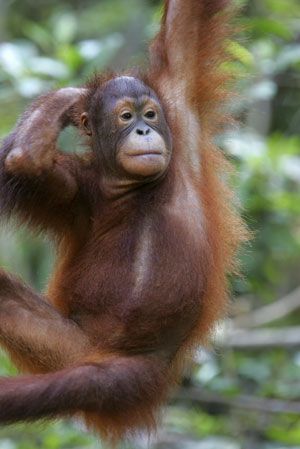
An evolutionary team has proposed a new hypothesis for the origin of human bipedalism (walking upright on two legs). They based their hypothesis on year-long observations of Sumatran orangutans moving bipedally in rainforest trees.1,2 The researchers analyzed nearly 3,000 examples of observed orangutan movements and discovered that the orangutans were more likely to use ‘hand-assisted bipedalism’ when balancing on the thinnest branches.
As a result, the researchers propose that human bipedalism may have originated in the trees before ancient apes and early ‘hominids’ relocated to the ground when rainforests supposedly dried out.
This challenges the traditional ‘savannah hypothesis’ which proposes that human bipedalism emerged after our alleged ape-like ancestors left the trees and began living in open savannahs. Once in the open savannahs, knuckle-walking supposedly converted to upright walking over millions of years.
The researchers made some telling comments relating to the difficulties confronting paleontologists endeavouring to construct an evolutionary history from fossil bones. ‘Our findings blur the picture even further’, lamented Robin Crompton, of the University of Liverpool (UK). ‘If we’re right, it means you can’t rely on bipedalism to tell whether you’re looking at a human or other ape ancestor. It’s been getting more and more difficult for us to say what’s a human and what’s an ape, and our work makes that much more the case.’
In other words, if paleontologists find a bone that seems to have ‘walked
upright’, the authors of this latest study warn that it does not
mean that it is an ape that was ancestral to humans.
The research team’s hypothesis is really a major extrapolation from a very
prosaic observation. The only really conclusive statement of the year-long observations
was: ‘Our results suggest that bipedalism is used to navigate the smallest
branches where the tastiest fruits are, and also to reach further to help cross
gaps between trees.’ This is really the only legitimate scientific conclusion
that can be drawn from the orangutan movements.
Simply put, orangutans occasionally move bipedally in order to reach fruits and navigate rainforest branches. This is similar to the other great apes in the respect that they, too, occasionally utilize a limited bipedality when moving from location to location. Though the great apes possess ideal skeletal designs for extremely effective quadrupedal locomotion (knuckle walking), they are physically capable of moving in an upright manner for short periods of time. They are not unique in this regard since bears, raccoons, and other animals can also move bipedally in their own special ways. However, the limited bipedalism of apes is qualitatively different from the obligatory bipedalism of human beings. Humans were architecturally designed to move bipedally from the very start. The observed arboreal bipedality of the orangutans is closer to that of humans in one respect—orangutans react to branch flexibility like humans running on springy tracks, i.e. by increasing knee and hip extension, whereas all other primates do the reverse.
Predictably, given the problems evolutionists face in trying to construct an evolutionary ‘history’ that fits the present evidence, other evolutionists have been quick to point out the shortcomings of the latest hypothesis re origin of bipedality. French anthropologist Yvette Deloison of the National Centre for Scientific Research says the orangutan model is incorrect. ‘If the ancestor of man had an anatomy allowing him to do the same thing as orangutans, with hands and feet so perfectly adapted to climbing and suspension, he would have been far too specialised to allow for the development of what we are today,’ she said.
Of course, science is limited when trying to ‘reconstruct’ the past—it highlights the degree of speculation that is present of necessity in trying to think up evolutionary scenarios. And isn’t it interesting that the contradictions and other difficulties encountered when attempting to do that are so often conveniently sidestepped in these headline-grabbing announcements of ‘the latest evolutionary discovery’. It’s a pity that media reports are taken by so many as evidence that evolution is a ‘fact’, that evidence of evolution is getting stronger, whereas actually even a little scrutiny soon highlights the very flimsy nature of these claims so often announced in a blaze of publicity.
References
- ScienceDaily, Lessons From The Orangutans: Upright Walking May Have Begun In The Trees, 01 June 2007. Return to Text.
- Thorpe, S, Holder, R., Crompton, R., Origin of human bipedalism as an adaptation for locomotion on flexible branches, Science 316: 1328-1331, 1 June 2007. Return to Text.
Readers’ comments
Comments are automatically closed 14 days after publication.