
Do we still sin?
The doctrine of sin in contemporary theology

In the last half century the Doctrine of Sin appears to have become a doctrine under attack in theological circles, but this has largely gone unnoticed. This article1 aims to show how in various ways the classical doctrine has been challenged. That doctrine can be summarized as:
- Creation took place in the recent past.
- Sin began in the spiritual realms with the fall of the angels.
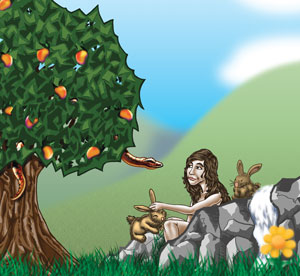
- Sin spread to mankind when Adam and Eve fell to temptation.
- Sin was first and foremost a breach of the commands of God.
- There followed a breakdown of relationships between God and mankind and then between people.
- Death entered as a consequence of the fall.
- The creation became corrupted and corruptible.
Protestantism, Catholicism and Orthodoxy have disagreed about how sin spread from Adam to his descendants but they were all agreed that it did spread and that the physical descent from Adam is fundamental to the doctrine.
1. Our understanding of ourselves
In the intellectual arena (rather than what real people think) it is said that the challenge arose first from the theories of Sigmund Freud and Carl Jung. But, with the passage of time, their views have infiltrated the popular mind.
1.1 Original goodness not original sin
Do you believe in original sin, or original goodness? The “creation-centred spirituality” of Matthew Fox and in the controversial The Lost Message ofJesus by Steve Chalke and Alan Mann have both been accused of having an unbiblical understanding of human nature. The Orthodox theologian Michael Pomanzansky put it starkly: “As for the newer sects of Protestantism … they have gone as far as the complete denial of original, inherited sin.”2
It is bad enough to deny what Scripture teaches but if sin is not really that serious then the need for the Son of God to bear our sin also becomes unnecessary and the Biblical doctrine of salvation is a swift casualty.
1.2 Sin as alienation
Paul Tillich is attributed with first arguing that sin is fundamentally a breach of relationship. The plight of man does not have to do with immorality and evil but with alienation and meaningless. “In every soul there is a sense of aloneness and separation.”3
Alister McGrath has defined sin as “something that separates humankind from God” and thus “salvation is the breaking down of the barrier of separation between humans and God on account of Christ.”4
The appeal for many is that it is possible to see the fall as a picture, or story, of alienation rather than historical fact. In the classical doctrine this breach of relationship is a consequence of rather than the heart of sin.
1.3 Victimhood
The breakdown of relationship comes into sharp focus when Cain murders Abel. If one person sins another is often the victim. The idea of victimhood has particularly appealed to liberation theologians and the cross is seen as showing Jesus as the victim of others’ sins.
It is a small step to thinking that victims are essentially sinless. But if the rich and powerful are the greater sinners why did Jesus, “the friend of sinners”, not spend more time with them? The argument breaks down, but it is nevertheless widely held. It is safer to say instead that all have a sinful nature but some, because of their circumstances, impact others more when they fall into sin.
1.4 Failure of potential
Process theology was an attempt to re-cast classical theology in an evolutionary framework and is particularly associated with Norman Pittenger. In this view “sin consists of man’s failure by free decision, whether his own or that of the society in which he shares, to become in reality what in possibility he is made for.”5 God is no longer sovereign, and sin marks our failure to live up to our potential. Those who try to resist theological “progress” and development are therefore particularly guilty of sin. This is developed particularly in feminist theology.
1.5 A man thing
Valerie Saiving is attributed with the beginning of the feminist attack on the classical doctrine of sin. Ironically feminist theology is the one area where the doctrine of sin has remained a prominent theme. Often in the past, women, in particular Eve, were blamed for sin. Men, it is said, formulated the doctrine of sin but it does not reflect the experience of women. For feminists Eve’s failure was that she did not take responsibility for herself. Women will break free of sin when they do what Eve failed to do, live up to their potential.
In all these ways our understanding of ourselves in the classical doctrine of sin has been and is being assaulted today.
2. Our understanding of our origins
The second type of challenge relates to human origins. All the views about the origin of sin assume, to some degree, the truth of Darwinian evolution and that the earth is very old, contrary to the classical view. If the earth is old, when did sin begin?
2.1 Sin radically new
The first view is that though the universe is old sin had a definite starting point. Rarely do people spell out what they really believe on this point;. Most hide behind generalities or plead ignorance but there are two broad variants.
2.1.1 Recent humans, recent sin
Human-like creatures may have been evolving for millions of years but man in the image of God is a recent arrival. Either man was made by special creation or God gave an existing creature a soul thus making them human.
2.1.2 Old humans, recent sin
Human beings have been around for a long time, but sin is relatively recent. Again many writers are wary about spelling out what they believe but many conservative evangelicals appear to adopt this approach.6 What this means is that death, destruction and disasters occurred long before the Fall and must have been included in what God calls “very good”. It is rare that those who put forward this view address how and why they deviate from the classical doctrine; usually they are content to plead ignorance.
2.2 Sin emerges
The second view asserts that man has fully evolved in the natural world and sin emerged along the way. There was no special creation and no Fall but again there are different ways in which this view is articulated. All of them represent a fundamental break with the classical doctrine of sin.

2.2.1 Sin and survival
“Sin is the inevitable outcome of the struggle to survive.”7 Sin is entirely human, it has no spiritual content; “evolution, even death and extinction are good unequivocably.”8 Natural evil is thus an illusion or just a helpful way of describing things. Sin, death and corruption are just natural, they cannot be avoided.
2.2.2 Leaving sin behind
An alternative is to see sin itself as a stage in the evolutionary process. The challenge is to rise out of the evolutionary soup and leave sin behind. This resonates with process theology and appeals to those most concerned with the survival of the eco-system. Under this view the greatest sins are those things which seem to threaten our survival. Try questioning Global Warming and you will soon discover this for yourself.
2.2.3 The Sin Myth
A third variation is found amongst the theological revisionists including the former Bishop of Newark, Jack Spong and the Cambridge academic Don Cupitt. Sin is just part of evolution so there is nothing wrong with it. The idea of sin was invented by men as a weapon of power within religion. They argue that this has turned the idea of God into a monster and Spong likens the doctrine of atonement to child abuse.9
We see, therefore, that the revisionists are just old-fashioned idolaters; God is a projection of their own thoughts and ideas. They have no sense that He has revealed Himself to us.
Summary
The doctrine of sin is far less prominent in theological discussion than it once was except, curiously, amongst feminists. Classically it was fundamental to explaining human nature and the doctrine of salvation. Today different understandings of human nature and human origins lead to a very different idea of sin.
At one end of the spectrum we have seen conservative evangelicals who wish to retain most of the classical doctrine except the first point—that creation and the fall occurred in the recent past. It is rare to find that the consequences of this approach are explored.
Along the way are various views which have sought to shift the focus away from sin as first and foremost a breach of the commands of God and place the emphasis elsewhere. Whereas the classical view sought to represent a straightforward reading of the narrative of Genesis (God said “don’t”—Adam and Eve did) these contemporary views lean much more heavily on human insights about human nature, although they may go on to search for support for these insights in the text of Scripture.
At the far end of the spectrum are those who reject every point of the classical doctrine. What is more, they argue that the biblical teaching itself is sinful, because it was invented by men to oppress their fellow men and women. In contrast, those who accept the biblical teaching cannot but conclude that the revisionists’ attempts to redefine sin are actually a exact illustration of what sin really is: a failure to accept and live by the Word of God.
"When with his whole soul Adam believed the serpent and not God, then the Divine Grace which had rested on him stepped away from him, so that he became the enemy of God by reason of the unbelief which he had shown to His words."10
Recommended Resources
References
- A fuller version of this article was published by Church Society in Churchman Vol 122/2, 2009; (www.churchman.org.uk). Return to text.
- Michael Pomanzansky, Orthodox Dogmatic Theology, St. Herman of Alaska Brotherhood Press, p. 165, 2005. Return to text.
- Paul Tillich, The Shaking of the Foundations, Charles Scribner’s & Sons, NY, p. 156, 1955. Return to text.
- Alister McGrath, Theology—The Basics, Blackwell, Oxford, p. 96, 2007. Return to text.
- Bruce A. Milne, The Idea of Sin in Twentieth-Century Theology, Tyndale Bulletin. 26:25, 1975. Return to text.
- For example: Robert S. White, Genesis and Creation, Reform, Sheffield, 2006, and Sandy Grant, The Design of Genesis, The Briefing, Issue 337, October 2006. Return to text.
- Charles Sherlock, The Doctrine of Humanity, IVP, Leicester, p. 63. Return to text.
- Russell and Wegter-McNelly, Science, The Blackwell Companion, p. 527. Return to text.
- John S. Spong, Why Christianity Must Change or Die, Harper, San Francisco, p. 95, 1998. Return to text.
- St. Symeon the New Theologian (949–1022AD) cited in: Pomanzansky Orthodox Dogmatic Theology, p. 158. Return to text.


Readers’ comments
Comments are automatically closed 14 days after publication.