

Why the electric battery was forgotten

Fifty years ago, the then Director of the Baghdad Museum, Wilhelm Konig, reported the discovery of an electric battery 2,000 years old. You had not heard about this sensational discovery? We can tell you why. It did not fit in with the established viewpoint, and most archaeologists did not want to know about it. They hoped it would go away.
But Konig’s electric battery did not go away. In fact a lot more of them were found in Parthian settlements near Baghdad.
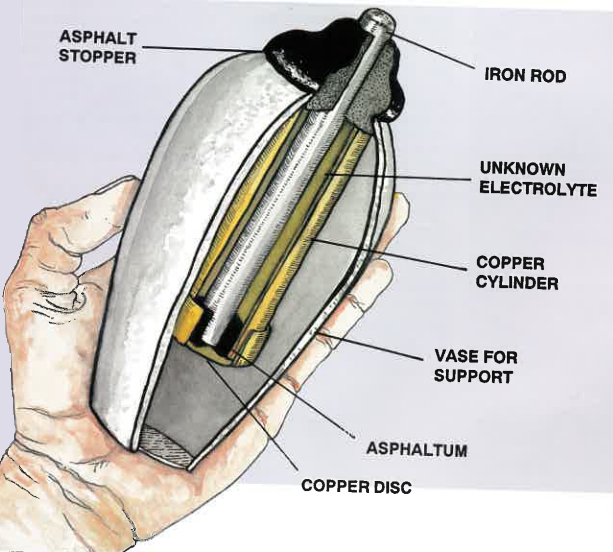
The battery Konig discovered consisted of a pottery jar 14 centimetres (5½ inches) high and 8 centimetres (3 inches) in diameter with a 3.3 centimetre (1½ inches) opening at the top. Inside this opening, and held in place with asphalt, was a tube made of a copper sheet. The tube was sealed at the bottom with a copper disc held in place with more asphalt. Suspended from the asphalt lid was an iron rod which hung down inside the centre of the copper roll.
Acid battery
The use of asphalt sealing indicated that the contraption must have contained some liquid. At that time virtually all available liquids, apart from vegetable and mineral oils, were acidic. So the logical conclusion was that the pottery jar and its contents were for the production of an electric current. Vinegar was the most likely acid that would have been used.
But it was the purpose to which this electric current could, or would, be put that produced some embarrassment.
About the only likely explanation was that it was used for electroplating, but no electroplated items had ever been found. In any case, there is a lot more to electroplating than the production of a mild electric current.
Used in medical therapy
Now, Paul T. Keyser of the University of Alberta in Canada has come up with an alternative suggestion. Writing in the prestigious archaeological Journal of Near Eastern Studies, he claims that these batteries were used as an analgesic. He points out that there is evidence that electric eels were used to numb an area of pain, or to anaesthetize it for medical treatment. The electric battery could have provided a less messy and more readily available method of analgesic.
Of course the 1.5 volts that would have been generated by such a device would not do much to deaden a patch of skin, so the next conclusion was that these ancient people must have discovered how to link up several batteries in series to produce a higher voltage.
Paul Keyser says that ‘Mesopotamian medical practice included a number of elements conducive to the reception of an electrotherapeutic device of this sort.’
In Sumeria, Akkad, and Babylon, there were two types of physicians, the ‘Asu’ and the ‘Asipu’. The latter practised diagnosis of the patient’s symptoms, or divination to determine the nature of the affliction. The former prescribed the medicine, or used incantation, to provide healing. They may have been the ones to apply electric currents to the patient’s stricken parts.
Ancient acupuncture?
Keyser considers it significant that bronze and iron needles were found with the battery devices discovered in Seleucia. He considers that these needles may have been used for acupuncture. He points out that acupuncture was already standard practice in China.
Electric eel ‘cure’
Electric fish were used for medicinal purposes in Greek and Roman times for relieving headache and gout. Scribonius Largus wrote long ago, ‘For any sort of foot gout, when the pain comes on it is good to put a living black torpedo fish under his feet while standing on the beach, not dry but one on which the sea washes, until he feels that his whole foot and ankle are numb up to the knees.’
But while electric fish are found in the Mediterranean Sea and in the Nile River, they are not found in the Persian Gulf or the river of Mesopotamia, hence the need to invent an electric battery.
But all that was just too much for the establishment. It did not fit in with the usual concept of the development of Homo sapiens, the brilliant generation of modern man which allegedly had slowly evolved from primitive ape-men to our sophisticated scientific society. The Parthian batteries were before their time and were best forgotten.
Artefacts called ‘ooparts’
Actually, this unwelcome discovery had been publicized by Rene Noorbergen before Keyser’s article appeared in the April 1993 edition of the Journal of Near Eastern Studies. Noorbergen, an American journalist turned college lecturer, wrote a book called Secrets of the Lost Races (Norcom Publishing, Collegedale (Tennessee), 1992). He not only wrote a whole chapter about the forgotten batteries, but drew attention to other artefacts that did not fit the established view. He called them ‘OOPARTS’, or ‘Out Of Place ARTefactS’.
Noorbergen seemed to go a little too far in places, neglecting to give sources or giving sources difficult to trace. He also dug up ‘evidence’ to support his idea that 4,000 years ago men had planes that could fly, and atom bombs that well-nigh destroyed civilization as it then was, and he seemed to accept the erroneous idea of pyramid power sharpening razor blades. But he did produce some apparently reliable reports that made a few contemporary geologists feel uncomfortable.
Modern invention millions of years old?
In 1967 papers across America reported the discovery of human remains and a well-tempered copper arrowhead in a silver mine in Colorado, at a depth of approximately 120 metres (400 feet).
The June 1851 edition of Scientific American reported that a beautiful metallic vase had been blasted out of solid rock in Dorchester, Massachusetts. The vase was adorned with six flowers and was inlaid with silver, but the rock was considered to be millions of years old.
The author draws attention to the Ashoka Pillar at the Kutb Minar in Delhi, India. It is a 10 metre high iron pillar weighing six tonnes, and has been standing there since AD 413 at the latest, yet it shows only the minutest trace of rusting. It has taken modern technology a long time to come up with stainless steel. King Chandragupta’s men seem to have had a head start back then.
Noorbergen also points to the well-known problems associated with the building of the pyramids. He concludes that ‘the builders used construction and engineering skills and techniques known only to them.’ We would have to acknowledge that modern man, with all his brilliant achievements, would not be able to erect such stupendous monuments with the primitive equipment we think was available then.
As for the cave-man concept, Noorbergen notes that there is no evidence that people who lived in caves had extensive body hair, for example. This is all just part of the supposed scene, the way some artists think it should have been.
Advanced culture in ‘stone age’
In reality, there is plenty of evidence to show that people in the ‘Stone Age’ were highly intelligent, with an advanced culture. Their stone plates, bowls and vases were skilfully made and the artistic designs on them reveal a sophisticated art form.
Robert Silverberg wrote, ‘The cave paintings are upsetting to those who prefer to think of Quaternary man as little more than an ape’ (Man Before Adam, p. 191). And the great archaeologist W.F. Albright wrote, ‘It is very doubtful whether man’s artistic capabilities are actually any higher today than they were in late prehistoric times’ (From the Stone Age to Christianity).
Of course, some people did live in caves, but there are people today living in caves alongside modern cultures.
So, let’s bring the batteries out into the open and recognize that we may not be so advanced after all. It is only because of the accumulation of knowledge during the centuries that we have computers, rockets and atom bombs today—not because we have evolved intelligence.
The biblical record says that even before the Flood, Tubal-Cain was ‘an instructor of every craftsman in bronze and iron …’ (Genesis 4:22), and ‘there were giants on the earth in those days’ (Genesis 6:4). Maybe some were intellectual giants as well as being physically powerful.
Readers’ comments
Comments are automatically closed 14 days after publication.