

Your appendix … it’s there for a reason
If you put your trust in evolutionary based publications like the 1997 Encyclopædia Britannica, you would think of your appendix this way:
The appendix does not serve any useful purpose as a digestive organ in humans, and it is believed to be gradually disappearing in the human species over evolutionary time. 1
However, even in 1976 medical textbooks were beginning to admit the appendix had functions:
The appendix is not generally credited with significant function; however, current evidence tends to involve it in the immunologic mechanism.2
And in a 1995 medical textbook, the authors are emphatic about the function of the appendix:
The mucosa and submucosa of the appendix are dominated by lymphoid nodules, and its primary function is as an organ of the lymphatic system.3
Despite this, many public school texts still continue indoctrinating people in the idea that the appendix is great evidence that man evolved. An evolutionist had the following testimony put into the record of the historic 1925 Tennessee Scopes Trial:4
There are, according to Wiedersheim, no less than 180 vestigal [sic] structures in the human body, sufficient to make of a man a veritable walking museum of antiquities. Among these [is] the vermiform appendix . These and numerous other structures of the same sort can be reasonably interpreted as evidence that man has descended from ancestors in which these organs were functional. Man has never completely lost these characters; he continues to inherit them though he no longer has any use for them.5
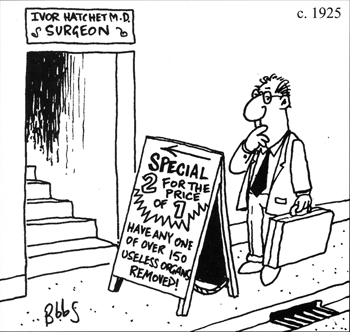
Thus, at one time evolutionists postulated there were 180 vestigial (functionless) structures (including the appendix) in the human body. Today this list has shrunk to virtually none. Imagine asking a doctor in 1925 to remove all these ‘functionless’ structures from your body!
Sadly, those brainwashed by the evolutionary idea that the appendix (and other organs) had no function included many Christians. This is yet another example of Christians being influenced by man’s theories outside the Bible. As the Bible is a revelation from the One who is infinite in knowledge and wisdom, then all of our thinking in every area should start with God’s Word.
Thinking Biblically about the appendix
Let’s assume that modern science knew of no function for the appendix. Would that show it was a useless left-over from our past evolution from the animals? Not at all. There would be at least two other possibilities, when our thinking is based upon the Bible:
- It had a created function in people originally, but as a result of the Curse (consequent upon Adam’s sin) on all creation, humanity has degenerated. Thus, our body has lost some functions which it once had. Evolution requires a gain in information—new structures, new functions.
- It has a created function, but we don’t know what it is yet.
Evidence of function
Why is the appendix so susceptible to disease?
If the appendix is a specially designed organ with a function, why do so many people suffer from appendicitis, which requires the appendix to be urgently removed to prevent death?
Answer:
Death, disease, and degeneration from original perfection are all a part of the curse on a once-perfect creation. They do not reflect on the suitability of the original design.
In addition, it is clear that appendicitis is only common in countries where a very highly refined modern diet is eaten. Where people eat a high proportion of vegetables, fruit and unrefined cereals, (in other words, have a high fibre diet), appendicitis is actually very rare. The original ‘Genesis diet’ for which we were designed7 was obviously much more like that.
Today, the appendix is recognized as a highly specialized organ with a rich blood supply. This is not what we would expect from a degenerate, useless structure.
The appendix contains a high concentration of lymphoid follicles. These are highly specialized structures which are a part of the immune system. The clue to the appendix’s function is found in its strategic position right where the small bowel meets the large bowel or colon. The colon is loaded with bacteria which are useful there, but which must be kept away from other areas such as the small bowel and the bloodstream.
Through the cells in these lymphoid follicles, and the antibodies they make (see box below), the appendix is ‘involved in the control of which essential bacteria come to reside in the caecum and colon in neonatal life’.6 Like the very important thymus gland in our chest, it is likely that the appendix plays its major role in early childhood. It is also probably involved in helping the body recognize early in life that certain foodstuffs, bacterially derived substances, and even some of the body’s own gut enzymes, need to be tolerated and not seen as ‘foreign’ substances needing attack.
But if it has a function, why can it be removed without ill effects?
Our body has been brilliantly designed, with plenty in reserve, and the ability for some organs to take over the function of others. Thus there are a number of organs which everybody agrees have a definite function, but we can still cope without them. Some examples:
- Your gall bladder has a definite function—it stores bile from the liver, and squirts it into the intestine as required to help with the digestion of fat. However, it can be removed and the body will cope—for instance, by secreting more bile continuously.
- You can cope with having a kidney out, because there is still enough kidney tissue left in the other one. (In the same way, a part of the Gut Associated Lymphoid Tissue, which includes the appendix, can be removed, and the remaining lymphoid tissue will usually be enough to carry on the total function). You won’t suffer from having your thymus out (if you’re an adult), because this extremely important gland, which ‘educates’ your immune cells when you are very young, is then no longer required. This is likely to be very relevant to the appendix.
Lessons of the appendix
1 Corinthians 8:2 says: ‘And if any man think that he knoweth any thing, he knoweth nothing yet as he ought to know.’ Think about the questions God asked of Job: Where wast thou when I laid the foundations of the earth? … Where is the way where light dwelleth? … By what way is the light parted … ? Knowest thou the ordinances of heaven?8 After many other questions, we read that Job repented in ‘dust and ashes’ when he realized how much he didn’t know.
We were not there to see Creation. We do not know everything. In fact, we know almost nothing compared to the infinite amount there is to know. So how could humans, with such limited knowledge, ever have dogmatically stated ‘the appendix is functionless’? It is impossible in principle to prove something has no function—without infinite knowledge.
So-called ‘facts’ for evolution are continually being discarded (though sometimes only deleted from textbooks years later). Numerous people today still believe many of the outdated evolutionary ideas they were taught at school or college, not realizing that even the evolutionists no longer accept them.
Making antibodies
The appendix, in conjunction with other parts of the body which also contain cells called B-lymphocytes, manufactures several types of antibodies:
- IgA immunoglobulins, involved in surface or mucosal immunity. These are vital in maintaining the protective barrier between the bowel and the bloodstream.
- IgM and IgG immunoglobulins, which fight invaders via the bloodstream.
The appendix is in fact part of the G.A.L.T. (Gut Associated Lymphoid Tissue) system. The lymphoid follicles develop in the appendix at around two weeks after birth, which is the time when the large bowel begins to be colonized with the necessary bacteria. It is likely that its major function peaks in this neonatal period.
References and notes
- New Encyclopædia Britannica, 1:491, 1997. Return to text.
- Henry L. Bockus, M.D., Gastroenterology, 2:1134–1148 (chapter ‘The Appendix’ by Gordon McHardy), W.B. Saunders Company, Philadelphia, Pennslyvania, 1976. Return to text.
- Frederic H. Martini, Ph.D., Fundamentals of Anatomy and Physiology, p. 916, Prentice Hall, Englewood Cliffs, New Jersey, 1995. Return to text.
- Sometimes known as the ‘Monkey Trial’. Incidentally, readers should not think that the play/film Inherit the Wind was anything like true depiction of this trial—see Inherit the Wind—An historical analysis. Return to text.
- The World’s Most Famous Court Trial, Tennessee Evolution Case (A word-for-word report), Bryan College, p. 268, 1990 (reprinted from the original 1925 edition). Return to text.
- A more detailed survey of the evidence, with numerous references to other technical literature, showing that the appendix is not a vestigial organ can be found in J.W. Glover, The Human Vermiform Appendix—a General Surgeon’s Reflections,CEN Technical Journal, 3:31–38, 1988. Dr Glover is a surgeon in Melbourne, Australia. Return to text.
- See P. Emerson, Eating out in Eden, Creation 18(2):10–13, March 1996. Return to text.
- Job 38:4, 19, 24, 33; Job 42:6. Return to text.

Readers’ comments
Comments are automatically closed 14 days after publication.