

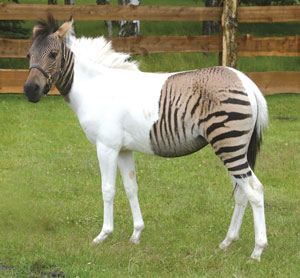
Zebra or horse? A ‘zorse’, of course!
Examples of zebra-horse hybrids abound, but few are as stunningly eye-catching as ‘Eclyse’ pictured here.1,2 While most other zorses have stripes across their entire body, Eclyse looks like she’s had her face and rear flank painted by a very clever artist. But the markings are real, and she’s become a major attraction at a safari park in the German town of Schloss Holte-Stukenbrock.
Her mother, Eclipse, had spent a short time at a ranch in Italy, where she shared a paddock with other horses, as well as a zebra called Ulysses. On her return to Germany, Eclipse surprised her keepers by giving birth to the baby zorse. (The hybrid foal’s name is itself a hybrid of her parents’ names.)
And it’s not just Eclyse’s physical markings that reflect her ‘mixed’ parentage, but her temperament, too. ‘She is usually relatively tame like a horse,’ said a park spokesman, ‘but occasionally shows the fiery temperament of a zebra, leaping around like one.’
The numerous examples of horses, zebras and donkeys interbreeding with one another points to them all being descended from the same original ‘kind’ created on Day 6 of creation week (Genesis 1:24–25).3 It also demonstrates that Noah needed far fewer animals than sceptics like to claim—he only needed two ‘horses’, i.e. one male and one female of the equine kind.4
And what might those two ancestors of today’s donkeys, horses and zebras have looked like? It seems probable that at least one of that Ark-borne pair must have had stripes, because while it’s now been documented that zebra offspring can progressively lose stripes (in just a few generations),5 horse offspring apparently cannot gain stripes unless a striped equine is (re-)introduced into the population—as is beautifully demonstrated by Eclyse.6
References and notes
- Meet Eclyse—the amazing zebra crossing, The Daily Mail (UK), <www.dailymail.co.uk/pages/live/articles/news/news.html?in_article _id=464723&in_page_id=1770>, 2 July 2007. Return to text.
- According to ref. 1: ‘Horses and zebras are often crossbred in Africa and are used as trekking animals on Mount Kenya.’ For other examples of zebra-horse hybrids see: Shetland-Zebra hybrid, Creation 24(1):9, 2001; and Batten, D., Ligers and wholphins—what next? Creation 22(3):28–33, 2000;<creation.com/liger>. Return to text.
- Catchpoole, D., Zenkey, zonkey, zebra donkey! Creation 26(3):56, 2004; <creation.com/zonkey>. Return to text.
- Assuming that Noah understood ‘clean’ and ‘unclean’ (Genesis 7:2) the same way that God later decreed to Moses (Leviticus 11:3–4,26; Deuteronomy 14:6), only one pair of ‘horses’, not seven, were needed. Return to text.
- The Quagga Project has made very significant progress towards re-establishing (evolutionists might say ‘re-evolving’) a population of southern Plains Zebras with markings similar to the exterminated quagga. (Historical illustrations and photographic evidence, along with preserved museum specimens, show that the quagga, Equus quagga, had zebra-like stripes on its front half while the back section was like a horse with no markings.) In just a few generations, the project now has offspring which exhibit not just a considerably reduced striped area, but also the body stripes themselves are considerably narrower and fainter. Quagga Project News, <media1.mweb.co.za/quaggaproject/news.htm>, 5 July 2007. Return to text.
- That being the case, the challenge therefore for evolutionists is: ‘How did the zebra get its stripes in the first place?’ Return to text.


Readers’ comments
Comments are automatically closed 14 days after publication.