
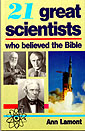
21 Great Scientists Who Believed the Bible
There is a widespread, but erroneous, view today that real scientists do not accept the truth of the Bible. It is therefore interesting to learn that many of the founding fathers of modern science were Bible-believing Christians, as were many of the less-well-known scientists who expanded our scientific knowledge. This book tells of the life and work of some of these great scientists who were Bible-believing Christians.
Each of these scientists either publicly acknowledged the Creator, or opposed evolutionary thinking, or, in many cases, did both. These scientists found their faith in God’s Word to be perfectly compatible with their scientific investigations. In some cases, their faith sustained them through times of physical hardship and professional difficulties. Samuel Morse, the American who invented the telegraph and Morse code, endured many frustrating years during which his ideas were rejected. Although he was penniless and frequently hungry, Morse never stopped trusting God because he believed that God’s guiding hand was on his life.
In other cases, the influence of their faith on the development of science was more direct, providing a framework of thinking which helped lead them to their discoveries. For example, astronomers had charted the paths of the planets across the sky, but could not make sense of the complicated paths they saw. Many scientists gave up searching for a simple logical pattern. After all, they reasoned, hadn’t the universe emerged from chaos anyway? In contrast, German astronomer Johannes Kepler reasoned that since the universe was designed by an intelligent Creator, it should function according to some logical pattern. To him, the idea of a chaotic universe was inconsistent with God’s wisdom. Kepler’s Christian faith led him to a way of thinking which eventually enabled him to solve the riddle of planetary motion.
This book includes scientists who have worked since Charles Darwin made evolutionary thinking popular. This should clearly show that confidence in the Bible was not replaced by Darwin’s ideas. Those scientists who have remained faithful to the Bible since Darwin’s time have continued to find that the Bible and scientific investigation are completely compatible.
While the contradiction between evolutionary thinking and the Bible certainly provides theological grounds for rejecting evolution, many famous scientists have argued strongly against evolution on scientific grounds. These include the brilliant French chemist, Louis Pasteur.
Spontaneous generation-the idea that a living organism can arise spontaneously from non-living matter is an essential part of the theory of evolution. Despite all the efforts of evolutionary scientists, not one case of spontaneous generation has been observed. Pasteur’s scientific findings clearly demonstrated the opposite-that life comes from life. Pasteur’s findings conflicted with the idea of spontaneous generation (as do scientific results since). Consequently, Louis Pasteur was a strong opponent of Darwin’s theory.
While each of the scientists discussed in this book was a creationist or Bible-believing Christian (or both), none of them was perfect in his professional, spiritual, or personal life. Although they greatly advanced our scientific knowledge, many followed wrong courses and blind alleys on the way to their scientific discoveries. Many of their findings have been modified as a result of subsequent investigations. Such modifications are part of normal scientific investigation, and in no way diminish the magnitude of these great men’s contributions.
Similarly, some of these men seem to have been wrong regarding some details of their religious beliefs. They came from numerous Christian denominations and held differing views on many, often minor, religious issues. However, they all seem to have believed that Jesus died on the cross so we could be forgiven for our wrongdoings. They believed that God created the universe and everything in it. They rejected the idea that these things came about by random, purposeless events.
Occasionally, we see flaws in the character of some of these men. For example, Isaac Newton’s confidence in his own findings and his eagerness to continue on to new discoveries caused him to be impatient with those who delayed his work because they were slow to understand it. He also tended to view others working in the same field as rivals rather than colleagues. While these tendencies are regrettable, Newton’s strong faith in God is evident in his writings. Such shortcomings merely serve to emphasize the universal sinfulness of man and our need to not only acknowledge God as our Creator and Saviour, but also to rely on Him daily as Lord over every aspect of our lives. It is probably an encouragement to know that these great men struggled with such human problems as pride and impatience just as we do, and like us, needed God’s help in these areas.
The 21 scientists (including the two Wright brothers) discussed at length in this book are merely a selection of some of the genuinely great scientists who accepted the truth of the Bible. For a list of others, see the Appendix. Those discussed here in detail made contributions in the fields of astronomy, biology, chemistry, electronics, geology, mathematics, medicine, oceanography, and physics. They include some of the greatest names in science. Despite some mistakes, their words, actions and attitudes clearly identified them as men of faith who had a high regard for the Bible. An open-minded assessment of the life and work of these men should once and for all, show that many real scientists do accept the truth of the Bible.
“21 great scientists who believed the Bible”, Ann Lamont, Creation Science Foundation, pp. 9–12
Readers’ comments
Comments are automatically closed 14 days after publication.