

Journal of Creation 21(1):69–74, April 2007
Browse our latest digital issue Subscribe
A 5D spherically symmetric expanding universe is young
Carmelian Cosmological General Relativity theory is considered in five dimensions. For it to be consistent with both Cosmological Relativity on the largest scales and Special Relativity on the smallest scales, the acceleration of the expansion of the cosmos must have been extremely large at Creation and must be zero at the present epoch. Hence the forced stretching of the fabric of space only occurred during the Creation Week and then ceased. This implies that during the creation of the heavenly bodies, massive time dilation occurred on Earth at the centre of the expansion. It is a necessary conclusion from the 5D theory describing a spherically symmetric expanding universe that light from the most distant sources reaches Earth within the biblical time scale as measured by local atomic time, but takes billions of years as measured in cosmic time.
In physics today we have the situation where Einstein’s Special Relativity (SR) theory has been very successfully applied in the local laboratory frame with moving and stationary clocks, to GPS satellites, and in analysing the decay of cosmic particles on Earth. Einstein’s Equivalence Principle (EEP) and his General Relativity (GR) theory have also been extensively tested with space-borne clocks in rockets and satellites.
It appears that it also has been successfully applied to the large-scale structure of the cosmos—cosmology. Today, the framework of Friedmann–Lemaître–Robertson–Walker (FLRW) is used to describe the expansion of the cosmos. However, various anomalies present themselves, including the mysterious ‘dark’ matter and ‘dark’ energy, which are said to comprise about 22% and 74% of the current universe, respectively. But they are still unknown. Moreover we are told that the universe underwent a rapid expansion, and this is the reason the Cosmic Microwave Background (CMB) is so smooth and why we don’t find monopoles. There are also many other problems1 with what has now become the standard paradigm—the big bang origin and evolution of the universe. It all seems to be unravelling at the seams.2,3
In recent years, a new five-dimensional cosmology has begun to challenge the standard model—Cosmological Special Relativity (CSR) and Cosmological General Relativity (CGR), developed by Moshe Carmeli.4–9 However, it might well be asked whether the application of GR to the universe as a whole is correct. The underlying principle upon which the standard model is built is the Copernican or cosmological principle, which essentially says that the physics we see here is the same for the whole universe at all epochs of time. It also says that wherever the observer is, he will see essentially the same picture of the distribution of galaxies in the universe. But if that principle is wrong, then the model that results is invalid. This seems to be the state of what is nowadays called ‘consensus cosmology’.
In this paper I explore an extension of Carmelian cosmology. In itself, it has had success in describing the large-scale structure as seen in the type 1a supernovae distance modulus versus redshift data,10,11 and in fitting to the anomalous rotation curves of spiral galaxies.12 I propose that the only 5D spacetimevelocity metric that can be correct on both the local scale, reproducing the 4D spacetime metric of SR and GR, and on the cosmological scale, reproducing the 4D spacevelocity metric of CSR and CGR, is one that requires that enormous cosmological acceleration and accompanying time dilation has occurred, in the past, between Earth clocks and those in the rest of the universe. This means the universe is very young as measured by Earth clocks. It only has the appearance of great age because we are biased by the vast size of the universe. Based on the observed retardation of cosmological clocks in the distant universe, I postulate that during Creation Week, specifically on Day 4, Earth clocks ran extremely slowly compared to the rest of the universe.
This means that if the new theory is shown to fit the observations of the large-scale structure of the universe and is consistent with Einstein’s well-tested special relativity theory, then we are forced to conclude that the correct understanding of the expanding universe means that clocks on Earth once ran at much slower rates than clocks in the universe. As a result, we have a mechanism for light to travel to Earth from the most distant galaxies within the biblical timescale.
Cosmological Relativity
The new 5D cosmology contains all of standard GR as a subset. All of the results in GR that are experimentally supported are also obtained in CGR.8 On the local scale where the universe is not expanding, Cosmological Relativity has no application. CSR applies a structure, similar to SR, to the whole cosmos without taking matter into account. When matter is added, CGR is required.
Here the CGR theory is considered using a Riemannian five-dimensional presentation of gravitation in which the coordinates are those of Hubble (i.e. proper distances as measured by the Hubble law and the measured redshifts of galaxies), and atomic time as measured by Earth clocks.
The metric4,7 used by Carmeli, in a covariant theory, extends the number of dimensions of the universe by the addition of a new dimension—the radial velocity of the galaxies in the Hubble flow. The Hubble law is assumed as a fundamental axiom for the universe and the galaxies are distributed accordingly.
5D line element
Initially, let us confine the discussion to an expanding universe without matter. The line element5,6 is that of CSR and is given by

where τ is the Hubble-Carmeli time constant, the reciprocal of the Hubble parameter H0 in the limit of weak gravity, and it is a constant in this epoch of time. The coordinate v is the expansion velocity of the cosmos, the radial speed of the expanding fabric of space. Coordinates x, y and z are spatial coordinates, and t is atomic time as recorded by Earth-based clocks. When ds = 0 one gets the Hubble expansion with no gravity, but this also requires dt = 0.
γ-factor in SR
Writing dr2 = dx2 + dy2 + dz2 in arbitrary spatial co-ordinates, (1) becomes

Now dividing by ds2 ,

where u = dr/dt. Therefore the relativistic γ-factor (γE) is

And when dv/dt → 0,

as per Einstein’s SR. This is because SR does not deal with an expanding space; that is, v is identically zero. The result is the usual γ-factor in SR, which causes strange relativistic effects (time dilation and length contraction) at high relative speeds; that is, where u → c. Besides on the local scale, the universe is not expanding now.
γ-factor in CSR
Similarly, from (1) it follows that

Dividing by ds2 ,

where tc = dr/dv is cosmic time measured backwards from tc = 0 at the observer, but determined from the expansion. By contrast, t is the locally measured atomic time. Therefore the relativistic γ-factor (γC ) is

When dv/dt is large compared to a0 = c/τ

as per Carmeli’s CSR.7 This is the normal case in the cosmos in CSR. The motion of the galaxies is dominated by the expansion, and local motions are negligibly small. As tc → τ, this γ-factor causes velocity dilation and length contraction analogous to that in SR.
Lorentz transformations
Since we assume Hubble law to be axiomatically true, v ≈ H0 r. Therefore locally,

Hence it follows that dv/dt → 0 as dr/dt → 0. We know that local space is not expanding. Therefore it follows from (2) that we can set dv/dt → 0 in (4) resulting in (5), and hence space and time coordinates transform according to the usual Lorentz transformations in SR.


In cosmology, space and velocity coordinates transform by the cosmological transformation,13


Comparing the above transformations shows that the cosmological transformation can be formally obtained from the Lorentz transformation by changing t to v and c to τ (hence u/c → tc /τ). Thus the transfer from ordinary physics to the expanding universe, under the above assumption of empty space, for null four-vectors is simply achieved by replacing u/c by tc /τ, where tc is the cosmic time measured with respect to us now.
Time dilation
Let us now suppose that the observer is located at the centre of the expansion. Let us also represent the time interval recorded by an inertial clock, co-moving with expanding sources14 attached to space as dT and local Earth-based atomic time interval as dt. From (2) we can write

Let us assume that motion through space is negligible. Therefore with u → 0,

At the present epoch dv/dt = 0 because we observe no expansion. This means, except for curvature effects, which are presently ignored, clocks in the universe run essentially at the same rate as on Earth. However, if dv/dt was much greater than c/τ = a0, a universal constant, it follows that dt << dT. I propose that this was the case during Day 4 of Creation Week and vast amounts of time passed on the galaxies expanding out from the centre of the universe with little time passing at the centre.
This is the critical point in understanding this paper. The assumption is that during the creation of the heavenly bodies15 on Day 4 the universe underwent a very rapid expansion. For example, the Bible tells us:
‘He wraps himself in light as with a garment; he stretches out the heavens like a tent’ (Psalms 104:2).
‘He sits enthroned above the circle of the earth, and its people are like grasshoppers. He stretches out the heavens like a canopy, and spreads them out like a tent to live in’ (Isaiah 40:22).
‘This is what God the Lord says—he who created the heavens and stretched them out, who spread out the earth and all that comes out of it, who gives breath to its people, and life to those who walk on it’ (Isaiah 42:5).
‘This is what the Lord says—your Redeemer, who formed you in the womb: I am the Lord, who has made all things, who alone stretched out the heavens’ (Isaiah 44:24).
The very fabric of space was stretched, and during that time of stretching, stars and galaxies were created.16 In order to conserve energy (and because of the underlying conservation laws imposed by the Creator) the period also involved massive particle production. This conclusion naturally results from the same 5D theory.17 This involved the creation of the stars and galaxies via massive ejection events from the centres of active galaxies and quasars. Though still controversial, this idea has observational support. Halton Arp and other astrophysicists have published many papers and a few books18 supporting this hypothesis based on decades of observations. Their view is totally naturalistic, whereas in the creationary model presented here all matter created this way was created during Day 4. This was part of the creation of the heavenly bodies, which we are able to see and which reveals His Glory for all to see.19
Now considering the fact that this would mean when we look out into the cosmos we are looking back in time, due to the finite speed of light, we are then looking at the events of Day 4 creation as they are actually happening. This also implies that the expansion of the universe only occurred during the Creation period, over six thousand years ago as measured by Earth clocks. The universe may no longer be expanding; at least the expansion is no longer accelerating. But we are seeing the after-effects of that expansion.
Therefore we expect that the environs of the solar system are not affected by any expansion now, which is consistent with the Hubble law, i.e. no expansion locally. But outside the Milky Way residual effects are still observed, particularly towards the limit of observation. And it is at great distances and towards the limits of the visible universe where the CGR theory is most applicable. But since we are looking back in time the great distant events actually occurred during the Creation Week. A large value of dv/dt, meaning dt/dv << a0 (c.f. eq. (8)), is consistent with the basis of CGR, which has been successfully applied to the high redshift (very distant) observations of the cosmos.10
The question might be asked, ‘Shouldn’t we then see massive blueshifts because of the existence of the large time dilation between sources at the edge of the universe and those at the observer?’ No, the time dilation that (14) refers to only occurred on Earth during the period of rapid expansion. Once the expansion was switched off there would be no difference in clock rates.20 And the expansion was switched off six thousand years ago. The Creator, who is omnipresent, switched off the acceleration when he stopped stretching out the fabric of space at that time. If we were on Earth to observe the cosmos during the period when the acceleration stopped we may have seen blueshifted starlight change colour as Earth clocks began to tick at approximately the same rate as cosmic clocks.
What we now observe in the universe is the redshifted light from the galaxies that has resulted from the expansion, not from this time dilation mechanism. The light is continuing to travel towards the Earth from the distant galaxies, as it has for billions of years by cosmological clocks, but because Earth clocks now run at the same rate we only observe expansion effects. The reference clocks in the cosmos are these cosmological or Hubble clocks, which can be related to redshift z by9

As z → ∞ we are seeing back towards the beginning of time, where tc → τ ≈ 13 billion years. But because this observation does not take into account the episode of rapid (superluminal) expansion (which is not observable today) the universal constant τ more correctly describes the size of the universe, not its true age as measured by Earth clocks.
One-way speed of light
We can write (1) as

where dr2 = dx2 + dy2 + dz2. Dividing (16) by dt2, and equating ds = 0 for the trajectory of a photon in spacetimevelocity, we get

The speed of light, c, in (17) is actually the locally measured two-way speed. The speed dr/dt is not the measurable two-way speed of light c but the non-measurable one-way speed of light.21,22 It tells us the speed of the expansion with respect to local Earth-based atomic clocks. Notice if dv/dt is zero we get the usual limiting speed c of SR. However, if dv/dt was extremely large in the unobservable past in the vicinity of Earth, as it now appears to be in the cosmos, which is in our past, then the one-way speed of light also was much larger then.
The apparent effect on the one-way speed of light dr/dt is really the direct result of time dilation. The actual measurable speed of light has not changed. It is time that is the variable in these equations, and as a result only appears to be producing enormous theoretical changes in the one-way speed of light, as seen by the observer. The actual speed of light is always the two-way speed c and is constant.
Spherically symmetric universe
From (16) it may be noted that this result is true in general for any coordinate system. In the real universe I consider the case of spherically symmetric coordinates, but it should be remembered that the time dilation is not the result of the choice of a coordinate frame.
In a spherically symmetric, isotropic, expanding23 universe, evenly filled with matter of density Ωm, it can be shown that for a photon trajectory:

where the effects of adding matter have been included in (17). Here Ωm is the averaged matter density of the universe expressed as a fraction of the critical density, which in this theory is 3/8πGτ2 ≈ 10–29 g/cm3 . The additional term results from solving Carmelian 4D spacevelocity representation of the large scale structure of the universe.
At the current epoch anywhere in the universe (17) holds. That means that the local physics is determined solely by SR, as expected, because dv/dt measured against local clocks is zero. However at past epochs dv/dt is non-zero and CSR must be applied instead. When matter is added, on a sufficiently large enough scale, the situation changes and we use (18). This means (18) is only really valid in a neighbourhood of a universe that is spherically symmetric around the origin—hence it must involve an isotropic matter distribution. Homogeneity is not required.
Light travel time
In order to calculate the light travel time in the universe from light sources at the edge we need to know the speed of the photons in terms of atomic time as measured by Earth clocks which have undergone a period of massive time dilation during the first days of Creation, especially on Day 4 when the Creator created the heavenly bodies. This is not the speed of light in terms of cosmic time, which is always c, and since Earth clocks now tick with nearly the same rate as cosmic clocks c is the locally measured value now also. So we need to know dr/dt where r is the proper distance to the source and t is atomic time units on Earth.
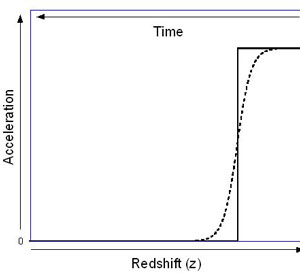
We have observed in (8) that the value of dv/dt needs to be very large at high redshifts (z >> 0) at cosmic times tc >> 0, but from (4) it is clear dv/dt needs to be zero at the current epoch tc = 0 (z ≈ 0). This is best described by a step function,

as shown in the solid curve in figure 1. The function (19) is shown with a finite maximum value, which at this stage we can only say was extremely large. This means that at the Creation the acceleration dv/dt was very large and then at some value of redshift z ≈ 0 the acceleration was switched to, or rapidly decreased to, zero. This switching was physically associated with the stretching of the fabric of space itself, as God spread out the heavens.
Now the function (19) can be approximated by an exponential of the form

where η is a dimensionless proportionality constant that is yet to be determined. The function in (20) has the needed characteristics and can be related to redshift z, using (15). This function is also illustrated by the broken curve in figure 1 where a maximum value has been imposed. However, for the purpose of the following calculations, (20) is used instead, which increases without bound as tc → τ or as z → ∞.
From a comparison of the magnitudes of the terms in (18) the matter density term can be neglected for the purposes of calculating the light travel time in the universe in terms of Earth atomic time units. It follows from (18) with Ωm = 1 and (20) that

is the one-way speed of light; the speed light travels toward the observer at the origin of a spherically symmetric universe, determined from the proper distances which the photons travel but with respect to local Earth-based atomic clocks. Note that (17) does not depend on spherical matter symmetry, but it only applies to an empty universe.
Into (21) we can substitute tc /τ → v/c, where v is the expansion speed. Now I make the assumption that the Hubble law (v ≈ r/τ) also applied at the Creation. Therefore it follows that

By integrating (22) we can calculate the distance light travelled in atomic time t:

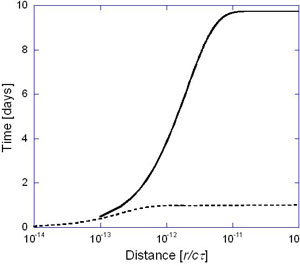
With c = 1 light-year/year and the chosen value of τ = 13.6 billion years11 the distance scale cτ = 13.6 billion light-years. Now the light travel time has been calculated from (23) using η = 1012 and 1013 , and is shown in figure 2. For large γ in (23) the light travel time t approaches a maximum value of 2τ/η. The result is an exponentially rising function that means light fills the universe to vast distances within 1 day (by Earth-based clocks) assuming the value of η = 1013. Depending on the exact magnitude of the undetermined parameter the light travel time may be days or, at most, years as measured by Earth based clocks.
Estimates for the size and extent of the acceleration term dv/dt may vary. At the present epoch in our local vicinity it is identically zero because the environment of the solar system is designed for life. In the past it was enormously larger as evidenced by the cosmos. Reducing the value of η in (23) will increase the length of time for light to traverse space in our time units, but this theory solves what has seemed to be a difficult problem.
Conclusion
Within the framework of Carmelian cosmology, for the 5D theory to be consistent on all scales (i.e. consistent with both SR on the local scale and CGR on the largest scales), the acceleration of the fabric of the expanding universe must be extremely large at high redshift and zero in the solar system. This then leads to the conclusion that at the Creation massive time dilation occurred with respect to the observer at the centre of a spherically symmetric, expanding universe. It also means that what we would calculate the one-way speed of light (not the actual speed of light that determines the physics in any local environment) is extremely large at high redshift—a direct result of massive time dilation and not any change in the speed of light. Therefore, light from the most distant galaxies could traverse the distances in a matter of a few days as measured by Earth-based atomic clocks, depending on the details of the magnitude of the past acceleration.
And there are no anomalous results on the aberration of starlight or any other well-proven relativistic effects because the speed of light measured locally with atomic clocks is always the constant c. Light arriving at Earth is stretched by expansion (hence redshifts observed) but because Earth based clocks at the present epoch run nearly at the same rate as cosmic clocks no other effects are observed.
The time dilation effect occurred on Earth during the Creation Week and was switched off simultaneously with the cessation of the acceleration of the expansion. This means the universe may no longer be expanding; we only see residual effects because of the finite travel time of light. An observer on Earth during the epoch of expansion would have seen large blueshifts. Currently, only redshifts are observed on the large scale in the universe. Everywhere within six thousand light years of Earth the expansion can be observed to have ceased, and this sphere of observation expands as the light continues to arrive from farther and farther away. Therefore events farther out are coming from Creation Week.
Observations are consistent our galaxy being situated at the centre of a 5D spherically symmetric universe of finite extent that has expanded many-fold. In terms of cosmological clocks it is as if the universe appears like a still photograph. This is the result of the vast distances and slow intrinsic motions on the cosmological scale. Nevertheless, the validity of the new theory applying to both the current and past epochs leads to the inescapable conclusion that the time it has taken light to travel from the most distant sources to Earth is billions of years of cosmic time, yet a matter of only days or years in local atomic time units.
References
- Williams, A.R. and Hartnett, J.G., Dismantling the Big Bang: God’s Universe Rediscovered, Master Books, Green Forest, AR, 2005. Return to text.
- Lerner, E.J. et al., An open letter to the scientific community, New Scientist 182(2448):20, 2004. Return to text.
- Ratcliffe, H., The first crisis in cosmology conference, Progress in Physics 3:19–24, 2005. Return to text.
- Behar, S. and Carmeli, M., Cosmological relativity: a new theory of cosmology, Int. J. Theor. Phys. 39(5):1375–1396, 2000. Return to text.
- Carmeli, M., Cosmological special relativity: a special relativity for cosmology, Found. Phys 25:1029, 1995. Return to text.
- Carmeli, M., Cosmological special relativity, Found. Phys 26:413, 1996. Return to text.
- Carmeli, M., Cosmological Special Relativity: The Large-Scale Structure of Space, Time and Velocity, Second Edition, Singapore, World Scientific, 2002. Return to text.
- Carmeli, M., Accelerating Universe: Theory versus Experiment, [arXiv: astro-ph/0205396], 2002. Return to text.
- Carmeli, M., Hartnett, J.G. and Oliveira, F.J., The cosmic time in terms of the redshift, [arXiv:gr-qc/0506079], Found. Phys. Letters 19(3):277–283, 2006. Return to text.
- Hartnett, J.G., The distance modulus determined from Carmeli’s cosmology fits the accelerating universe data of the high-redshift type Ia supernovae without dark matter, [arXiv:astro-ph/0501526], Found. Phys. 36(6): 839–861, 2006. Return to text.
- Oliveira, F.J. and Hartnett, J.G., Carmeli’s cosmology fits data for an accelerating and decelerating universe without dark matter nor dark energy, [arXiv: astro-ph/0603500], Found. Phys. Lett. 19(3):277–283, 2006. Return to text.
- Hartnett, J.G., Spiral galaxy rotation curves determined from Carmelian general relativity, [arxiv:astro-ph/0511756], Int. J. Theor. Phys. 45(11):2118–2136, 2006. Return to text.
- See Carmeli, refs. 5 and 6; Carmeli, ref. 7, p. 15, Section 2.11. Return to text.
- These sources are subject to the Hubble law τ dv = dr. Return to text.
- The period of rapid expansion of the universe may have involved Days 1 through 4, but the principle is the same. Return to text.
- Hartnett, J.G., The heavens declare a different story! J. Creation 17(2):94–97, 2003. Return to text.
- Gemelli, G., Particle production in 5-Dimensional cosmological relativity, Int. J. Theor. Phys. DOI: 10.1007/s10773-006-9187-z, 2006; Gemelli, G., Hydrodynamics in 5-dimensional cosmological special relativity, [arxiv:gr-qc/0610010], Int. J. Theor. Phys. (in press) 2006. Return to text.
- Arp, H., Seeing red, redshifts, cosmology and academic science, Apeiron, Montreal, 2003; Arp, H. Quasars, redshifts and controversies, Interstellar Media, Cambridge University Press, Berkeley, CA, 1987 Return to text.
- Psalm 19:1. Return to text.
- Hartnett, J.G., A new cosmology: solution to the starlight travel time problem, J. Creation 17(2):98–102, 2003. Return to text.
- Hartnett, J.G., Distant starlight and Genesis: is ‘observed time’ a physical reality? J. Creation 16(3): 65–67, 2002. Return to text.
- Newton, R., Distant starlight and Genesis: conventions of time measurement, J. Creation 15(1):80–85, 2001. Return to text.
- Hartnett, J.G., Cosmological expansion in a creationist cosmology, J. Creation 19(3):96–102, 2005. Return to text


Readers’ comments
Comments are automatically closed 14 days after publication.