

Calvin said: Genesis means what it says
Some professing evangelical Christians accuse creationists of taking a naïve literalistic view of Genesis, and claim that creationism is a 20th century aberration. Nothing could be further from the truth. A straightforward view of Genesis was the view of Moses (Exodus 20:8–11), the Apostle Paul (Romans 5:12; 1 Corinthians 15:21–22,45; 1 Tim. 2:13–14) and the Apostle Peter (2 Peter 3:3–7), and the Lord Jesus Christ Himself (Matthew 19:3–6; Mark 10:6–9; Luke 17:26–27).
It was also the view of the vast majority of the Church Fathers, including the faithful defender of the Trinity, Basil the Great. See Genesis means what it says: Basil (AD 329–379).1
And the great leaders of the 16th Century Protestant Reformation, in returning to biblical authority, also accepted a straightforward view of Genesis. This includes the Father of the Reformation, Martin Luther — see What was Martin Luther’s stand on Creation/Evolution? 2
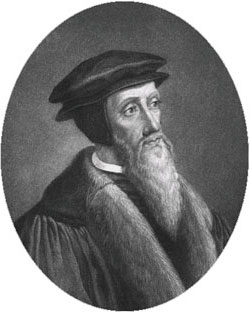
One of the most influential of the Reformers was the French lawyer and theologian John Calvin (1509–1564). He became leader of Geneva (Switzerland), which became a refuge for 6,000 Protestants. Calvin founded the University of Geneva in 1559, which attracted many foreign scholars, and still does today. His monumental Institutes of the Christian Religion (1559) proclaimed the grace of God and salvation in Jesus Christ. He was also a skilled commentator on books of the Bible, including Genesis. His teachings influenced many confessions, catechisms, preachers, leaders of modern Christian revivals, and were brought to America by the Pilgrim Fathers.3
It’s very interesting that on every point on which CMI disagrees with much of modern Christendom, Calvin took our side. For example, Calvin believed that:
- The earth is ‘young’:
‘They will not refrain from guffaws when they are informed that but little more than five thousand years have passed since the creation of the universe.’4
- God created in six consecutive normal days:
‘Here the error of those is manifestly refuted, who maintain that the world was made in a moment. For it is too violent a cavil to contend that Moses distributes the work which God perfected at once into six days, for the mere purpose of conveying instruction. Let us rather conclude that God himself took the space of six days, for the purpose of accommodating his works to the capacity of men.’5
‘I have said above that six days were employed in the formation of the world; not that God, to whom one moment is as a thousand years, had need of this succession of time, but that he might engage us in the contemplation of his works.’6
- The day-night cycle was instituted from Day 1 — before the sun was created [commenting on ‘let there be light’ (Genesis 1:3)]:
‘Therefore the Lord, by the very order of the creation, bears witness that he holds in his hand the light, which he is able to impart to us without the sun and the moon. Further, it is certain, from the context, that the light was so created as to be interchanged with the darkness … there is, however, no doubt that the order of their succession was alternate …’7
- The sun, moon and stars were created on Day 4 — after the earth — and took over the role as light dispensers to the earth [commenting on ‘let there be lights …’ (Gen. 1:14)]
‘God had before created the light, but he now institutes a new order in nature, that the sun should be the dispenser of diurnal light, and the moon and the stars should shine by night. And he assigns them to this office, to teach us that all creatures are subject to his will, and execute what he enjoins upon them. For Moses relates nothing else than that God ordained certain instruments to diffuse through the earth, by reciprocal changes, that light which had been previously created. The only difference is this, that the light was before dispersed, but now proceeds from lucid bodies; which, in serving this purpose, obey the commands of God.’8
[See also How could the days of Genesis 1 be literal before the sun was created?]
- The Creation was originally ‘very good’ , lacking any evil [commenting on Genesis 1:31]:
‘On each of the days, simple approbation was given. But now, after the workmanship of the world was complete in all its parts, and had received, if I may so speak, the last finishing touch, he pronounces it perfectly good; that we may know that there is in the symmetry of God’s works the highest perfection, to which nothing can be added.’9
- Suffering on the earth is the result of sin [commenting on Gen. 3:19]:
‘Therefore, we may know, that whatever unwholesome things may be produced, are not natural fruits of the earth, but are corruptions which originate from sin.’
- Physical death is the result of sin:
‘And therefore some understand what was before said. “Thou shalt die”, in a spiritual sense; thinking that, even if Adam had not sinned, his body must still have been separated from his soul. But since the declaration of Paul is clear, that “all die in Adam, as they shall rise again in Christ” (1 Cor. xv. 22), this wound was inflicted by sin. …Truly the first man would have passed to a better life, had he remained upright; but there would have been no separation of the soul from the body, no corruption, no kind of destruction, and, in short, no violent change.’10
- God created Adam and Eve directly [commenting on Gen. 5]:
‘… [Moses] distinguishes between our first parents and the rest of mankind, because God had brought them into life by a singular method, whereas others had sprung from previous stock, and had been born of parents.’11
- The Flood was global [just a small part of an extensive discussion on the real, historical nature of the Flood and Ark]:
‘And the flood was forty days, &c. Moses copiously insists on this fact, in order to show that the whole world was immersed in the waters.’12
It is thus clear that if we accept the authority of Scripture alone, we must believe that Genesis should be taken at its plain meaning. Christians who deny this are imposing outside ideas onto Scripture. This is shown by the frank admission by the ‘progressive creationist’ Pattle Pun:
‘It is apparent that the most straightforward understanding of Genesis, without regard to the hermeneutical considerations suggested by science, is that God created the heavens and the earth in six solar days, that man was created on the sixth day, and that death and chaos entered the world after the fall of Adam and Eve, and that all fossils [sic — creationists would say ‘most’] were the result of the catastrophic deluge that spared only Noah’s family and the animals therewith.’13
Sadly, one hotbed of anti-creationist, theistic evolutionary/long age ideas even includes a college named after Calvin — Calvin College in Grand Rapids, Michican, USA. Some of their staff have even invoked Calvin in support, although, as we have seen, Calvin opposed all such compromises.
Today the church needs a new Reformation to return to the authority of the Bible, the written Word of God, rather than trusting the fallible conjectures of unbelieving scientists.
References
- Batten, D., Genesis means what it says: Basil (AD 329–379), Creation 16(4):23, 1994. Return to text.
- Citing Martin Luther, in Jaroslav Pelikan, editor, ‘Luther’s Works,’ Lectures on Genesis Chapters 1–5, 1:3,6, Concordia, St. Louis, MO, USA, 1958. Return to text.
- Packer, J.I., John Calvin and Reformed Europe; in: Great Leaders of the Christian Church, Ed. Woodbridge, J.D., Moody Press, Chicago, IL, USA, pp. 206–215, 1988. Return to text.
- Calvin, Institutes of the Christian Religion 2:925, ed. John T. McNeill, Westminster Press, Philadelphia, PA, USA, 1960. Return to text.
- Calvin, J., Genesis, 1554; Banner of Truth, Edinburgh, UK, 1984, p. 78. Return to text.
- Calvin, Genesis, p. 105. Return to text.
- Ref. 5, pp. 76–77. Return to text.
- Calvin, Genesis, p. 83. Return to text.
- Calvin, Genesis, p. 100. Return to text.
- Calvin, Genesis, p. 180. Return to text.
- Calvin, Genesis, p. 227. Return to text.
- Calvin, Genesis, p. 272. Return to text.
- Pun, P.P.T., Journal of the American Scientific Affiliation 39:14, 1987; emphasis added. Return to text.


Readers’ comments
Comments are automatically closed 14 days after publication.