
Darwin’s slippery slide into unbelief
Charles Darwin’s thinking and writing on the subject of evolution and natural selection caused him to reject the evidence for God in nature and ultimately to renounce the Bible, God, and the Christian faith.
Early religious influences and thoughts
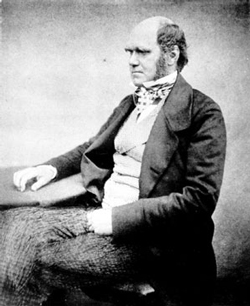
Darwin did not lack religious influences in his youth. Baptized an Anglican and steeped in his mother’s Unitarianism, young Charles was brought up to pray. He used to run the mile or so from home to school, concerning which he wrote, ‘I often had to run very quickly to be on time, and from being a fleet runner was generally successful; but when in doubt I prayed earnestly to God to help me, and I well remember that I attributed my success to the prayers and not to my quick running, and marvelled how generally I was aided’.1
He had dropped out of medical studies after two years at Edinburgh, and his father suggested to him the calling of an Anglican clergyman. Charles wasn’t sure whether he could accept everything in the Thirty-nine Articles of the Church of England. However, he later wrote, ‘I liked the thought of being a country clergyman. Accordingly I read with care "Pearson on the Creed"and a few other books on divinity; and as I did not then in the least doubt the strict and literal truth of every word in the Bible, I soon persuaded myself that our Creed must be fully accepted’.2
During his three years of theological studies at Christ’s College, Cambridge, he was greatly impressed by Paley’s Evidences of Christianity and his Natural Theology (which argues for the existence of God from design). He recalled, ‘I could have written out the whole of the "Evidences" with perfect correctness, but not of course in the clear language of Paley’,3 and, ‘I do not think I hardly ever admired a book more than Paley’s "Natural Theology." I could almost formerly have said it by heart’.4 In a letter of condolence to a bereaved friend at that time, he wrote of ‘so pure and holy a comfort as the Bible affords’, compared with ‘how useless the sympathy of all friends must appear’.5
His intention to enter the ministry, he wrote, was never ‘formally given up, but died a natural death’ when, on leaving Cambridge, he joined HMS Beagle as unpaid naturalist.6 However, the religious influences in his life did not abate. His official position was that of gentleman companion to the captain, and for the next five years Darwin heard the Bible read and expounded on a regular basis. Captain Robert FitzRoy was a deeply religious man who believed every word in the Bible and personally conducted divine service every Sunday, at which attendance by all on board was compulsory. Darwin later recalled his own doctrinal orthodoxy when, in discussion with some of the officers, much to their amusement he quoted the Bible as ‘an unanswerable authority on some point of morality’.7 And at Buenos Aires, he and another officer requested a chaplain to administer the Lord’s Supper to them before they ventured into the wilds of Tierra del Fuego.8
The progress of unbelief
Despite all of the above religious influences in his life, the decline of Darwin’s faith began when he first started to doubt the truth of the first chapters of Genesis. This unwillingness to accept the Bible as meaning what it said probably started with and certainly was greatly influenced by his shipboard reading matter—the newly published first volume of Charles Lyell’s Principles of Geology (the second volume, published after the Beagle left England, was sent on to Darwin in Montevideo). This was a revolutionary book for that time. It subtly ridiculed belief in recent creation in favour of an old earth, and denied that Noah’s Flood was worldwide; this, of course, was also a denial of divine judgment. Based on James Hutton’s dictum that all natural processes have continued as they were from the beginning (2 Peter 3:4), or ‘uniformitarianism’, Lyell’s book presented Darwin with the time frame of vast geological ages needed to make his theory of natural selection as the mechanism of evolution ‘work’. One of Darwin’s biographers calls Charles’s reading of this book his ‘point of departure from orthodoxy’.9 And when Lyell died in 1875, Darwin said, ‘I never forget that almost everything which I have done in science I owe to the study of his great works’.10
Inevitably, the more Darwin convinced himself that species had originated by chance and developed by a long course of gradual modification, the less he could accept not only the Genesis account of creation, but also the rest of the Old Testament as the divinely inspired Word of God. In his Autobiography, Darwin wrote, ‘I had gradually come by this time, i.e. 1836 to 1839, to see that the Old Testament was no more to be trusted than the sacred books of the Hindoos or the beliefs of any barbarian’.11
When Darwin came to write up the notes from his scientific investigations he faced a choice. He could interpret what he had seen either as evidence for the Genesis account of supernatural creation, or else as evidence for naturalism, consistent with Lyell’s theory of long ages. In the event, he chose the latter—that everything in nature has come about through accidental, unguided purposelessness rather than as the result of divinely guided, meaningful intention,12 and, after several years, in 1859 his Origin of Species13 was the result. On the way, in 1844, he wrote to his friend, Joseph Hooker, ‘I am almost convinced … that species are not (it is like confessing a murder) immutable’. Concerning this, Ian Taylor writes, ‘Many commentators have pointed out that the "murder" he spoke of was in effect the murder of God’.14
Having abandoned the Old Testament, Darwin then renounced the Gospels. This loss of belief was based on several factors, including his rejection of miracles: ‘the more we know of the fixed laws of nature, the more incredible do miracles become’; his rejection of the credibility of the Gospel writers: ‘the men of that time were ignorant and credulous to a degree almost incomprehensible to us’; his rejection of the Gospel chronology: ‘the Gospels cannot be proved to have been written simultaneously with the events’; and his rejection of the Gospel events: ‘they differ in many important details, far too important, as it seemed to me, to be admitted as the usual inaccuracies of eye-witnesses’. Summing up the above, he wrote, ‘by such reflections as these … I gradually came to disbelieve in Christianity as a divine revelation’.15 On another occasion he wrote, ‘I never gave up Christianity until I was forty years of age’.16 He turned 40 in 1849. Commenting on this, Darwin’s biographer, James Moore, says, ‘… just as his clerical career had died a slow "natural death," so his faith had withered gradually’.17
One immediate effect of Darwin’s rejection of the Bible was his loss of all comfort from it. The hopeless grief of his later letters to the bereaved contrasts sharply with the earlier letter of condolence quoted above. In 1851, his dearly loved daughter Annie, aged 10, died from what the attending physician called a ‘Bilious Fever with typhoid character’.18 Charles was devastated, and wrote, ‘Our only consolation is that she passed a short, though joyous life’.19 Two years later, to a friend who had lost a child, Darwin’s only appeal was to ‘time’, which ‘softens and deadens … one’s feelings and regrets’.20
The role models of his forebears
One major factor that contributed to Charles’s apostasy is worth noting—the role model of his father, Robert, and of his grandfather, Erasmus.21 Both were ‘freethinkers’, so disbelief was an acceptable trait within the Darwin family—perceived not as ‘a moral crisis or rebellion’, but perhaps even as ‘a filial duty’.22 Indeed, in 1838, when Charles had become engaged to Emma Wedgwood, a very devout Unitarian, Robert had felt the need to advise his son to conceal his religious doubts from his wife—other households did not discuss such things.23
Surrounded as he was by unbelievers, and having soaked his mind in literature that rejected the concept of divine judgment in earth’s history, Charles mused, ‘I can hardly see how anyone ought to wish Christianity to be true; for if so, the plain language of the text seems to show that the men who do not believe, and this would include my Father, Brother, and almost all my best friends, will be everlastingly punished. And this is a damnable doctrine’.24
Descent into darkness
The descent into darkness did not stop there. In 1876, in his Autobiography, Darwin wrote, ‘Formerly I was led … to the firm conviction of the existence of God and the immortality of the soul. In my Journal I wrote that whilst standing in the midst of the grandeur of a Brazilian forest, "it is not possible to give an adequate idea of the higher feelings of wonder, admiration, and devotion, which fill and elevate the mind". I well remember my conviction that there is more in man than the mere breath of his body. But now the grandest scenes would not cause any such convictions and feelings to rise in my mind’.25 In 1880, in reply to a correspondent, Charles wrote, ‘I am sorry to have to inform you that I do not believe in the Bible as a divine revelation, & therefore not in Jesus Christ as the Son of God’.26 In the last year of his life, when the Duke of Argyll suggested to him that certain purposes seen in nature ‘were the effect and the expression of mind,’ Charles looked at him very hard and said, ‘Well, that often comes over me with overwhelming force; but at other times,’ and he shook his head vaguely, adding, ‘it seems to go away’.27 And about the same time he wrote to his old friend, Joseph Hooker, ‘I must look forward to Down graveyard as the sweetest place on earth’.28,29
Conclusion
Thus did this tragically mistaken man drift from a childlike trust in One who helped him run to school on time into an abyss of hopelessness and agnosticism.30 While the spiritual journey of a Christian is a journey out of darkness into Christ’s marvellous light, that of Charles Darwin was a slippery slide out of Gospel light (although not saving spiritual sight) into the sheer ‘blackness of darkness for ever’.31
Darwin’s unbelief, like that of so many people today, had its roots in a mind which first rejected the revelation of God in the Bible and then was unwilling to accept the revelation of God which God Himself has given in nature. This religion of revelation, of the Bible, of the Lord Jesus Christ, will keep us tuned to truth, hope, and life in God, and away from evolutionism, humanism, and atheism, only as we allow it to exercise its power in our hearts. The tragedy of Charles Darwin is that he never did.
References and notes
- Life and Letters of Charles Darwin, D. Appleton and Co., New York, 1911, Vol. 1, p. 29.
- ibid, Vol. 1, p. 39.
- ibid, Vol. 1, p. 41. Charles’s best subjects at Cambridge were Paley and Euclid.
- ibid, Vol. 2, p. 15. (C. Darwin to John Lubbock, 15 November 1859).
- ibid, Vol. 1, p. 153. (C. Darwin to D. Fox, 23 April 1829).
- ibid, Vol. 1, p. 39.
- ibid, Vol. 1, p. 277.
- Gertrude Himmelfarb, Darwin and the Darwinian Revolution, Chatto and Windus, London, 1959, p. 54.
- Glass, Bentley, Editor, Forerunners of Darwin. 1745–1859. Chapter by Francis Haber (The Johns Hopkins Press, 1959), p. 259, quoted by Bolton Davidheiser, Evolution and Christian Faith, Presbyterian and Reformed Publishing Co., New Jersey, 1969, p. 60.
- Ref. 1,Vol. 2, p. 374. (C. Darwin to Miss Buckley, Sir Charles Lyell’s secretary, 23 February 1875).
- ibid,Vol. 1, p. 277. Note: the words ‘or the beliefs of any barbarian’ in Charles’s original Autobiography (written in 1876 for his family) were deleted by his son, Francis, at the insistence of his widow, Emma, in the version published after his death, as were his views on the Old Testament, namely, what he called, ‘its manifestly false history of the world, with the Tower of Babel, the rainbow as a sign, etc. etc.’ (ref. 8, p. 317). The uncensored version of the autobiography, published by Charles’s granddaughter, Lady Nora Barlow, in 1958, contained some 6,000 words expunged by Francis and Emma, much of which related to Charles’s irreligious nature, and which ‘might embarrass the Darwin name’. (Source: Ian Taylor, In the Minds of Men, TFE Publishing, Toronto, 1984, pp. 115 and 449, note 1.)
- See Carl Wieland, Darwin’s real message: have you missed it?, Creation magazine, Vol. 14 No. 4, September–November 1992, pp. 16-18; also Don Batten, Darwin’s Contribution, Creation magazine, Vol. 17 No. 4, September-November 1995, p. 25.
- Charles Darwin wrote many other monographs and books, of which the most well known is probably The Descent of Man, and Selection in Relation to Sex, which deals inter alia with human evolution, published in 1871.
- Ian Taylor, In the Minds of Men, TFE Publishing, Toronto, 1984, p. 126.
- Ref. 1, p. 278. Curiously, Darwin continued, ‘But I was very unwilling to give up my belief; I feel sure of this, for I can well remember often and often [sic] inventing day-dreams of old letters between distinguished Romans, and manuscripts being discovered at Pompeii or elsewhere, which confirmed in the most striking manner all that was written in the Gospels. But I found it more and more difficult, with free scope given to my imagination, to invent evidence which would suffice to convince me. Thus disbelief crept over me at a very slow rate, but was at last complete. The rate was so slow that I felt no distress.’
- Adrian Desmond and James Moore, Darwin, Michael Joseph, London, 1991, p. 658.
- James Moore, The Darwin Legend, Baker Books, Michigan, 1994, p. 46.
- Ref. 15, p. 384.
- Ref. 1, Vol. 1, p. 348. (C. Darwin to W.D. Fox, 29 April 1851).
- ibid, Vol. 1, p. 355. (C. Darwin to W.D. Fox, 10 August 1853).
- Although Erasmus died seven years before Charles was born, Charles undoubtedly was familiar with both his liberal views and his writings about evolution. Charles read Erasmus’s book Zoonomia twice, once in his youth and ‘a second time after an interval of ten or fifteen years’ (Ref. 1, Vol. 1, p. 34).
- Ref. 8, p. 10
- Ref. 15, p. 256.
- Ref. 8, pp. 10, 318.
- Ref. 1, Vol. 1, p. 281.
- Ref. 15, pp. 634–35.
- Ref. 1, Vol. 1, p. 285 footnote.
- Ref. 16, p. 46.
- For an account of Darwin’s almost-life-long illness, see Russell Grigg, Darwin’s Mystery Illness, Creation magazine, Vol. 17 No. 4, September–November 1995, pp. 28–30.
- In 1881, at a meeting with Edward Aveling (Karl Marx’s son-in-law) and Ludwig Büchner, Darwin said he preferred to be called an agnostic. Ref. 1, Vol. 1, p. 286.
- Jude 13.
Readers’ comments
Comments are automatically closed 14 days after publication.