

Journal of Creation 17(1):10–11, April 2003
Browse our latest digital issue Subscribe
Clear picture—blurry story?
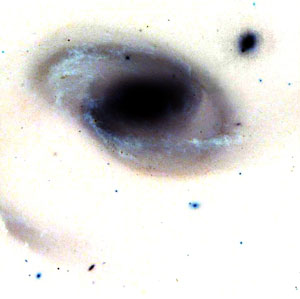
In 2002, NASA published a picture from the Hubble Space Telescope (HST) of a famous celestial duo in the constellation Draco—the spiral galaxy NGC 4319 and the quasar Markarian 205 (Mrk 205).1 NASA’s picture (Figure 1), published through the Space Telescope Science Institute, reveals incredible detail in the celestial pair. But the accompanying press seems blurred.
The article asserts that ‘appearances can be deceiving’. This is because, although the two objects appear to be neighbours, in reality, according to NASA, they ‘don’t even live in the same city’. Blandly the article declares that the duo is separated by time and space. According to NASA, NGC 4319 is 80 million light-years from Earth and Mrk 205 is more than 14 times farther out, residing 1 billion light-years away. NASA explains that the apparent close alignment of Mrk 205 and NGC 4319 as ‘simply a matter of chance’.
The justification? Astronomers used two methods to determine the distances to these objects. First, they measured how their light has been stretched in space due to the universe’s expansion. Then they measured how much the ultraviolet light from Mrk 205 dimmed as it passed through the interstellar gas of NGC 4319.1 Presto!
Thirty years of controversy ignored
Most people would not know the history behind this celestial ‘odd couple’. Those who do know are dumfounded by the attitude in this article. This celestial duo has been a source of contention for 30 years and is still controversial.2 But you would never learn that from the NASA press release.
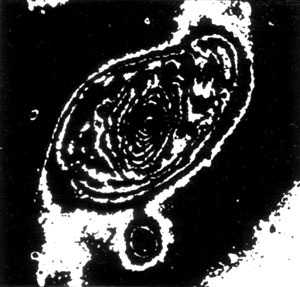
Halton Arp observed and reported some unusual features about this pair in 1971. They appear very close in the sky but have vastly different redshifts (0.00453 for the galaxy and 0.07085 for the quasar). If redshift is a reliable indicator of stellar distance, then obviously their closeness must be just a fluke. Yet Arp reported a visible connection between the two (Figure 2).3
This couple has prompted an extensive exchange in the astronomical literature. For example, in 1983 Jack Sulentic published a definitive paper showing the reality of the connection.4 Further papers were published with Arp in 1987.5,6 The duo is discussed in both of Arp’s books.7,8 They were observed by an amateur in the 1990s using the HST, and the connection confirmed, but these observations were not published.9
After all this debate we now get this STScI press release (repeated in Sky and Telescope,10 and Astronomy11 magazines), which does not mention any of the previous 30 years of serious observation, scientific debate, or controversy!
Interpretations driven by cosmology?
The NASA commentary on the space image refers to dark and unusually misshapen dust lanes in the galaxy’s inner region and claims they are evidence of a disturbance. Of course they can’t attribute this disturbance to the quasar which appears alongside the galaxy, in the image as large as life. That’s because, driven by their ideological framework, they have already placed the quasar a billion light years away. So, the disturbance must be due to some unseen cause, perhaps another galaxy not visible in the photograph. These interpretations seem to be motivated less by the observations of the billion-dollar HST, and more by a prior cosmological commitment. It is hard to imagine that this is the best way for science to proceed.
It seems that some people would like to erase part of the history of astronomy. Is this because the NGC-4319 observations are so problematical for current cosmological thinking? The discussions in scientific journals over 30 years that have seriously questioned the methods of measuring distance are ignored. Is this omission to protect the current cosmological view from the need to compete with any contrary opinion?
References
- Image details: odd couple widely separated by time and space, 3 October 2002. Return to text.
- See for example: DeYoung, D.B., The redshift controversy; in: Mulfinger, G. (Ed.), Design and Origins in Astronomy, Monograph Series No. 2, Creation Research Society Books, St Joseph, pp. 54–57, 1983. Return to text.
- Snelling, A.A., Galaxy-quasar ‘connection’ defies explanation, Journal of Creation 11(3):254–255, 1997. Return to text.
- Sulentic, J.W., Image processing of connective filament in NGC 4319, Astro. J. (letters) 265:L49–L53, 1983. Return to text.
- Sulentic, J.W. and Arp, H.C., The galaxy-quasar connection: NGC 4319 and MARKARIAN 205, I, direct imagery, Ap. J. 319:687–692, 1987. Return to text.
- Sulentic, J.W. and Arp, H.C., The galaxy-quasar connection: NGC 4319 and MARKARIAN 205, II, spectroscopy, Ap. J. 319:693–708, 1987. Return to text.
- Arp, H., Quasars, Redshifts and Controversies, Interstellar Media, Cambridge University Press, 1987. Return to text.
- Arp, H., Seeing Red: Redshifts, Cosmology and Academic Science, Apeiron, Montreal, 1999. Return to text.
- A reviewer described some simple experiments using the HST image available from the NASA Web site (Ref. 1), which demonstrate the existence of the connection between NGC 4319 and Mrk 205. It should be possible for any interested reader to repeat these experiments. When the story was published late in 2002 he downloaded the NASA photograph for the wallpaper on his PC at work. A few days later the lights in the office were switched off for testing, and by averted vision in the relative darkness (a very familiar technique to variable-star observers) it was quite easy to see the connection between the galaxy and the quasar. Later, one of his colleagues passed the new NASA image through special image processing software and readily produced a picture just like those produced in the past by Arp and Sulentic (e.g. Refs 5 and 6), again confirming the connection! Return to text.
- Astro image in the news: interstellar odd couple , 10 November 2002. Return to text.
- Thomas, V., Near and far, 13 February 2003. Return to text.


Readers’ comments
Comments are automatically closed 14 days after publication.