

Journal of Creation 22(3):93–100, December 2008
Browse our latest digital issue Subscribe
Constellations: legacy of the dispersion from Babel
There are deep similarities among diverse cultures in their constellations. The similarities stem from an origin at least as remote as the dispersion from Babel, and vastly pre-date cross-cultural missionary outreaches of recent centuries. Cultural differences in constellations have resulted from distinct developments in various people groups since the dispersion from Babel. Constellations appear to contain memories (in corrupted form) of ancient historical events such as the Flood, but evidence does not support the claim that the constellations were a kind of primeval revelation, a ‘gospel in the stars’.
Why do diverse cultures have similar constellations?

If the biblical story of the dispersion from Babel were true, peoples from Babel would carry common ideas which might survive today in the cultures they founded after the dispersion. From a biblical point of view, therefore, any common denominator among diverse modern cultures is a possible indication that all peoples really did once live at a single place identified in the Bible as Babel. A common denominator crossing many cultures past and present is the prevalence of legends about the creation, the Flood and the dispersion from Babel. Flood legends are especially pervasive:
‘It is commonly understood that something like the story of Noah and the flood is part of the mythology of cultures around the globe. It is less widely realized that the unity of the world’s myths goes far beyond such basic similarities. So elaborate and intertwined are the mythic traditions in places as disparate as Mayan Central America, Viking Scandinavia, and Pharaonic Egypt, that it has for some decades been widely accepted among specialists in the field that a single mythic tradition, what Joseph Campbell called the monomyth, underlies all the discrete mythic traditions.’1
However, in today’s secular culture, nothing is supposed to point back to the true history of the Bible, especially to the creation, the Flood or the dispersion from Babel. Indications from science and history that the Bible might be accurate are vigorously denied, particularly for the events in Genesis chapters 1–11. Thus it is claimed that the development of constellation patterns is a kind of convergent cultural evolution that happened spontaneously in many cultures. Anthony F. Aveni, for example, ignores the cross-cultural links between constellations and restricts his focus to the Pleiades, which eases the way to supposing that in a kind of ‘convergent development’, the Pleiades pattern could have arisen spontaneously in many isolated cultures. He writes,
‘Among primitive societies, the Pleiades are often the only celestial group paid any attention. In Bali, the Pleiades and Orion’s Belt are the only stars people use to correct their lunar calendar. The Pleiades are also worshipped among aboriginal people who do not practice agriculture. This may be due to the coincidence of the first annual appearance of the group at the beginning of the rainy season. Developing civilizations could hardly fail to observe that wild fruits grew more plentifully and therefore that they would have more to eat after a heavy fall of rain than after a long drought. Hunters could learn of the migration of their prey as a function of the meteorological cycle. It would then be but a simple step to attribute the cause of certain terrestrial occurrences to these stars. Indeed, many of the aboriginal people of Australia regard the Pleiades not merely as a signal but instead as the cause of rain—an astrological rather than an astronomical function. They curse the Pleiades if their appearance in the sky is not immediately followed by a rainy period.’2
Aveni’s view is simplistic. Though no two cultures share constellations identical in every detail, nevertheless there are deep and basic similarities that have attracted the attention of secular researchers who give no credence to Genesis 1–11. Emphasizing the differences cannot erase the similarities, and these similarities are too wide-ranging to be due to coincidence alone. Therefore it is plausible to claim that ‘most cultures recognize more or less the same constellations.’3 The truth is that the constellations trace back to a time consistent with the chronology of Nimrod’s life, were arguably common knowledge at Babel, and have since been preserved among the world’s cultures.4
When did the constellations originate?
Using the spread of Western culture and missions to account for the cross-cultural similarity of constellations overlooks the existence of similarities in ancient constellations. As we will see, similarities in ancient constellations are a difficulty for conventional views of the past. On the other hand, having similarities among ancient constellations does not mean that ancient cultures had identical constellations. Biblical creationists have recognized these similarities as being connected with the dispersion from Babel.5
Even more, the existence of any similarity at all is damaging to the belief that isolated groups of primitive peoples evolved in different localities. In fact the constellations have no objective existence. The patterns that we call constellations are in the minds of the beholders, for the stars comprising them, with few exceptions, do not lie on the same plane in space. The stars that seem to be situated on the surface of the ‘celestial sphere’ are actually at various distances from us. This may be obvious to astronomers and other scientists, but laypeople are often unaware of the fact that
‘The stars of a constellation have no connection one with another apart from the fact that they happen to lie in approximately similar directions as seen from earth. A constellation is therefore an arbitrary or conventional grouping of stars. Indeed, the Chinese, for example, divided the sky up into groups different from those familiar to us.’6

With the thousands of stars visible to the naked eye, the probability of independently evolving cultures arriving at the same constellations by chance alone is remote. There is no evolutionary approach that explains how different cultures, supposedly developing in separate parts of the world, managed to imagine the same or similar star patterns in the sky. Conversely, the existence of even a few identical constellations suggests that all of mankind was once congregated at one point from which all ethnic groups dispersed.
Since the Bible describes such a dispersion scenario, at least some of the constellation similarities among ancient cultures represented shared ideas originating before mankind dispersed. While some post-dispersion borrowing may have occurred among adjacent cultures, borrowing cannot account for the existence of similarities between ancient Old and New World cultures now separated by the ocean. Even secular authorities place the origin of constellations at a time consistent with the biblical date for Babel. Astronomer and historian of science James Jeans wrote:
‘The earth wobbles as it rotates … so that the portion of the sky which can be seen from any portion of the earth’s surface is continually changing; that part in which the constellations bear ancient names is the part which could be seen from about latitude 40° N., in about the year 2750 BC, and this is thought to suggest that these constellations were grouped and named by the Babylonians of some such date. They are practically identical with our present-day constellations of the northern sky.’7
The biblical date for Babel is about 2300–2400 BC,8 comparable with the 2750 date that Jeans cited.
Jeans’ assessment was not new. In 1913, one writer noted that ‘[According to Maunder] there was a tradition that Taurus was the original leader in the zodiac; the equinox, therefore, was probably in Taurus when the constellations of the zodiac were formed, and this was the case between 4000 and 1700 BC’9 Maunder himself claimed that ‘the [celestial] sphere was mapped out in North latitude 40° and about 2800 years BC’10
Astronomer Michael Ovenden later confirmed a similar date of origin for the constellations. He ‘found the mean of the different dates from the various constellations to be 2800 BC ± 300 years … . There can … be no doubt that the constellations are, individually, oriented symmetrically with respect to the celestial poles of about 2800 BC’11 More recently, astronomer William K. Hartmann concluded that the constellations as we know them date from sometime between 2600 ± 800 BC: ‘Many constellations may be Minoan … handed down to us from around 2600 BC, with still earlier elements incorporated into them. We should not assume that “it all started with the Greeks”.’12
Much of this range of dates, especially the lower end, is consistent with a tight biblical chronology without ‘gaps’ which places the dispersion from Babel around 2300 BC. Further, Hartmann is not saying that the constellations began with the Minoans, but that they continued the use of ‘earlier elements.’ This blending of ‘earlier elements’ into new cultural frameworks explains the modifications which became the differences now commonly taken as proof that the constellations were not shared among the early (post-Babel) cultures. Along this line, Evershed proposed that the Assyrians imposed major modifications on the original constellations:
‘Is it not possible that in the golden age of Assyrian astronomy, which began in the 8th century BC, many traditional forms were gathered together, and the whole sphere definitely mapped out; while at the same time, in the new calendar which was introduced under Nabonassar, the first month for the first time connected with the invisible group of Aries, in which the Sun was known to be, instead of with the group Taurus which appeared after his [the sun’s] setting in the west?’13
However, the Assyrians cannot be considered the originators of the constellations, even though this has been claimed. B.E. Schaefer, wrote,
‘I have found 172 useful constraints for Eudoxus’ lore [leading to the following conclusion]. … (1) All lore reported by Eudoxus were based on observations from the year 1130 ± 80 BC and at a latitude of 36.0 ± 0.9 degrees north. (2) My derived date and latitude correspond only to the peak of the Assyrian culture. (3) The typical accuracy of the lore is 4–8 degrees even though 1 degree accuracy is easy to be gotten by primitive methods. (4) About half the rise/set pairs [of recorded star positions] recorded in the Mesopotamian MUL.APIN tablets are also given in Eudoxus’ lore. (5) The
‘MUL.APIN tablets have been independently determined to be based on observations from roughly 1000 BC at a latitude of 36 degrees north … I conclude that both Eudoxus’ lore and MUL.APIN were derived from the same old Assyrian observations.’14
The low accuracy Schaefer perceives for the latitude of the lore also implies a low accuracy in the time inferred from the lore. Having focused on the MUL.APIN tablets as supplying the time frame for the lore, Schaefer inferred the latitude necessary from the lore to give him the time frame he expected, then concluded that the time frame matched the time of Assyria’s cultural dominance. His conclusion that the MUL.APIN tablets and Eudoxus derive from the same source is true, except that the ultimate source dates from c. 2800 BC (a date which should be revised downward by several centuries, as noted below), so could not have been Assyria. Nor could the Romans via Ptolemy have given us the constellations, for ‘Ptolemy’s catalogue bears witness to a constellation scheme that originated and had received its completion before his day.’15
Even the common belief that the constellations as we know them originated with the Greeks cannot be true.
‘[The Greek naturalist] Hipparchus was not the originator of the constellations. He had before him the description of the sky known as ‘The Sphere of Eudoxus’ (Eudoxus of Cnidos, c. 403–350 BC), and a poetic description of the sphere of Eudoxus given by Aratus (c. 315–250 BC) in the work known as the Phaenomenon. If [2800 BC for] the date of the constellations is correct, then Aratus and Hipparchus lie about half-way between us and the constellation-makers, and Hipparchus will be trying to fit what he sees with descriptions in the sphere of Eudoxus that are really appropriate to a situation 2500 years before his time.’16
Maunder likewise observed, ‘the correspondence between the Greek and Indian planispheres [sky maps] shows that one of them was copied from the other, or both from the same original model.’17
Constellation similarities are not coincidence
A number of historians have asserted that the very earliest cultures, those we would recognize as early post-dispersion peoples, did in fact employ the same constellations. Differences developed, but similarities remained. For example, historian Kenneth Brecher pointed out that
‘The Babylonians identify [Sirius] as part of a constellation which they describe as a bow and arrow. The Chinese independently described a bow and arrow in the sky, but they used different stars for their construction. For them, Sirius is part of the image at which the arrow is shooting; and curiously, the image at which that arrow is shooting is a dog. In Western tradition, Sirius is part of the constellation Canis Major, the Big Dog. It is remarkable that the same images—dogs, bows and arrows—occur in the cosmographies of different cultures; after all, if you look at the sky, you see only points of light on a dark field. … [This can be taken] as an indication that the astronomical myths of China and Mesopotamia derive from a common origin.’18
Historians Giorgio de Santillana and Hertha von Dechend have also noted that the Orion motif is ‘common to the spheres of Mesopotamia, Egypt and China.’ Further, ‘there is strong circumstantial evidence of this bow and arrow in Mexico also: the bow of the Chichimeca, the Dog-people.’19 Orion with modifications was also recognized in ancient Iran and India,20 but modification is what one would expect for diffusing legends. Orion was also familiar to the ancient Norwegians,21 and Old Norse rock art depicted Orion.22
The Pleiades were another constellation known worldwide in ancient times, even among Australian aborigines: ‘In Aboriginal mythology there are many stories of the Pleiades: they are given female attributes and are known as seven sisters. In this there is a pronounced similarity to legends from all over the world.’23 But the Pleiades’ renown is not due to their prominence in the heavens: ‘Those stars are apparently only six’, with the seventh so dim at times so as to be unseen,
‘ … yet all the world over, among civilized and savage races, in Europe, in India, China, Japan, America, and Africa, this diminutive group is not merely regarded as seven stars, but what is still more surprising, as “The Seven Stars,” though the far brighter seven stars of the Great Bear might seem to deserve the title.’24
The Great Bear was also known worldwide in antiquity: ‘The star group in Ursa Major was seen as a bear in Europe, Asia, North America, and even ancient Egypt, where there are no bears … the bear identification may go all the way back to ice-age Euro-Asia, from where it spread.’25 Significantly, ‘ice-age Euro-Asia’ would have been the location of Babel, and would have existed at the time indicated by biblical chronology for Babel.
As mentioned earlier, Maunder estimated that the latitude of the constellation makers was 40° north. A more recent investigation placed the latitude slightly farther south, at approximately 30° to 38° north.26
The latitude of Babylon, 32½° north, is within this range.27 A significant fact about the constellations is that the oldest ones fill only the northern sky and are absent in an empty zone surrounding the south celestial pole.25,28 This is consistent with the existence of Babel in the northern hemisphere,13 together with the fact that dispersing cultures did not reach the extremities of the southern hemisphere until relatively recently. In contradiction, however, Ovenden asserted,
‘There are four main contenders for the title of constellation-makers. The credit is often given to the Babylonians, but their seafaring would have been in the Persian Gulf and Indian Ocean, too far south for the latitude of the constellation makers [but Babel slightly south of Baghdad was at about 32° north, close to Ovenden’s estimated latitude range for these people]. The Egyptians sailed in the Mediterranean, but much of their seafaring also would have been in more southern waters. The Phoenicians were great traders, with a great centre at Byblus, latitude about 34° (consistent with our determined latitude). … But I would like to put forward the claims of the Minoans, based on Crete, who were out in the Mediterranean in strength by the beginning of the third millennium BC’29
Hartmann’s reservation about naming the Minoans as the constellation-makers has been mentioned. Further, Ovenden’s proposals have a chronological problem. The chronologies of his four candidates—and of other ancient chronologies tied to conventional Egyptian chronology—are too long by as much as a millennium.30 Once the chronologies are scaled down, as they ought to be, by shrinking the Egyptian chronology appropriately, and by subtracting out the years of the non-existent ‘dark ages’ from the Minoan and Greek chronologies, these cultures date not from c. 2500 BC, but from closer to 1500 BC, a date roughly a millennium too young to match the date of the constellation-makers.
The constellations: remembrance of Noah’s Flood?
There is a view that God mapped out the constellations as a kind of primeval revelation before man had the Bible.31 An even older view of the constellations is that they were a device of Nimrod at Babel to lead mankind away from God, or at least they reflect the corrupted mythologies that mankind fell into at Babel and afterward.32 In between these extreme views is a middle view that constellations are corrupted memories of significant events happening early in history. The most traumatic such event was the global Flood of Noah, and—as Glasglow University astrophysicist and historian of science Michael Ovenden observed—one of the most expansive constellations is
‘ … the large constellation of Arago the Ship, often shown in early representations [of the constellations] as though atop a mountain. Coming from the ship is the Centaur, a man-animal, sacrificing a Beast upon the Altar. We see, too, the Water-snake (Hydra) with a Raven (Corvus) eating its flesh. There can be no doubt that here we have, in imagination pictured in the sky, a version of the story of Noah and the Flood. The picture is complete with the Milky Way seeming to rise as smoke from the Altar.
‘Consider the following quotation, with which we are all familiar: “And Noah builded an altar unto the Lord, and took of every clean beast and of every clean fowl and offered burnt offerings at the altar. … And God said, ‘This is the token of the covenant which I make between me and you for perpetual generations. I do set my bow in a cloud, and it shall be a token of a covenant between me and the Earth’.” The bow of Sagittarius is fixed pointing to one of the most obvious rifts, or clouds, in the Milky Way. Of course, this association of the Southern constellations with the flood story that occurs in Genesis, and in the Babylonian Book of Gilgamesh, is no new insight, for when the stars left vacant by changing the course of Eridanus [due to precession] were later given a name, Columba the Dove was chosen [i.e. the “Dove” motif was preserved even as the star patterns in the heavens changed over the centuries because of precession]. …
‘Did the constellations inspire the myth [of the Flood] or did the myth inspire the constellations? I am sure that the latter was the case. Indeed, what better aid to memory of the pattern of the stars by uneducated sailors could there be than to associate the star-patterns with the stories known to the sailors from their childhood, as a pictorial mnemonic.’33
It appears that Ovenden’s assessment has support from other quarters, for Arago is not the only stellar reminder of the Flood. ‘from the Lake Eyre region [Australia] there is a myth that links [the Pleiades, known as the Seven Sisters] with a flood’.34 In this myth, ‘the ancestor figure who tried to capture one of them was prevented by a great flood.’35 By association with the Flood, the Pleiades became associated with the giving of rain, even though the aborigines were not farmers and therefore had no practical reason to monitor rainfall.
‘[Primitive peoples] have commonly timed the various operations of the agricultural year by observation of [the Pleiades’] heliacal rising or setting. … great attention has been paid to the Pleiades by savages in the southern hemisphere who do not till the ground. … Now amongst the rudest of savages known to us are the Australian aborigines, none of whom in their native state ever practised agriculture. [Yet they] sing and dance to gain the favour of the Pleiades … the constellation worshipped … as the giver of rain.’36
There is also a Jewish legend that links the Pleiades with the Flood: ‘The upper waters rushed through the space left when God removed two stars out of the constellation Pleiades.’37 How the Pleiades became connected with the Flood is not known. Nevertheless, the Pleiades are another component of legends worldwide that testify to the reality of Noah’s Flood.
Is the Gospel in the stars?
Table 1. Constellations and asterisms in the Bible.

The gospel-in-the-stars concept is the idea that God originally defined the constellations as a primeval revelation preceding the giving of the written Word. The constellations were intended to tell the Gospel story, but eventually the meaning of the constellations was corrupted into astrology; now we have God’s revelation in His Word, a ‘more sure word of prophecy’ (2 Peter 1:19).
Though God made the stars (Genesis 1:16), and though the Bible mentions various constellations and groups of stars called ‘asterisms’, e.g. the Pleiades (see table 138), the Bible nowhere claims that God designed the constellations for a revelatory purpose. Biblical references to constellations merely assert that God, not pagan deities, controls the stars in the constellations. Biblical references to constellations are therefore a rebuttal of ancient and modern astrology, not proof of a ‘gospel in the stars’.
In fact God has a name for each star: ‘He telleth the number of the stars; he calleth them all by their names’ (Psalm 147:4). Isaiah 40:26 links God’s ability to create and name each star with His ability to control them: ‘Lift up your eyes on high, and behold who hath created these things, that bringeth out their host by number: he calleth them all by names of the greatness of his might, for that he is strong in power; not one faileth.’ Isaiah 40:26 is a strong assertion that God controls the heavens, which means that God, not the heavens, controls our lives. This assertion remains relevant today, for astrology was and still is a common belief. In antiquity,
‘ … astrology was based on the doctrine that the outer spheres of the universe influenced the inner. … This conception coloured all departments of thought and embedded itself deeply in speech. “The scheme was conceived under an evil star”, “His fortune is in the ascendant”, “The seventh heaven of delight”, “He has gone to a higher sphere”, “The British sphere of influence”, “Canst thou bind the sweet influences of the Pleiades” (Job XXXViii. 31), “He has the influenza” are such cases.’39

Modern belief in the constellations as Gospel revelation began with the publication of Mazzaroth: or, the Constellations by Frances Rolleston (figure 3).40 Rolleston cited ‘proof texts’ without context but in so doing made an argument which became popular. Rolleston’s assertion was that ‘the signs [in the zodiac] were intended to symbolize prophecy, as recorded in the Holy Scriptures.’41
Subsequent books teaching a Gospel in the stars trace back to Rolleston’s Mazzaroth. For example, Joseph R. Seiss in The Gospel in the Stars acknowledged: that ‘from [Rolleston’s] tables and references the writer of these Lectures was helped to some of his best information.’42 E.W. Bullinger in The Witness of the Stars likewise described his debt to Rolleston: ‘Some years ago it was my privilege to enjoy the acquaintance of Miss Frances Rolleston, of Keswick, and to carry on a correspondence with her with respect to her work, Mazzaroth: or, the Constellations. She was the first to create an interest in this important subject.’43 Kenneth C. Fleming in God’s Voice in the Stars cited Rolleston, Seiss, and Bullinger in a conceptual lineage spanning more than a century,44 as did Henry M. Morris45 and Ruth Beechick.46
Christians gravitated to Rolleston’s argument because it seemed to lend historical veracity to the early chapters of Genesis. But similarities among the constellations provide intriguing evidence of biblical history without the need of resorting to Rolleston’s ‘gospel in the stars’ idea. Indeed, Rolleston and Seiss advanced the claim of this present paper, that constellations of diverse cultures show basic similarities, implying that humanity once lived at a single site. Rolleston, for example, noted that ‘the Egyptian and Chaldean signs were the same as everywhere else, but differently named.’47
Seiss maintained that he came to the gospel-in-the-stars concept by encountering sceptical polemical works attempting ‘to throw contempt on Christianity as a mere accommodation of certain old mythic ideas common to all primitive peoples’, but rather than doubting Christianity, Seiss began noticing the ‘striking correspondence between [the ancient myths] and the subsequent Scriptural story of Christ and salvation.’48
The skeptics had exploited the cultural similarities among the constellations as evidence that Christian beliefs were merely primitive archetypes. With input from Rolleston, Seiss in turn interpreted these archetypes as evidence that the stars carried an ancient Gospel message visible to all. However, the remembrance, in legendary form, of historical events such as the Flood also accounts for these so-called ‘archetypes’. Images of these ‘archetypes’ were indeed imposed on star patterns. That is the claim of this paper. Thus the similarities in constellations reflect the reality of historical events affecting all mankind rather than a supposed prophecy in the stars.
Was there ever a need for a Gospel in the stars? A careful reading of the Bible suggests not, for even among the ante-diluvians Enoch (Genesis 5:21–24) ‘prophesied … saying, Behold, the Lord cometh with ten thousands of his saints’ (Jude 14–15). And long before this, Genesis 3:15—the so-called ‘proto-evangelium’—records that God, speaking to Adam and Eve, had prophesied the coming of His Son to Earth. Gospel-in-the-stars advocates associates constellations with the biblical statement in Genesis 1:14–18 that God created stars for ‘signs’, but these verses mention only stars, not constellations. Seeing constellations in Genesis 1:14–18 is a kind of eisegesis, the reading in of a concept not mentioned in the passage but present in the mind of the reader.
Table 2. Names of the 24 brightest stars according to Fleming.44
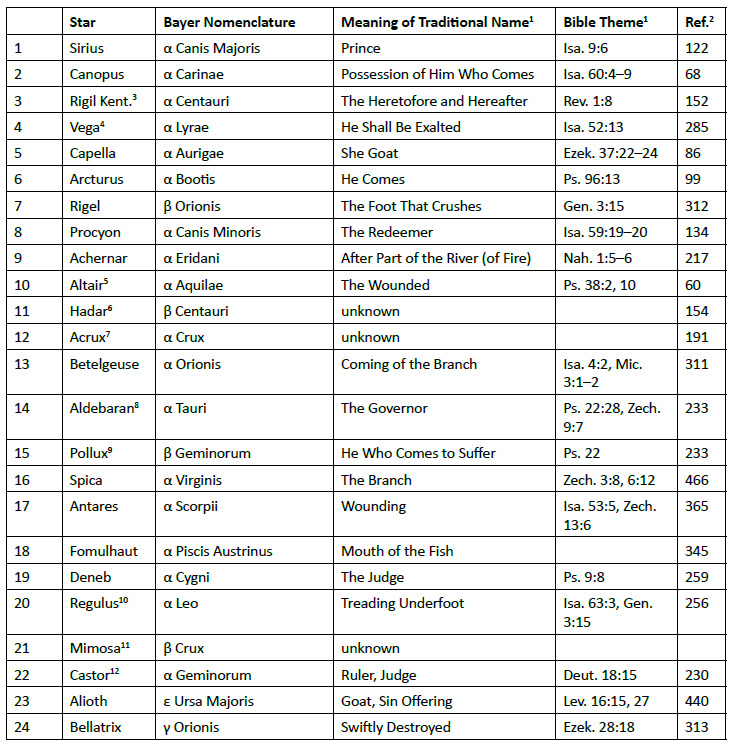
References for Table 2. (1) Fleming,44 pp. 21–22. (2) Pages cited in Allen.21 (3) In Fleming44 (p. 21), Rigil Kentaurus is Toliman. (4) Vega and Capella are actually 5th and 6th; Arcturus is 4th.50 (5) Altair is actually 12th, after Betelgeuse and Hadar.50 (6) In Fleming (p. 21), Hadar is Agena. (7) A-crux is actually 24th.50 (8) Aldebaran, 14th, is actually preceded by HD 213468,50 not listed in Fleming.44 (9) Pollux, Spica and Anteres are actually 17th, 15th and 16th, respectively.50 (10) Regulus is actually 21st and Mimosa is 20th.50 (11) In Fleming44 (p. 22), Mimosa is B-crux. (12) Castor is actually 25th, Alioth 33rd, and Bellatrix 28th.50
Gospel-in-the-stars advocates also infer from star names that the stars individually must have been primeval revelation. Some of the brightest stars, for example, have names reminiscent of biblical themes49 (see table 2). However, the Bible nowhere reveals the name that God has given to each star, so there is no guarantee that the traditional star names preserve elements of divine nomenclature. Mankind’s ancient awareness of special revelation as mentioned in Genesis 3:15 and Jude 14–15, along with mankind’s memories of ancient historical ‘archetypes’, however, explains the similarity between star names and biblical themes.
Further, the primeval meaning of many star names is uncertain at best; ‘“etymology has full play with a word which has not traveled beyond astronomical language”—a statement … applicable to very many … star names.’21 By stretching uncertain meanings, the appearance of agreement can be produced between the supposed ancient meanings and biblical themes. In addition, the errors in Fleming’s list of star brightness order, noted at the bottom of table 2, do not add credibility to the supposed ‘revelatory’ significance he attributed to each star name.
Conclusions
The cultures of today emanated from a single point which the Bible identifies as Babel. Constellation similarities are an evidence of this fact. The question has been asked, ‘is there not a good deal of evidence to show that the constellations grew up gradually in Babylonia, and approximated more and more nearly to those we know as time approached the age of Greek astronomy?’13 The answer appears to be yes.
This conclusion falsifies the claim that the constellations were a kind of primeval Gospel revelation. It strengthens the realization that God has always given special revelation to mankind though His chosen prophets and His written Word, this last being the exclusive source of special revelation since the close of the apostolic age.
Acknowledgments
The crucial assistance of Mr Michael Clater, head librarian at Clearwater Christian College, in locating original versions of the old documents cited herein is gratefully acknowledged.
References
- Murray, C., Human Accomplishment: The Pursuit of Excellence in the Arts and Sciences, 800 BC to 1950, HarperCollins, New York, pp. 21–22, 2003. Return to text.
- Aveni, A.F., Skywatchers of Ancient Mexico, University of Texas, Austin, TX, pp. 30–31, 1989. Return to text.
- Henry, J.F., The Astronomy Book, Master Books, Green Forest, AR, 1999, pp. 24–25. Return to text.
- There has long been the idea that God defined the constellations as a pre-biblical revelation, a so-called ‘gospel in the stars’. See in the text the section, ‘Is the Gospel in the stars?’ Return to text.
- Morris, H.M., The Genesis Record, Institute for Creation Research, San Diego, CA, p. 278, 1976. Return to text.
- Ovenden, M.W., The origin of constellations, The Philosophical Journal 3:1–18, July 1966; p. 1. An exception is the three stars in Orion’s belt (Levy, D.H. and Betelgeuse, J.P., Astronomy 15(4):7–13, April 1987. Orion’s belt has the three bright stars zeta Orionis (Alnitak), epsilon Orionis (Alnilam), and delta Orionis (Mintaka). These three stars are at the same distance from earth (1,500 light-years), so they lie in the very plane in which they appear to be situated. Perhaps that is why, in Job 38:31, God asks Job, ‘Canst thou … loose the bands of Orion?’ in an apparent allusion to His ability to maintain the placement of the Pleiades’ stars in space. These three stars are also remarkably similar in other ways (the same size, about 20 times larger than the sun; and similar surface temperatures, about 50,000 ºC or somewhat higher). Return to text.
- Jeans, J., The Story of Physical Science, Cambridge University, Cambridge, England, p. 8, 1951. Return to text.
- Morris, ref. 5, p. 675. Return to text.
- Evershed, M.A., The origin of the constellations, Observatory 36:179–181, April 1913; p. 179. Return to text.
- Maunder, E.W., The zodiac explained, Observatory 21:441, December 1898. Return to text.
- Ovenden, ref. 6, p. 6. Return to text.
- Hartmann, W.K., Astronomy, Wadsworth, Belmont, CA, p. 15, 1991. Return to text.
- Evershed, ref. 9, p. 181. Return to text.
- Schaefer, B.E., The latitude and epoch for the origin of the astronomical lore of Eudoxus, American Astronomical Society Meeting 203, #35.01, December 2003;
, 8 July 2004. Return to text. - Maunder, E.W., The origin of the constellations, Observatory 36:330, April 1913. Return to text.
- Ovenden, ref. 6, p. 8. Return to text.
- Maunder, ref 10, p. 439. Return to text.
- Brecher, K., Sirius Enigmas; in: Brecher, K. and Feirtag, M. (Eds.), Astronomy of the Ancients, MIT, Cambridge, MA, p. 91, 1979. Return to text.
- de Santillana, G. and von Dechend, H., Hamlet’s Mill, Gambit, Boston, MA, p. 216, 1969. Return to text.
- de Santillana and von Dechend, re. 19, p. 358. Return to text.
- Allen, R.H., Star Names: Their Lore and Meaning, Dover, New York, p. 313, 1963; originally published as Star-Names and Their Meanings, G.E. Stechert, New York, 1899. Return to text.
- Schoemfeld, M., Prehistoric astronomy: a zodiac from bohusian province, Norway, Scientific American 3:301–303, 1921. Return to text.
- Aitchison, J.E., The Pleiades in Aboriginal Mythology, SIS Workshop 5, September 1983; in: Tresman, I. (Ed.), Catastrophism!: Man, Myth and Mayhem in Ancient History and the Sciences, CD–ROM version 1.41, (33 Reginald Street, Derby DE23 8FR, UK, Knowledge Computing, May 2004). The Nazca Indians of Peru recognized the Pleiades. Hadingham, E., Lines to the Mountain Gods, University of Oklahoma, Norman, p. 104, 1988. Return to text.
- Haliburton, R.G., Primitive traditions as to the Pleiades, Nature 25:100–101, 1 December 1881; p. 100. Return to text.
- Hartmann, ref. 12, p. 14. Return to text.
- ‘… if we take the date to be 2800 BC ± 300 years, the observers’ latitude becomes 34° ± 4° … [On the other hand, a statistical analysis of star positions inferred from various statements in Aratus yields an estimate for the date and latitude of] 2600 BC ± 800 years, 36°N ± 1½°’ (Ovenden, ref. 6, pp. 11, 12). Return to text.
- Pannekoek, A., A History of Astronomy, Allen and Unwin, London, 1961, p. 74; reprinted Dover, Mineola, New York, 1989. Return to text.
- Gingerich, O., On the origin of the zodiac, Sky & Telescope 67:218–220, March 1984; p. 218. Return to text.
- Ovenden, ref. 6, p. 15. Return to text.
- Henry, J.F., Fallacies of radiometric dating, Appendix A, The Sothic Cycle and Egyptian chronology, 2007,
, accessed 30 August 2008. Return to text. - See the section, ‘Is the Gospel in the stars?’ Return to text.
- Hislop, A., The Two Babylons: or the Papal Worship Proved to Be the Worship of Nimrod and His Wife, Loizeaux Brothers, Neptune, NJ, p. 13, 1959. Hislop began this work in 1853 in the form of a pamphlet; it was first published as a book in 1919. See ‘The Two Babylons’ (
, April 24, 2007). Ralph Woodrow, in Babylon Mystery Religion (Ralph Woodrow Evangelistic Association, Palm Springs, CA, 1966), once advocated Hislop’s ideas. But in The Babylonian Connection? (Ralph Woodrow Evangelistic Association, Palm Springs, CA, 1997), pp. 23–28, Woodrow claimed some of Hislop’s conclusions to be undocumented speculation. However, one should not swing from Hislop’s assertion that nearly all cultural practices began at Babel to the opposite claim that virtually nothing began at Babel (Woodrow, 1997, p. 24). In fact, History Begins at Sumer is the title of a book by historian Samuel Noah Kramer (Doubleday Anchor, Garden City, NY, 1959). Sumer was the biblical Shinar (Genesis 11:1), the location of Babel, and the centre of the first civilization after the Flood. Kramer asserted that many cultural practices and patterns did in fact first appear in the Sumer of 2800 BC (p. 29). Return to text. - Ovenden, ref. 6, pp. 16–17. Return to text.
- Aitchison, ref. 23. Return to text.
- Isaacs, J. (Ed.), Australian Dreaming, Aboriginal Arts Board and Lansdowne Press, Sydney, Australia, p. 152, 1980. Return to text.
- Frazier, J.G., The Golden Bough, Part 5, Spirits of the Corn and of the Wild vol. 1, Macmillan, London, p. 313, 1920. Return to text.
- Ginzberg, L., Szold, H. (tr.), Legends of the Jews vol. 1, Jewish Publication Society of America, Phildelphia, PA, p. 162, 1968; reprint of 1909 edition. Return to text.
- Allen, ref. 21, p. 554. Return to text.
- Singer, C., A Short History of Scientific Ideas to 1900, Oxford University, New York, p. 215, 1959. Return to text.
- Rolleston, F., Mazzoroth, or, the Constellations, Rivingtons, London, 1862,
), reprinted 1882. Return to text. - Rolleston, ref. 40, part 1, p. 7. Return to text.
- Seiss, J.R., The Gospel in the Stars, E. Claxton, Philadelphia, p. 6, 1882; reprinted Kregel, Grand Rapids, Michigan, 1972. Return to text.
- Bullinger, E.W., The Witness of the Stars, Lamp Press, London, p. iii, 1954. Return to text.
- Fleming, K.C., God’s Voice in the Stars, Loizeaux Brothers, Neptune, NJ, p. 143, 1981. Return to text.
- Morris, H.M, Many Infallible Proofs, Creation-Life, San Diego, CA, p. 343, 1974. Return to text.
- Beechick, R., Adam and His Kin, Arrow Press, Pollock Pines, CA, pp. 50–53, 172, 175, 1990. Return to text.
- Rolleston, ref. 40, part 2, p. 7. Return to text.
- Seiss, ref. 42, p. 6. Return to text.
- Fleming, ref. 44, pp. 21–22. Return to text.
- Kornberg, C., The Brightest Stars, 9 November 1998,
. Return to text.
Readers’ comments
Comments are automatically closed 14 days after publication.